



Community hub
Recent from talks
Knowledge base stats:
Talk channels stats:
Members stats:
Lithgow Zig Zag
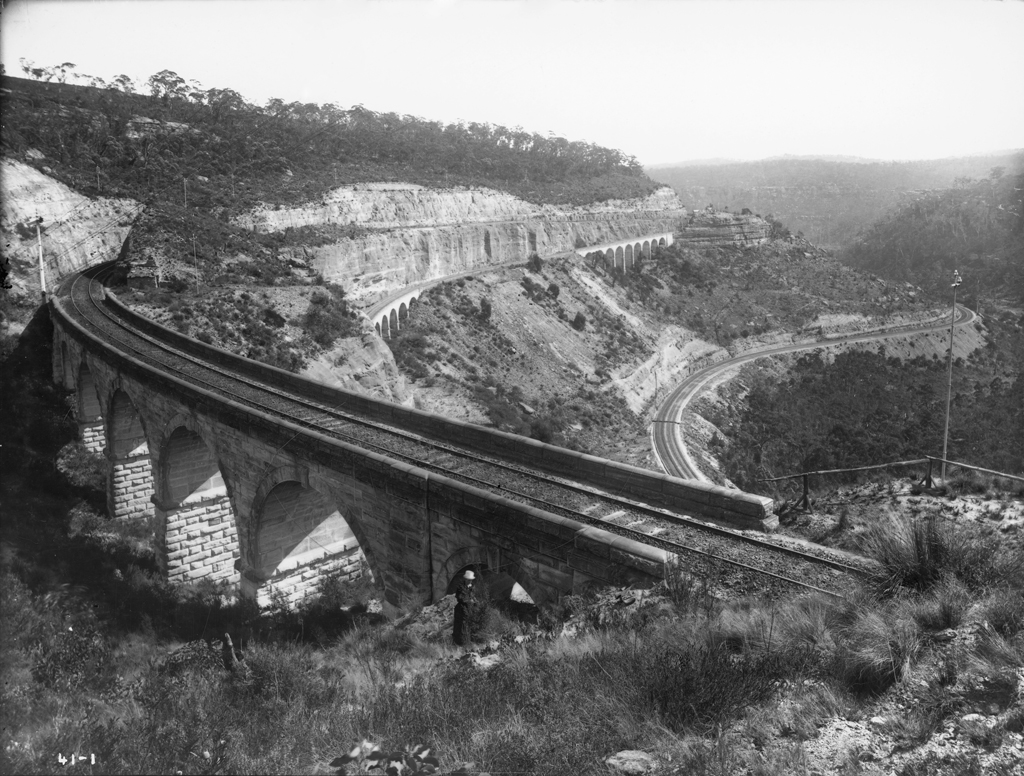
The Lithgow Zig Zag is a heritage-listed former zig zag railway line built near Lithgow on the Great Western Line of New South Wales in Australia. The zig zag line operated between 1869 and 1910, to overcome an otherwise insurmountable climb and descent on the western side of the Blue Mountains. It was designed by John Whitton and built from 1863 to 1869 by Patrick Higgins as contractor. It is also known as the Great Zig Zag Railway and Reserves and Zig Zag Railway. The property is owned by Department of Planning and Infrastructure (State Government). It was added to the New South Wales State Heritage Register on 2 April 1999.
Part of the railway line is now used by the Zig Zag Railway, a narrow gauge tourist railway.
The original plan by the Engineer-in-Charge of New South Wales Government Railways, John Whitton, had been to build a 2-mile (3.2 km) tunnel. However, this was beyond the resources of the Colonial Government at the time. The zig zag alternative still required several short tunnels and some viaducts. After consideration of several alternate routes the Great Western Railway was extended along the high ridge of the Darling Causeway from Mount Victoria. The descent to the Lithgow Valley was originally proposed by means of a tunnel. In 1866 the tunnel was estimated to be about two miles in length and a figure of $800,000 was set down as the cost of its construction. However, due to the enormous cost, construction time and, as John Whitton, Engineer-in-Chief of the NSW Railways reported at the time, it would have been difficult to get a contractor to undertake such difficult work. As a result, John Whitton selected the zig zag method of ascent and descent.
On the eastern side of the range, the Lapstone Zig Zag, also designed under the supervision of John Whitton, opened near Glenbrook in 1867. The Lapstone Zig Zag ascended Lapstone Hill on a gradient of 1:30 to 1:33 (~ 3 - 3.3%), which contoured up the side of the range with comparatively light earthworks.
By contrast, the Lithgow Zig Zag railway, built between 1866 and 1869, required much heavier engineering, including four large rock cuttings, three fine stone viaducts with 30-foot (9.1 m) semi-circular arches (originally four were planned, but one was built as an embankment instead) and a short tunnel (three tunnels were planned, but two were daylighted during construction due to leaks, becoming two of the four cuttings mentioned above). In the descent of the middle road, the line dropped 101 feet (31 m) between the reversing points, being part of the 550 feet (170 m) descent from Clarence. The whole route had a ruling grade of 1:42 (~2.38%).
John Whitton and his work have been underrated in Australian history, although they provided the operational foundation of the main railway lines in New South Wales. In international references Whitton is recognised as one of approximately twenty of the greatest railway civil engineers in the first century of world railway construction. The achievement of his crossings of the Great Divide was superlative at the time and in terms of British railway civil engineering was only exceeded by the difficult crossing of the Indian Ghats.
The contract to build the Great Zig Zag was awarded to Mr Patrick Higgins in May 1866. It was for the Clarence to Wallerawang section of railway which consisted of seven stone viaducts, varying in height from 3.0 to 21.3 metres (10 to 70 ft), three tunnels and nearly one and a quarter million cubic yards of excavations, two-thirds through rock.
George McGarvie Donald of Lithgow was a master stonemason and builder who helped create the city of Lithgow. Born in Paddington in 1846, he was son of a Scottish stonemason, George Donald, senior. George senior had been encouraged to migrate to New South Wales by Governor Macquarie who wished him to assist with government building works. George junior did an apprenticeship as a stonemason under his father and uncle. After this he was engaged on railway construction projects in the Bowenfels district in the late 1860s. He worked on stone railway bridges at the Great Zig Zag and Marrangaroo, and married Marion Miles, daughter of one of the construction foremen. Following completion of the railway he moved to Hill End and worked on a range of construction projects. Among these was Hill End Methodist church, built of basalt rubble from the gold mines. It is now used as an Anglican church. After the failure of the deep lead gold boom of the 1870s George returned to the Lithgow valley and established a construction business with Thomas Crowe. In the early 1880s he constructed St.Mary's Presbyterian church for Thomas Brown, built as a memorial to Brown's wife, Mary. He also built Cooerwull Academy for Brown, and the Church of St. John the Evangelist at Wallerawang. Other projects included Lithgow Town Hall, Wallerawang Public School the Lithgow Oddfellows Hall and many residences. Donald and Crowe also built Mort's freezing works. George Donald was extremely active in community affairs and had a great sense of social justice. He was founding member of the GUIOOF Lily of the Valley Lodge and the Good Templars Lodge. Popular among citizens he was elected the first mayor of Lithgow after establishment of the Municipality of Lithgow in 1889. He held the seat of Hartley in the NSW Legislative Assembly jointly with Joseph Cook from 1891.
Hub AI
Lithgow Zig Zag AI simulator
(@Lithgow Zig Zag_simulator)
Lithgow Zig Zag
The Lithgow Zig Zag is a heritage-listed former zig zag railway line built near Lithgow on the Great Western Line of New South Wales in Australia. The zig zag line operated between 1869 and 1910, to overcome an otherwise insurmountable climb and descent on the western side of the Blue Mountains. It was designed by John Whitton and built from 1863 to 1869 by Patrick Higgins as contractor. It is also known as the Great Zig Zag Railway and Reserves and Zig Zag Railway. The property is owned by Department of Planning and Infrastructure (State Government). It was added to the New South Wales State Heritage Register on 2 April 1999.
Part of the railway line is now used by the Zig Zag Railway, a narrow gauge tourist railway.
The original plan by the Engineer-in-Charge of New South Wales Government Railways, John Whitton, had been to build a 2-mile (3.2 km) tunnel. However, this was beyond the resources of the Colonial Government at the time. The zig zag alternative still required several short tunnels and some viaducts. After consideration of several alternate routes the Great Western Railway was extended along the high ridge of the Darling Causeway from Mount Victoria. The descent to the Lithgow Valley was originally proposed by means of a tunnel. In 1866 the tunnel was estimated to be about two miles in length and a figure of $800,000 was set down as the cost of its construction. However, due to the enormous cost, construction time and, as John Whitton, Engineer-in-Chief of the NSW Railways reported at the time, it would have been difficult to get a contractor to undertake such difficult work. As a result, John Whitton selected the zig zag method of ascent and descent.
On the eastern side of the range, the Lapstone Zig Zag, also designed under the supervision of John Whitton, opened near Glenbrook in 1867. The Lapstone Zig Zag ascended Lapstone Hill on a gradient of 1:30 to 1:33 (~ 3 - 3.3%), which contoured up the side of the range with comparatively light earthworks.
By contrast, the Lithgow Zig Zag railway, built between 1866 and 1869, required much heavier engineering, including four large rock cuttings, three fine stone viaducts with 30-foot (9.1 m) semi-circular arches (originally four were planned, but one was built as an embankment instead) and a short tunnel (three tunnels were planned, but two were daylighted during construction due to leaks, becoming two of the four cuttings mentioned above). In the descent of the middle road, the line dropped 101 feet (31 m) between the reversing points, being part of the 550 feet (170 m) descent from Clarence. The whole route had a ruling grade of 1:42 (~2.38%).
John Whitton and his work have been underrated in Australian history, although they provided the operational foundation of the main railway lines in New South Wales. In international references Whitton is recognised as one of approximately twenty of the greatest railway civil engineers in the first century of world railway construction. The achievement of his crossings of the Great Divide was superlative at the time and in terms of British railway civil engineering was only exceeded by the difficult crossing of the Indian Ghats.
The contract to build the Great Zig Zag was awarded to Mr Patrick Higgins in May 1866. It was for the Clarence to Wallerawang section of railway which consisted of seven stone viaducts, varying in height from 3.0 to 21.3 metres (10 to 70 ft), three tunnels and nearly one and a quarter million cubic yards of excavations, two-thirds through rock.
George McGarvie Donald of Lithgow was a master stonemason and builder who helped create the city of Lithgow. Born in Paddington in 1846, he was son of a Scottish stonemason, George Donald, senior. George senior had been encouraged to migrate to New South Wales by Governor Macquarie who wished him to assist with government building works. George junior did an apprenticeship as a stonemason under his father and uncle. After this he was engaged on railway construction projects in the Bowenfels district in the late 1860s. He worked on stone railway bridges at the Great Zig Zag and Marrangaroo, and married Marion Miles, daughter of one of the construction foremen. Following completion of the railway he moved to Hill End and worked on a range of construction projects. Among these was Hill End Methodist church, built of basalt rubble from the gold mines. It is now used as an Anglican church. After the failure of the deep lead gold boom of the 1870s George returned to the Lithgow valley and established a construction business with Thomas Crowe. In the early 1880s he constructed St.Mary's Presbyterian church for Thomas Brown, built as a memorial to Brown's wife, Mary. He also built Cooerwull Academy for Brown, and the Church of St. John the Evangelist at Wallerawang. Other projects included Lithgow Town Hall, Wallerawang Public School the Lithgow Oddfellows Hall and many residences. Donald and Crowe also built Mort's freezing works. George Donald was extremely active in community affairs and had a great sense of social justice. He was founding member of the GUIOOF Lily of the Valley Lodge and the Good Templars Lodge. Popular among citizens he was elected the first mayor of Lithgow after establishment of the Municipality of Lithgow in 1889. He held the seat of Hartley in the NSW Legislative Assembly jointly with Joseph Cook from 1891.