Hubbry Logo
Little Jimmy DickensLittle Jimmy DickensMain
Open search
Little Jimmy Dickens
Community hub
Little Jimmy Dickens
logo
8 pages, 0 posts
0 subscribers
Be the first to start a discussion here.
Little Jimmy Dickens
from Wikipedia

Key Information

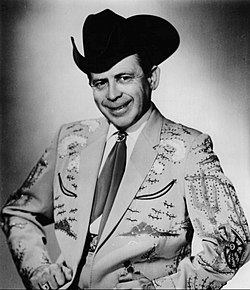
James Cecil Dickens (December 19, 1920 – January 2, 2015), better known by his stage name Little Jimmy Dickens, was an American country music singer and songwriter famous for his humorous novelty songs, his small size (4'10" [150 cm]), and his rhinestone-studded outfits (which he is given credit for introducing into live country music performances).[1] He started as a member of the Grand Ole Opry in 1948 and was inducted into the Country Music Hall of Fame in 1983.[2] Before his death, he was the oldest living member of the Grand Ole Opry.

Early life

[edit]

Dickens was born in Bolt, West Virginia. He began his musical career in the late 1930s, performing on radio station WJLS in Beckley, West Virginia, while attending West Virginia University.[3] On the radio station, he got his experience with performers such as Mel Steele, Molly O'Day, and Johnnie Bailes.[2] In the 1940s, Jimmy hosted his own radio programs in places including West Virginia, Indiana, Kansas, and even Ohio.[2] He soon quit school to pursue a full-time music career, traveling the country performing on local radio stations under the name "Jimmy the Kid".

Career

[edit]
Dickens in 1955

In 1948, Dickens was heard performing on WKNX, a radio station in Saginaw, Michigan, while on location at Buck Lake Ranch, Angola, Indiana. Roy Acuff introduced him to Art Satherley at Columbia Records and to officials from the Grand Ole Opry.[2] Dickens signed with Columbia in September and joined the Opry in August. Around this time, he began using the nickname Little Jimmy Dickens, inspired by his short stature.[4]

Dickens recorded many novelty songs for Columbia, including "Country Boy", "A-Sleeping at the Foot of the Bed", and "I'm Little but I'm Loud".[5] His song "Take an Old Cold Tater (And Wait)" inspired Hank Williams to nickname him Tater. Later, telling Dickens he needed a hit, Williams wrote "Hey Good Lookin'" in only 20 minutes while on a plane with Dickens, Minnie Pearl, and Pearl's husband, Henry Cannon.[6] A week later, Williams recorded the song himself, jokingly telling Dickens, "That song's too good for you!",[7] to which Dickens replied, "Much obliged, Hiram."

In 1950, Dickens formed the Country Boys with musicians Jabbo Arrington, Grady Martin, Bob Moore, and Thumbs Carllile. During this time, he discovered future Country Music Hall of Famer Marty Robbins at a Phoenix, Arizona, television station while on tour with the Grand Ole Opry road show. In 1957, Dickens left the Grand Ole Opry to tour with the Philip Morris Country Music Show.[8]

In 1962, Dickens had his first top-10 country hit since 1954 with "The Violet and a Rose".

In 1964, he became the first country artist to circle the globe while on tour. He also made numerous appearances on television, including on The Tonight Show Starring Johnny Carson. In 1965, he released his biggest hit, "May the Bird of Paradise Fly Up Your Nose", which reached number one on the country chart and number 15 on the pop chart.

In the late 1960s, Dickens left Columbia for Decca Records, before moving again to United Artists in 1971.[9] That same year, he married his wife, Mona,[10][11] and in 1975, he returned to the Grand Ole Opry. In 1983, Dickens was inducted into the Country Music Hall of Fame.[12]

Dickens joined producers Randall Franks and Alan Autry for the In the Heat of the Night cast CD Christmas Time's a Comin’, performing "Jingle Bells" with the cast. The CD released by Sonlite and MGM/UA was one of the most popular Christmas releases of 1991 and 1992 with Southern retailers.

Later career

[edit]

In 1984, Dickens appeared in Hank Williams Jr.'s music video for the hit single "All My Rowdy Friends Are Coming Over Tonight".

Dickens performing at the Grand Ole Opry House in 2004: Notice the six-foot circle of oak cut from the corner of the Ryman Auditorium's stage and inlaid into center stage at the Grand Ole Opry House.

Toward the end of his life, Dickens made appearances in a number of music videos by fellow West Virginia native and country musician Brad Paisley. He was also featured on several of Paisley's albums in bonus comedy tracks, along with other Opry mainstays such as George Jones and Bill Anderson. They were collectively referred to as the Kung-Pao Buckaroos.

With the death of Hank Locklin in March 2009, Dickens became the oldest living member of the Grand Ole Opry, at the age of 90. He made regular appearances as a host at the Opry, often with the self-deprecating joke that he was also known as "Willie Nelson after taxes", playing on his resemblance to Nelson in his later years, Nelson's highly publicized problems with the Internal Revenue Service, and Dickens' own short stature. At the 2011 CMA Awards, Dickens was dressed as Justin Bieber and made fun of Bieber's then-current paternity scandal.

Personal life

[edit]

Dickens married Connie Chapman in 1944; the marriage ended in divorce in 1955. Later that year, he married Ernestine Jones; she died in 1968 in an automobile accident while traveling in Texas. He married Mona Evans in 1971.[13] They had two daughters, Pamela Detert and Lisa King.[14]

Death

[edit]

Dickens was hospitalized after a stroke on December 25, 2014, six days after marking his birthday in what was his last appearance on the Opry.[1] He died of cardiac arrest on January 2, 2015, at the age of 94.[15] After his funeral on January 8, 2015, at the Grand Ole Opry House, Dickens was entombed in the Cross Mausoleum at Woodlawn Memorial Park in Nashville.[16]

Discography

[edit]

Studio albums

[edit]
Year Album details Chart positions
US Country
1954 Old Country Church
1960 Big Songs by Little Jimmy Dickens
  • Released: September 1960
  • Label: Columbia
1962 Little Jimmy Dickens Sings Out Behind the Barn
  • Released: September 1962
  • Label: Columbia
1965 Handle with Care
  • Released: February 1965
  • Label: Columbia
May the Bird of Paradise Fly Up Your Nose
  • Released: November 1965
  • Label: Columbia
4
1968 Big Man in Country Music
  • Released: 1968
  • Label: Columbia
Little Jimmy Dickens Sings
  • Released: March 1968
  • Label: Decca
1969 Jimmy Dickens Comes Callin'
  • Released: February 1969
  • Label: Decca
"—" denotes releases that did not chart.

Compilation albums

[edit]
Year Album details Chart positions
US Country
1957 Raisin' the Dickens
  • Released: November 1957
  • Label: Columbia
1966 Little Jimmy Dickens' Greatest Hits
  • Released: 1966
  • Label: Columbia
39
1969 Greatest Hits
  • Released: 1969
  • Label: Decca
1976 Hymns of the Hour
  • Released: 1976
  • Label: Quantum
1983 Historic Edition
  • Released: 1983
  • Label: Columbia
"—" denotes releases that did not chart.

Singles

[edit]
Year Song Peak positions Album
US Country US
1949 "Take an Old Cold 'Tater (And Wait)" 7 Raisin' the Dickens
"Country Boy" 7
"My Heart's Bouquet" 10 Big Songs by Little Jimmy Dickens
"A-Sleeping at the Foot of the Bed" 6 Raisin' the Dickens
1950 "A Rose from the Bride's Bouquet" Non-album singles
"Hillbilly Fever" 3
"F-o-o-l-i-s-h M-e"
"Walk, Chicken, Walk"
"Out of Business"
"I'm Little, but I'm Loud" Raisin' the Dickens
1951 "Cold Feet" Non-album singles
"What About You"
"Sign On the Highway"
"Poor Little Darlin'"
"Old Rugged Cross" (with the Johnson Family Singers)
1952 "They Locked God Outside the Iron Curtain"
"Lola Lee"
"Hot Diggity Dog"
"Waitress, Waitress"
"Take Up Thy Cross" Old Country Church
"No Tears in Heaven"
"Wedding Bell Waltz" Non-album single
1953 "I Shall Not Be Moved" Old Country Church
"Sidemeat and Cabbage" Non-album singles
"I'm Making Love to a Stranger"
"Thick and Thin"
"No Place Like Home on Christmas"
1954 "That Little Old Country Church House" Old Country Church
"Y'All Come Home" Non-album singles
"You Better Not Do That"
"Out Behind the Barn" 9 Raisin' the Dickens
"Blackeyed Joe's" Non-album singles
"Stinky Pass the Hat Around"
1955 "Salty Boogie"
"We Could"
"I'm Braver Now"
1956 "Hey Worm (You Wanna Wiggle)"
"Big Sandy"
"Country Boy Bounce" (with the Country Boys)
"Cornbread and Buttermilk"
"Say It Now"
"Raisin' the Dickens" (with the Country Boys)
1957 "I Never Had the Blues"
"Makin' the Rounds"
"Family Reunion"
1958 "(I Got a) Hole in My Pocket"
1959 "When Your House Is Not a Home"
"Hannah"
"Hey Ma (Hide the Daughter)"
1960 "We Lived It Up"
"Fireball Mail" Big Songs by Little Jimmy Dickens
1961 "Talking to the Wall" Non-album single
1962 "Twenty Cigarettes" Out Behind the Barn
"The Violet and a Rose" 10
"Police, Police" Non-album single
1963 "Another Bridge to Burn" 28 Handle with Care
1964 "I Leaned Over Backwards for You"
"Is Goodbye That Easy to Say"
1965 "He Stands Real Tall" 21
"May the Bird of Paradise Fly Up Your Nose"[A] 1 15 May the Bird of Paradise Fly Up Your Nose
1966 "When the Ship Hit the Sand" 27 103 Greatest Hits
"Who Licked the Red Off Your Candy" 41 Big Man in Country Music
"Where the Buffalo Trud"
1967 "Country Music Lover" 23
"Jenny Needs a G-String (For Her Old Guitar)"
"Daddy and the Wine" Little Jimmy Dickens Sings
1968 "I Love Lucy Brown"
"How to Catch an African Skeeter Alive" 69 Little Jimmy Dickens Comes Callin'
"Someday You'll Call My Name"
"When You're Seventeen" 55 Greatest Hits (1969)
1969 "Times Are Gonna Get Better" Non-album singles
1970 "(You've Been Quite a Doll) Raggedy Ann" 75
"Everyday Family Man" 70
1971 "Here It Comes Again"
"You Only Want Me for My Body"
1972 "Try It, You'll Like It" 61
"Alabam"
1973 "Dead Skunk"
1976 "Preacherman"
1978 "How Much is That Picture of Jesus?"
Dash denotes releases that did not chart.

Notes A^ "May the Bird of Paradise Fly Up Your Nose" also peaked at number 4 on the Canadian RPM Top Singles Chart.

B-sides

[edit]
Year Song Peak positions A-Side Single
US Country
1949 "Pennies for Papa" 12 "Take an Old Cold 'Tater (And Wait)"
1962 "Honky Tonk Troubles" 25 "The Violet and a Rose"

References

[edit]
[edit]
Revisions and contributorsEdit on WikipediaRead on Wikipedia
from Grokipedia
Little Jimmy Dickens (December 19, 1920 – January 2, 2015) was an American country music singer, songwriter, and entertainer renowned for his humorous novelty songs, diminutive stature of 4 feet 11 inches, and flamboyant stage attire, including the first Nudie suit worn on the Grand Ole Opry. Born James Cecil Dickens in Bolt, West Virginia, as the oldest of 13 children in a large family, he developed an early interest in music influenced by his mother's singing and relatives in the coal mining region. Dickens began performing on local radio station WJLS in Beckley while in high school, later hosting programs in cities including Fairmont, West Virginia; Indianapolis, Indiana; Cincinnati, Ohio; Topeka, Kansas; and Saginaw, Michigan, during the 1940s. In 1948, with assistance from Roy Acuff, he debuted at the Grand Ole Opry, joined as a member shortly after, and signed with Columbia Records on September 16 of that year, launching a career that spanned over seven decades. Dickens achieved commercial success with witty, upbeat tracks such as his debut hit "Take an Old Cold 'Tater (and Wait)" (1949), "Hillbilly Fever" (1950), "Out Behind the Barn" (1954), "The Violet and a Rose" (1962), and his lone number-one country single "May the Bird of Paradise Fly Up Your Nose" (1965), which also reached number 15 on the pop charts. He briefly left the Opry in 1957 for a Philip Morris-sponsored tour but rejoined in 1975, becoming its longest-tenured member and hosting segments until his final performance on December 20, 2014. As the first country artist to tour internationally in 1964, Dickens influenced the genre's global reach and pioneered elements like the twin lead guitar sound with his backing band, the Country Boys; he was inducted into the Country Music Hall of Fame in 1983 and continued appearing in later years with artists like Brad Paisley. Dickens died at age 94 in Nashville, Tennessee, following a stroke on Christmas Day 2014.

Early years

Birth and family background

James Cecil Dickens, known professionally as Little Jimmy Dickens, was born on December 19, 1920, in the small unincorporated community of Bolt, West Virginia, deep in the coal-mining region of southern Appalachia. He was the eldest of 13 children in a large family rooted in the hardships of rural coal country. Raised primarily by his grandparents, Lewis Calvin Dickens and Edna Young Dickens, after they took him in as a baby, young Jimmy grew up in a modest household shaped by his grandfather's work as a coal miner and the broader family's ties to the industry. This environment instilled in him a strong work ethic and resilience, as the family navigated the economic uncertainties of mining life in Raleigh County, where opportunities were limited and community bonds were tight. His mother, a singer and guitar player, along with uncles who played guitars and banjos, contributed to a home filled with informal music-making, though none pursued it professionally. Dickens' early childhood was marked by exposure to traditional country sounds through family gatherings and the flickering glow of a battery-powered radio, where the family would huddle on Saturday nights to listen to broadcasts from the Grand Ole Opry. This rural immersion in Appalachian folk traditions and emerging country music fostered his lifelong appreciation for the genre, laying the groundwork for his future pursuits without formal instruction at that stage.

Musical beginnings and education

In high school during the late 1930s, James Cecil Dickens began performing on WJLS radio in Beckley, West Virginia, gaining initial exposure through local broadcasts that showcased his singing talents, including crowing like a rooster to sign on the station. These appearances marked his entry into the regional music scene, allowing him to hone his skills alongside established performers such as Mel Steele, Molly O'Day, and Johnnie Bailes. He graduated from Trap Hill High School in 1940, where he served as senior class president and participated in dramatics. Following high school, he briefly enrolled at West Virginia University but left around 1940 to commit fully to music, transitioning from student performer to aspiring professional. By the early 1940s, Dickens had adopted the stage name "Jimmy the Kid" to appeal to audiences, reflecting his youthful energy and diminutive stature. This decision propelled him to host his own radio programs across the Midwest, including in Fairmont, West Virginia; Indianapolis, Indiana; Cincinnati, Ohio; and Topeka, Kansas, where he entertained listeners with country songs and comedy.

Career

Rise to fame and Grand Ole Opry

In 1947, while performing in Cincinnati, Little Jimmy Dickens was discovered by Grand Ole Opry star Roy Acuff, who was impressed by his energetic renditions of novelty songs and invited him to make guest appearances on the Opry. Dickens relocated to Nashville in 1948 to pursue opportunities in the burgeoning country music scene, debuting as a guest on the program on February 21 of that year. Shortly thereafter, he officially joined the Opry cast, becoming a fixture known for his humorous, high-energy performances that quickly endeared him to audiences. Acuff also introduced Dickens to Columbia Records talent scout Art Satherley, leading to a recording contract signed on September 16, 1948. During his initial sessions, Dickens adopted the stage name "Little Jimmy Dickens" to highlight his diminutive 4-foot-11-inch stature, which contrasted amusingly with his powerful voice and larger-than-life stage presence. This moniker, along with his first recordings, helped establish his unique persona in the competitive Nashville music industry. By 1950, Dickens had assembled his backing band, the Country Boys, featuring musicians such as Jabbo Arrington on fiddle and Grady Martin on guitar, which provided a tight, innovative sound with twin lead guitars and steel guitar that influenced early Nashville ensembles. Early in his Opry tenure, he formed a close friendship with fellow performer Hank Williams, who, inspired by Dickens's 1949 hit "Take an Old Cold 'Tater (And Wait)," affectionately nicknamed him "Tater" as a playful nod to the song's theme of humble Southern fare.

Major hits and recordings

Little Jimmy Dickens launched his recording career with Columbia Records in 1949, releasing his debut single "Take an Old Cold 'Tater (And Wait)," which peaked at number 7 on the Billboard country chart and showcased his lighthearted rural storytelling style. That same year, "Take an Old Cold 'Tater (And Wait)" solidified Dickens' reputation for humorous novelty songs that blended wit with country traditions and earned him the enduring nickname "Tater" from peers like Hank Williams. In the early 1950s, Dickens continued his success with novelty tracks like "A-Sleepin' at the Foot of the Bed," which climbed to number 6 on the country chart in 1950, further emphasizing his comedic persona through playful lyrics about everyday mishaps. During this period, while touring, Dickens discovered aspiring performer Marty Robbins in 1951 during a guest appearance on Robbins' Arizona TV show Western Caravan, impressing him enough to recommend the talent to Columbia Records and help secure Robbins' first recording contract and Grand Ole Opry slot. Dickens' commercial peak arrived in the 1960s with a shift toward more varied material, including the Mel Tillis-penned ballad "The Violet and a Rose," which marked his first top-10 country hit in nearly a decade by reaching number 10 in 1962. His signature novelty triumph came in 1965 with "May the Bird of Paradise Fly Up Your Nose," a satirical tune that soared to number 1 on the Billboard country chart for two weeks and crossed over to number 15 on the Hot 100 pop chart, capturing widespread appeal through its absurd humor. The accompanying album, May the Bird of Paradise Fly Up Your Nose, also performed strongly, peaking at number 4 on the Billboard Top Country Albums chart and spending 12 weeks in the top ranks.

Later career and Opry return

In 1957, Dickens departed from the Grand Ole Opry to headline the Philip Morris Country Music Show, a sponsored touring production that traveled across the United States. After nearly two decades away, he rejoined the Opry as a permanent member on February 8, 1975, marking a renewed commitment to the institution where he had first risen to prominence. Upon his return, Dickens assumed the role of a respected veteran, warmly greeting emerging artists and contributing to the show's legacy through consistent participation. Throughout the 1970s and 1980s, Dickens sustained his career through extensive touring, performing for audiences nationwide and internationally, including his pioneering 1964 world tour—the first by a country artist to fully circle the globe with performances in Hawaii, Japan, Taiwan, Hong Kong, Vietnam, and Europe—while releasing occasional recordings that echoed his earlier novelty style. He made guest appearances on country television programs, including the Ralph Emery Show in 1983, where he showcased his humorous persona and classic hits. Dickens saw a notable resurgence in the 2000s via collaborations with contemporary stars, particularly Brad Paisley, a fellow West Virginian whom he mentored early in Paisley's career. In 2000, Dickens joined Bill Anderson and Jeannie Seely in surprising Paisley with an invitation to become an Opry member during a live broadcast. Their partnership extended to Paisley's 2005 album Time Well Wasted, where Dickens lent his voice to the comedic track "Cornography," a playful sketch alongside George Jones, Bill Anderson, and Dolly Parton that highlighted his enduring wit. Entering the 2010s, Dickens held the distinction of being the Grand Ole Opry's oldest active member at age 90 and beyond, embodying the program's historical continuity as an elder statesman. He continued occasional onstage performances at the Opry, with his final appearance occurring on December 20, 2014, during a celebration of his 94th birthday, and made select television guest spots that underscored his longevity in the industry.

Personal life

Marriages and relationships

Little Jimmy Dickens entered into his first marriage with Connie Chapman in 1944, a union that spanned 11 years before ending in divorce in 1955. The couple had no children. That same year, shortly after his divorce, Dickens married Ernestine Jones, marking his second marriage; it lasted 13 years until her untimely death in a car accident in 1968. Dickens' third and final marriage was to Mona Evans in 1971, a partnership that endured for 44 years until his death in 2015 and provided stability during his later career in Nashville, where the couple resided and remained actively involved in the local music scene.

Family and children

Little Jimmy Dickens had two daughters: Pamela Detert from his second marriage to Ernestine Jones and Lisa King from his third marriage to Mona Evans. Despite the rigors of his career, which involved extensive travel for Grand Ole Opry performances and national tours, Dickens' family served as a steadfast source of emotional support, enabling him to sustain his professional commitments while nurturing personal bonds. His daughters did not enter the music industry, diverging from Dickens' own trajectory, but they remained connected to his legacy in retirement by preserving family traditions and participating in commemorative events honoring his contributions to country music.

Death and legacy

Illness and death

On December 25, 2014, Little Jimmy Dickens, then 94 years old, suffered a stroke and was hospitalized in a Nashville-area facility. Despite initial signs of improvement, he died on January 2, 2015, from cardiac arrest at the same hospital. A public celebration of life service was held on January 8, 2015, at the Grand Ole Opry House in Nashville, attended by numerous country music stars including Brad Paisley, Vince Gill, and Carrie Underwood, who performed tributes during the event. A private family entombment followed at Woodlawn Memorial Park Cemetery's Cross Mausoleum in Nashville. Immediate tributes poured in from Grand Ole Opry management and peers, emphasizing Dickens' 67-year association with the institution since joining in 1948. Opry vice president and general manager Pete Fisher stated, "The Grand Ole Opry did not have a better friend than Little Jimmy Dickens," while performers like Carrie Underwood and Vince Gill shared personal memories of his warmth and humor on social media and at the service.

Honors, influence, and enduring impact

In 1983, Little Jimmy Dickens was inducted into the Country Music Hall of Fame, an honor that recognized his pioneering role in novelty songs and his longstanding contributions to the Grand Ole Opry. Additional accolades followed, including the Cliffie Stone Pioneer Award from the Academy of Country Music in 2005 for his innovative showmanship, and induction into the West Virginia Music Hall of Fame in 2007, celebrating his roots and global touring as the first country artist to do so in 1964. In 2022, a West Virginia State Memory Highway marker was dedicated in his honor in Raleigh County, near his birthplace. Dickens exerted significant influence on country music through his humorous novelty style, which earned him the title "King of the Novelty Song" and shaped the genre's comedic tradition. He pioneered the twin-lead-guitar sound with his backing band, the Country Boys, as heard in tracks like "Hillbilly Fever," and became a fashion icon by being the first to wear a Nudie Cohn-designed rhinestone suit on the Opry stage in 1949, influencing the flashy attire of later stars. His mentorship extended to emerging talents; in 1951, he discovered Marty Robbins during a guest spot on Robbins's Phoenix TV show and recommended him to Columbia Records producer Art Satherley, launching Robbins's career. Later, Dickens guided younger artists like Brad Paisley, appearing in Paisley's music videos and recordings, and inducting new Opry members such as Trace Adkins in 2003, passing on his emphasis on humor and stage presence. Dickens's enduring impact lies in his unparalleled longevity and role as country music's premier entertainer, serving as the oldest living Opry member for over 66 years until his death in 2015. His archival performances and recordings preserve the spirit of mid-20th-century country humor and balladry, while biographies and tributes underscore his humility and global ambassadorship for the genre. Through these elements, Dickens inspired generations of performers to blend wit with heartfelt songcraft, ensuring his legacy as a foundational figure in Opry history.

Discography

Studio albums

Little Jimmy Dickens began his recording career with Columbia Records in the late 1940s, but his first full-length studio album arrived in 1954 with The Old Country Church, a 10-inch LP emphasizing gospel and religious themes through tracks like "No Tears in Heaven" and "Just a Closer Walk with Thee," showcasing his early affinity for inspirational country music. This debut set a tone for his blend of heartfelt ballads and novelty tunes, though his subsequent releases increasingly highlighted humorous, uptempo country storytelling. Throughout the 1950s and early 1960s, Dickens produced a series of Columbia albums that captured his signature style of witty, character-driven songs alongside traditional country standards. Albums like Raisin' the Dickens (1957) featured playful hits such as "Take an Old Cold Tater (And Wait)" and covers of classics like "Jambalaya," reflecting his honky-tonk roots and rising popularity on the Grand Ole Opry. Big Songs by "Little" Jimmy Dickens (1960) delved into narrative-driven tracks including "John Henry" and "Fire Ball Mail," emphasizing Dickens' vocal expressiveness in folk-country tales. By 1962's Out Behind the Barn, the focus shifted to relational and rustic themes, with the title track highlighting everyday rural life. A career highlight came in 1965 with May the Bird of Paradise Fly Up Your Nose on Columbia, an album centered on novelty content that propelled Dickens to new commercial heights; it peaked at No. 4 on the Billboard Top Country Albums chart, driven by the irreverent title track's success and supported by humorous cuts like "He Knocked Me Right Out of the Box." Later that year, Handle with Care explored more melancholic territory with songs addressing heartbreak and regret, such as "Another Bridge to Burn." Dickens' final Columbia effort, Big Man in Country Music (1968), leaned into self-referential humor with tracks like "Country Music Lover" and "Who Licked the Red Off Your Candy," underscoring his enduring appeal as a lighthearted country figure. In the late 1960s, Dickens transitioned to Decca Records, releasing albums that continued his mix of novelty and traditional country. Jimmy Dickens Sings (1968) included sentimental pieces like "I'm So Lonesome I Could Cry" alongside comedic numbers such as "They're Gonna Have Me Committed." The following year's Jimmy Dickens Comes Callin' featured whimsical storytelling in songs like "How to Catch an African Skeeter Alive," maintaining his playful persona into the 1970s. He continued with MGM Records in the 1970s, releasing Thought for Today (1970), a collection blending inspirational and novelty tracks. While later efforts were sparser, a 1976 gospel album, Hymns of the Hour on Queen City, revisited inspirational roots with collaborations like the Blue Ridge Quartet.
Album TitleRelease YearLabelKey Themes/Notes
The Old Country Church1954ColumbiaGospel and religious tracks; 10-inch LP.
Raisin' the Dickens1957ColumbiaHonky-tonk hits and covers; upbeat rural humor.
Big Songs by "Little" Jimmy Dickens1960ColumbiaFolk-country narratives and standards.
Out Behind the Barn1962ColumbiaRelational and rustic storytelling.
May the Bird of Paradise Fly Up Your Nose1965ColumbiaNovelty humor; peaked at No. 4 on Billboard Top Country Albums.
Handle with Care1965ColumbiaHeartbreak ballads and emotional depth.
Big Man in Country Music1968ColumbiaSelf-referential comedy and country tributes.
Jimmy Dickens Sings1968DeccaSentimental and comedic mixes.
Jimmy Dickens Comes Callin'1969DeccaWhimsical tales and traditional covers.
Thought for Today1970MGMInspirational and novelty tracks.
Hymns of the Hour1976Queen CityGospel collaborations; inspirational focus.

Compilation albums

Little Jimmy Dickens' first major compilation album, Little Jimmy Dickens' Greatest Hits, was released in 1966 by Columbia Records and peaked at number 39 on the Billboard country albums chart. This collection focused on his early novelty successes from the 1950s, including tracks like "Take an Old Cold Tater (And Wait)" and "Out Behind the Barn," which highlighted his humorous, high-energy style that defined his initial rise in country music. The album served as a retrospective of his Columbia era hits, capturing the playful persona that earned him the nickname "Little Jimmy." In the 1990s and 2000s, Bear Family Records issued comprehensive multi-disc box sets that spanned Dickens' career, providing in-depth retrospectives with extensive liner notes discussing his distinctive honky-tonk and novelty influences. Country Boy (1997), a four-CD set, compiled all of his Columbia recordings from 1949 to 1957, including 105 tracks and a 60-page booklet detailing his early Grand Ole Opry performances and songwriting approach. This was followed by Out Behind the Barn (1998), another four-CD collection covering his Columbia output from 1957 to 1966, featuring 95 songs with notes on his evolution toward more mature country themes while retaining his witty delivery. These sets emphasized Dickens' role in bridging postwar honky-tonk and the Nashville Sound, drawing from archival sessions to showcase rare material alongside hits. Following Dickens' death in 2015, posthumous compilations continued to emerge, often as digital remasters highlighting his Opry-era contributions. Top 100 Classics - The Very Best of Little Jimmy Dickens (2020), a 100-track digital collection, aggregated key recordings from his 1950s peak, focusing on live-wire performances that exemplified his enduring appeal in traditional country. A digital Greatest Hits compilation was released in 2025, featuring 10 tracks including Opry-associated novelty songs like "I'm Little But I'm Loud." These releases underscored the ongoing interest in Dickens' foundational role in country entertainment, with emphasis on restored audio from his Grand Ole Opry tenure.

Singles

Little Jimmy Dickens launched his recording career in 1949 with Columbia Records, debuting with the single "Take an Old Cold 'Tater (And Wait)" b/w "Country Boy," humorous tracks that highlighted his distinctive high-pitched voice and rural-themed novelty style; the A-side peaked at #7 on the Billboard country singles chart and earned him the enduring nickname "Tater" from Hank Williams. Dickens sustained a string of moderate hits through the 1950s, including "Hillbilly Fever" at #2 on the country chart in 1950 and "Out Behind the Barn" at #9 in 1954, both exemplifying his flair for lighthearted, character-driven songs. His career resurgence in the 1960s featured the ballad "The Violet and a Rose," which climbed to #10 on the country chart in 1962, followed by his signature novelty hit "May the Bird of Paradise Fly Up Your Nose" in 1965; the latter held #1 on the country chart for two weeks and crossed over to #15 on the Billboard Hot 100. In the 1970s and 1980s, Dickens's singles achieved lower chart placements amid shifting country music trends, such as "(You've Been Quite a Doll) Raggedy Ann" reaching #75 on the country chart in 1970, a spoken-word recitation that appealed to his Opry audience. Despite modest commercial results, he frequently performed these tracks and earlier favorites on the Grand Ole Opry, where his longevity as a member since 1948 reinforced his status as a beloved fixture in live country entertainment.

References

Add your contribution
Related Hubs
User Avatar
No comments yet.