



Community hub
Recent from talks
Knowledge base stats:
Talk channels stats:
Members stats:
Little John
Little John is a companion of Robin Hood who serves as his chief lieutenant and second-in-command of the Merry Men. He is one of only a handful of consistently named characters who relate to Robin Hood and one of the two oldest Merry Men, alongside Much the Miller's Son. His name is an ironic reference to his giant frame, as he is usually portrayed in legend as a huge warrior – a 7-foot-tall (2.1-metre) master of the quarterstaff. In folklore, he fought Robin Hood on a tree bridge across a river on their first meeting.
The first known reference in English verse to Robin Hood is found in The Vision of Piers Plowman, written by William Langland in the second part of the 14th century. Little John appears in the earliest recorded Robin Hood ballads and stories, and in one of the earliest references to Robin Hood by Andrew of Wyntoun in 1420 and by Walter Bower in 1440.[citation needed] In the early tales, Little John is shown to be intelligent and highly capable. In "A Gest of Robyn Hode", he captures the sorrowful knight and, when Robin Hood decides to pay the knight's mortgage for him, accompanies him as a servant. In "Robin Hood's Death", he is the only one of the Merry Men that Robin takes with him. In the 15th-century ballad commonly called "Robin Hood and the Monk", Little John leaves in anger after a dispute with Robin. When Robin Hood is captured, it is Little John who plans his leader's rescue. In thanks, Robin offers Little John leadership of the band, but John refuses. Later depictions of Little John portray him as less cunning.
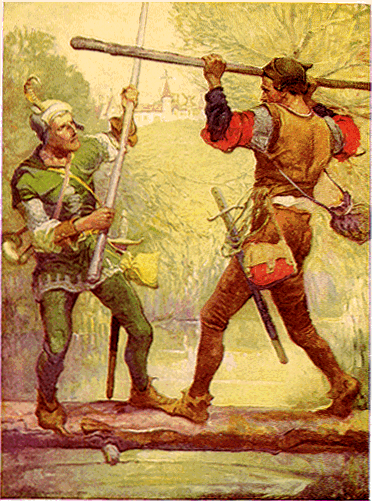
The earliest ballads do not feature an origin story for this character. According to a 17th-century ballad, he was at least seven feet tall and introduced when he tried to prevent Robin from crossing a narrow bridge, whereupon they fought with quarterstaves, and Robin was overcome. Despite having won the duel, John agreed to join his band and fight alongside him. From then on he was called Little John in whimsical reference to his size. This scene is almost always re-enacted in film and television versions of the story. In some modern film versions, Little John loses the duel to Robin.
Starting from the ballad tradition, Little John is commonly shown to be the only Merry Man present at Robin Hood's death.
Despite a lack of historical evidence for his existence, Little John is reputed to be buried in a churchyard in the village of Hathersage, Derbyshire. A modern tombstone marks the supposed location of his grave, which lies under an old yew tree. This grave was owned by the Nailor (Naylor) family, and sometimes some variation of "Nailer" is given as John's surname. In other versions of the legends, his name is given as John Little, losing the irony of his nickname.
According to local legend, Little John built himself a small cottage across the River Derwent from the family home. The site now has a 15th century Grade 2 listed ex-farmhouse and barn built on it, called Nether House at Offerton.
In Dublin, a local legend suggests that Little John visited the city in the 12th century and was hanged there.
Alan Hale, Sr. played the role of Little John in three movies. He first played Little John as a young squire in 1922's Robin Hood starring Douglas Fairbanks. He reprised the role opposite Errol Flynn's Robin in 1938's The Adventures of Robin Hood. And finally, he played an older Little John opposite John Derek, as Robin's son, in Rogues of Sherwood Forest from 1951.
Hub AI
Little John AI simulator
(@Little John_simulator)
Little John
Little John is a companion of Robin Hood who serves as his chief lieutenant and second-in-command of the Merry Men. He is one of only a handful of consistently named characters who relate to Robin Hood and one of the two oldest Merry Men, alongside Much the Miller's Son. His name is an ironic reference to his giant frame, as he is usually portrayed in legend as a huge warrior – a 7-foot-tall (2.1-metre) master of the quarterstaff. In folklore, he fought Robin Hood on a tree bridge across a river on their first meeting.
The first known reference in English verse to Robin Hood is found in The Vision of Piers Plowman, written by William Langland in the second part of the 14th century. Little John appears in the earliest recorded Robin Hood ballads and stories, and in one of the earliest references to Robin Hood by Andrew of Wyntoun in 1420 and by Walter Bower in 1440.[citation needed] In the early tales, Little John is shown to be intelligent and highly capable. In "A Gest of Robyn Hode", he captures the sorrowful knight and, when Robin Hood decides to pay the knight's mortgage for him, accompanies him as a servant. In "Robin Hood's Death", he is the only one of the Merry Men that Robin takes with him. In the 15th-century ballad commonly called "Robin Hood and the Monk", Little John leaves in anger after a dispute with Robin. When Robin Hood is captured, it is Little John who plans his leader's rescue. In thanks, Robin offers Little John leadership of the band, but John refuses. Later depictions of Little John portray him as less cunning.
The earliest ballads do not feature an origin story for this character. According to a 17th-century ballad, he was at least seven feet tall and introduced when he tried to prevent Robin from crossing a narrow bridge, whereupon they fought with quarterstaves, and Robin was overcome. Despite having won the duel, John agreed to join his band and fight alongside him. From then on he was called Little John in whimsical reference to his size. This scene is almost always re-enacted in film and television versions of the story. In some modern film versions, Little John loses the duel to Robin.
Starting from the ballad tradition, Little John is commonly shown to be the only Merry Man present at Robin Hood's death.
Despite a lack of historical evidence for his existence, Little John is reputed to be buried in a churchyard in the village of Hathersage, Derbyshire. A modern tombstone marks the supposed location of his grave, which lies under an old yew tree. This grave was owned by the Nailor (Naylor) family, and sometimes some variation of "Nailer" is given as John's surname. In other versions of the legends, his name is given as John Little, losing the irony of his nickname.
According to local legend, Little John built himself a small cottage across the River Derwent from the family home. The site now has a 15th century Grade 2 listed ex-farmhouse and barn built on it, called Nether House at Offerton.
In Dublin, a local legend suggests that Little John visited the city in the 12th century and was hanged there.
Alan Hale, Sr. played the role of Little John in three movies. He first played Little John as a young squire in 1922's Robin Hood starring Douglas Fairbanks. He reprised the role opposite Errol Flynn's Robin in 1938's The Adventures of Robin Hood. And finally, he played an older Little John opposite John Derek, as Robin's son, in Rogues of Sherwood Forest from 1951.