


Community hub
Recent from talks
Contribute something
Nothing was collected or created yet.
Little ringed plover
View on Wikipedia | This article needs additional citations for verification. (December 2025) |
| Little ringed plover | |
|---|---|

| |
| In Kesmeburun, Osmaniye, Turkey | |
Scientific classification 
| |
| Kingdom: | Animalia |
| Phylum: | Chordata |
| Class: | Aves |
| Order: | Charadriiformes |
| Family: | Charadriidae |
| Genus: | Thinornis |
| Species: | T. dubius
|
| Binomial name | |
| Thinornis dubius (Scopoli, 1786)
| |

| |
| Range of Ch. dubius Breeding Resident Passage Non-breeding
| |
| Synonyms | |
|
Charadrius dubius | |

The little ringed plover (Thinornis dubius) is a small plover native to the Old World. It has mostly brown upperparts, a black neckband and a black mask around the eye with a noticeable yellow eyering. Its forehead, belly and the rest of the breast are white. A migratory species, it breeds in open gravel areas near freshwater, including gravel pits, islands and river edges. Its diet consists mainly of insects and worms, which it forages for in muddy areas.
Taxonomy
[edit]The little ringed plover was formally described in 1786 as Chadrius dubius by the Austrian naturalist Giovanni Antonio Scopoli.[2] The specific dubius is Latin meaning "doubtful", "uncertain" or "dubious" since French naturalist Pierre Sonnerat in 1876 had thought this bird might be just a variant of the common ringed plover.[3] The little ringed plover is now one of seven plovers placed in the genus Thinornis that was introduced in 1789 by Johann Friedrich Gmelin.[4] The genus name combines the Ancient Greek this meaning "beach" or "sand" with ornis meaning "bird".[5]
Three subspecies are recognized:[4]
- T. d. curonicus (Gmelin, JF, 1789) – breeds Palearctic from Scandinavia southward to northern Africa, eastward across Russia to Sea of Okhotsk and Ussuriland, southward through Middle East and eastward to Japan and Taiwan; winters to Africa and southern Asia
- T. d. jerdoni (Legge, WV, 1880) – India to southeastern Asia
- T. d. dubius (Scopoli, GA, 1786) – Philippines to New Guinea and Bismarck Archipelago
Description
[edit]An adult little ringed plovers has a grey-brown back and wings, a white belly and a white breast with one black neckband. It has a brown cap, a white forehead, a black mask around the eyes with white above and a short dark bill. The legs are flesh-coloured and the toes are all webbed.
This species differs from the larger common ringed plover (Charadrius hiaticula) in the head pattern, leg colour, and the presence of a clear yellow eye-ring.

Gallery
[edit]-
 Mating, the male bird hits the cloaca of the female bird
 -
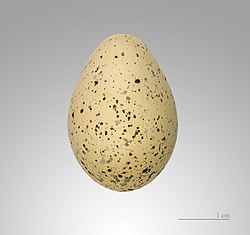 Egg of Charadrius dubius, MHNT
 -
 Little ringed plover chick
 -
 A juvenile at Pulicat Lake, India
 -
 At Fulzar Dam, Jamnagar
 -
 At Padma River, Bangladesh
 -
 Adult in breeding plumage at Khijadiya Bird Sanctuary, Gujarat, India
 -
 In Malta
 -
 Near Roermond, Netherlands


_in_padma_river.jpg)

_in_flight_Malta.jpg)

Habitats and range
[edit]Their breeding habitat is open gravel areas near freshwater, including gravel pits, islands and river edges across the Palearctic including northwestern Africa. They nest on the ground on stones with little or no plant growth. Both males and females take turns incubating the eggs.
They are migratory and winter in Africa. These birds forage for food on muddy areas, usually by sight. They eat insects and worms.
Conservation
[edit]The little ringed plover is one of the species to which the Agreement on the Conservation of African-Eurasian Migratory Waterbirds (AEWA) applies. It is listed as a least concern species by the IUCN.[1]
References
[edit]- ^ a b BirdLife International (2019). "Charadrius dubius". IUCN Red List of Threatened Species. 2019 e.T22693770A155486463. doi:10.2305/IUCN.UK.2019-3.RLTS.T22693770A155486463.en. Retrieved 12 November 2021.
- ^ Scopoli, Giovanni Antonio (1786). Deliciae florae faunae insubricae, seu Novae, aut minus cognitae species plantarum et animalium quas in Insubica austriaca tam spontaneas, quam exoticas vidit (in Latin). Vol. 2. Ticini [Pavia]: Typographia Reg. & Imp. Monasterii S. Salvatoris. p. 93.
- ^ Jobling, James A. "dubius". The Key to Scientific Names. Cornell Lab of Ornithology. Retrieved 7 November 2025.
- ^ a b AviList Core Team (2025). "AviList: The Global Avian Checklist, v2025". doi:10.2173/avilist.v2025. Retrieved 7 November 2025.
- ^ Jobling, James A. "Thinornis". The Key to Scientific Names. Cornell Lab of Ornithology. Retrieved 7 November 2025.
External links
[edit]

- Little ringed plover Images and documentation
- Sexing and ageing (PDF; 5.4 MB) by Javier Blasco-Zumeta & Gerd-Michael Heinze
- BirdLife species factsheet for Charadrius dubius
- "Charadrius dubius". Avibase.
- "Little ringed plover media". Internet Bird Collection.
- Little ringed plover photo gallery at VIREO (Drexel University)
- Interactive range map of Charadrius dubius at IUCN Red List
- Audio recordings of Little ringed plover on Xeno-canto.
- Charadrius dubius in Field Guide: Birds of the World on Flickr

| International | |
|---|---|
| National | |
| Other | |