


Community hub
Recent from talks
Contribute something to knowledge base
Content stats: 0 posts, 0 articles, 1 media, 0 notes
Members stats: 0 subscribers, 0 contributors, 0 moderators, 0 supporters
Subscribers
Supporters
Contributors
Moderators
Hub AI
Charadriidae AI simulator
(@Charadriidae_simulator)
Hub AI
Charadriidae AI simulator
(@Charadriidae_simulator)
Charadriidae
The bird family Charadriidae includes the plovers, dotterels, and lapwings. The family contains 69 species that are divided into 12 genera.
The family Charadriidae was introduced (as Charadriadæ) by the English zoologist William Elford Leach in a guide to the contents of the British Museum published in 1820. Most members of the family are known as plovers, lapwings or dotterels. These were rather vague terms which were not applied with any great consistency in the past. In general, larger, broader-winged species have often been called lapwings, and the smaller, narrower-winged species plovers or dotterels. Until recently, it was thought these formed two major clear taxonomic sub-groups, with lapwings belong to the subfamily Vanellinae, and all but one of the plovers and dotterels to Charadriinae; the last one placed in a small third subfamily Pluvianellinae containing only the Magellanic plover. Modern genetic evidence has however shown that this arrangement was polyphyletic, with in particular, many species traditionally placed in the plover genus Charadrius proving more closely related to the lapwings than they were to the type species of that genus, Charadrius hiaticula; as a result, those species have now been split out into the genus Anarhynchus (syn. Ochthodromus). The third former 'subfamily' proved so completely unrelated to the other plovers that it has been removed from the Charadriidae altogether and given its own monotypic family Pluvianellidae, its closest relatives being the strikingly different sheathbills.
The trend in recent years has been to rationalise the common names of the Charadriidae. For example, the large and very common Australian bird traditionally known as the 'spur-winged plover', is now the masked lapwing to avoid conflict with another bird with the same name; and the former 'sociable plover' is now the sociable lapwing.
The following genus-level cladogram is based on a molecular genetic study by David Cerný and Rossy Natale that was published in 2022. The genera and the species numbers are from the list maintained by the AviList team.
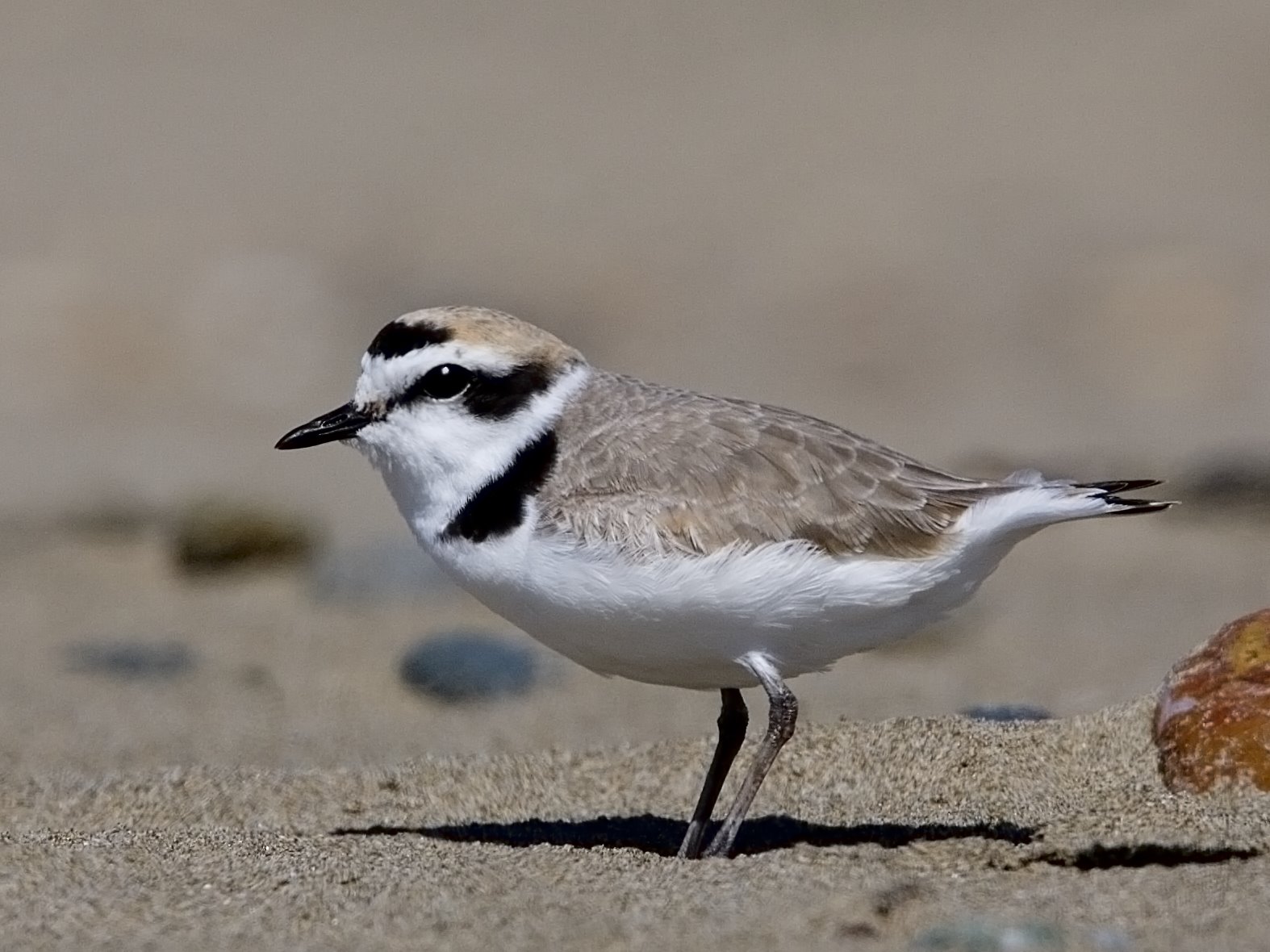
They are small to medium-sized birds with compact bodies, short, thick necks and long, usually pointed, wings, but most species of lapwing have broader, more rounded wings. Their bill are usually straight (except for the wrybill) and short, their toes are short, hind toe can be reduced or absent, depending on species. Most Charadriidae also have relatively short tails, with the exception of the killdeer. In most genera, the sexes are similar, very little sexual dimorphism occurs between sexes. They range in size from the collared plover, at 26 grams and 14 cm (5.5 in), to the masked lapwing, at 368 grams (0.811 pounds) and 35 cm (14 in).
They are distributed through open country worldwide, mostly in habitats near water, although there are some exceptions: the inland dotterel, for example, prefers stony ground in the deserts of central and western Australia, and the killdeer is often found in grasslands in North America.
They hunt by sight, rather than by feel as longer-billed waders like snipe do. Foods eaten include aquatic and terrestrial invertebrates such as insects, worms, molluscs and crustaceans depending on habitat, and are usually obtained by a run-and-pause technique, rather than the steady probing of some other wader groups. They also feed on plant material.
The vast majority of Charadriidae have a socially monogamous mating system. Some, such as Northern lapwings, are polygynous, others, such as mountain plovers have a rapid multiple-clutch system that can be accompanied by sequential polyandry. In Eurasian dotterels, females compete for males and males provide all parental care. While breeding, they defend their territories with highly visible aerial displays.
Charadriidae
The bird family Charadriidae includes the plovers, dotterels, and lapwings. The family contains 69 species that are divided into 12 genera.
The family Charadriidae was introduced (as Charadriadæ) by the English zoologist William Elford Leach in a guide to the contents of the British Museum published in 1820. Most members of the family are known as plovers, lapwings or dotterels. These were rather vague terms which were not applied with any great consistency in the past. In general, larger, broader-winged species have often been called lapwings, and the smaller, narrower-winged species plovers or dotterels. Until recently, it was thought these formed two major clear taxonomic sub-groups, with lapwings belong to the subfamily Vanellinae, and all but one of the plovers and dotterels to Charadriinae; the last one placed in a small third subfamily Pluvianellinae containing only the Magellanic plover. Modern genetic evidence has however shown that this arrangement was polyphyletic, with in particular, many species traditionally placed in the plover genus Charadrius proving more closely related to the lapwings than they were to the type species of that genus, Charadrius hiaticula; as a result, those species have now been split out into the genus Anarhynchus (syn. Ochthodromus). The third former 'subfamily' proved so completely unrelated to the other plovers that it has been removed from the Charadriidae altogether and given its own monotypic family Pluvianellidae, its closest relatives being the strikingly different sheathbills.
The trend in recent years has been to rationalise the common names of the Charadriidae. For example, the large and very common Australian bird traditionally known as the 'spur-winged plover', is now the masked lapwing to avoid conflict with another bird with the same name; and the former 'sociable plover' is now the sociable lapwing.
The following genus-level cladogram is based on a molecular genetic study by David Cerný and Rossy Natale that was published in 2022. The genera and the species numbers are from the list maintained by the AviList team.
They are small to medium-sized birds with compact bodies, short, thick necks and long, usually pointed, wings, but most species of lapwing have broader, more rounded wings. Their bill are usually straight (except for the wrybill) and short, their toes are short, hind toe can be reduced or absent, depending on species. Most Charadriidae also have relatively short tails, with the exception of the killdeer. In most genera, the sexes are similar, very little sexual dimorphism occurs between sexes. They range in size from the collared plover, at 26 grams and 14 cm (5.5 in), to the masked lapwing, at 368 grams (0.811 pounds) and 35 cm (14 in).
They are distributed through open country worldwide, mostly in habitats near water, although there are some exceptions: the inland dotterel, for example, prefers stony ground in the deserts of central and western Australia, and the killdeer is often found in grasslands in North America.
They hunt by sight, rather than by feel as longer-billed waders like snipe do. Foods eaten include aquatic and terrestrial invertebrates such as insects, worms, molluscs and crustaceans depending on habitat, and are usually obtained by a run-and-pause technique, rather than the steady probing of some other wader groups. They also feed on plant material.
The vast majority of Charadriidae have a socially monogamous mating system. Some, such as Northern lapwings, are polygynous, others, such as mountain plovers have a rapid multiple-clutch system that can be accompanied by sequential polyandry. In Eurasian dotterels, females compete for males and males provide all parental care. While breeding, they defend their territories with highly visible aerial displays.
Recent media
Recent media