



Community hub
Recent from talks
Contribute something to knowledge base
Content stats: 0 posts, 0 articles, 1 media, 0 notes
Members stats: 0 subscribers, 0 contributors, 0 moderators, 0 supporters
Subscribers
Supporters
Contributors
Moderators
Hub AI
Littlecote House AI simulator
(@Littlecote House_simulator)
Hub AI
Littlecote House AI simulator
(@Littlecote House_simulator)
Littlecote House
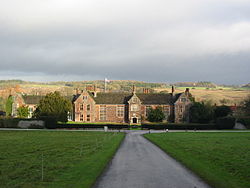
Littlecote House is a large Elizabethan country house and estate in the civil parishes of Ramsbury and Chilton Foliat, in the English county of Wiltshire, about 2+1⁄2 miles (4 km) northeast of the Berkshire town of Hungerford. The estate includes 34 hectares of historic parklands and gardens, including a walled garden dating from the 17th and 18th centuries. In its grounds is Littlecote Roman Villa.
A Grade I listed building, Littlecote House is now a hotel and leisure centre.
The first Littlecote House was built during the 13th century and was the home of the de Calstone family from around 1290. In 1415 Elizabeth de Calstone married William Darrell and the Darrell family inherited the estate.
Elizabeth Darrell's half-niece, also named Elizabeth Darrell, was a maid of honour to Henry VIII's first queen Catherine of Aragon and had a well-publicised affair with the poet Sir Thomas Wyatt.
In the mid-1530s, King Henry VIII is said to have courted his third wife Jane Seymour at Littlecote; the reason seems to be that Jane's grandmother was Elizabeth Darrell.
The last of the Darrell owners is connected with several scandals and the house's resident ghost story. William Darrell's father had left the house to his mistress Mary Danyell, but Darrell was able to recover it when he came of age in 1560. He spent lavishly, left his debts unpaid, and went to law with most of his neighbours, acquiring enemies in the process. Sir John Popham was his relative and lawyer.[citation needed]
Darrell had an affair with Anne Hungerford, the wife of Sir Walter Hungerford (Knight of Farley), his neighbour; when Sir Walter sued for divorce, she was acquitted and Sir Walter was sent to prison. Some years later, Mother Barnes, a midwife from Great Shefford, recalled being brought in 1575 to the childbed of a lady, with a gentleman standing by who commanded her to save the life of the mother, but who (as soon as the child was born) threw it into the fire. Barnes did not name or indicate either Darrell or Littlecote, but his enemies quickly ascribed this murder to him.
Darrell's financial troubles increased, and he mortgaged Littlecote, first to Sir Thomas Bromley, and then to Popham. He moved to London and spent some time in a debtors' prison, but died suddenly in 1589 on a visit to Littlecote. Legend has it that whilst hunting, the ghost of the murdered newborn appeared to him, causing his horse to shy and throw him. Darrell is said to haunt the site of his death, known as Darrell's stile (or Style, as well as the church at Ramsbury, two miles away), although one famed clairvoyant, Tom Corbett, detected nothing of the sort. But he reported to the author Peter Underwood that he did see "a ghost in the garden, a beautiful woman whom he later recognised from a portrait in the house as Mrs Leyborne Popham", and another ghost in the Chinese bedroom he termed a "busybody", a word Mrs. Wills, wife of the then owner Major George Wills, agreed described the presence in that room. Another possible ghost is that of a past tenant, Gerard Lee Bevan, who lived at Littlecote after World War I and later served time for embezzlement. His presence has been felt in the Long Gallery.
Littlecote House
Littlecote House is a large Elizabethan country house and estate in the civil parishes of Ramsbury and Chilton Foliat, in the English county of Wiltshire, about 2+1⁄2 miles (4 km) northeast of the Berkshire town of Hungerford. The estate includes 34 hectares of historic parklands and gardens, including a walled garden dating from the 17th and 18th centuries. In its grounds is Littlecote Roman Villa.
A Grade I listed building, Littlecote House is now a hotel and leisure centre.
The first Littlecote House was built during the 13th century and was the home of the de Calstone family from around 1290. In 1415 Elizabeth de Calstone married William Darrell and the Darrell family inherited the estate.
Elizabeth Darrell's half-niece, also named Elizabeth Darrell, was a maid of honour to Henry VIII's first queen Catherine of Aragon and had a well-publicised affair with the poet Sir Thomas Wyatt.
In the mid-1530s, King Henry VIII is said to have courted his third wife Jane Seymour at Littlecote; the reason seems to be that Jane's grandmother was Elizabeth Darrell.
The last of the Darrell owners is connected with several scandals and the house's resident ghost story. William Darrell's father had left the house to his mistress Mary Danyell, but Darrell was able to recover it when he came of age in 1560. He spent lavishly, left his debts unpaid, and went to law with most of his neighbours, acquiring enemies in the process. Sir John Popham was his relative and lawyer.[citation needed]
Darrell had an affair with Anne Hungerford, the wife of Sir Walter Hungerford (Knight of Farley), his neighbour; when Sir Walter sued for divorce, she was acquitted and Sir Walter was sent to prison. Some years later, Mother Barnes, a midwife from Great Shefford, recalled being brought in 1575 to the childbed of a lady, with a gentleman standing by who commanded her to save the life of the mother, but who (as soon as the child was born) threw it into the fire. Barnes did not name or indicate either Darrell or Littlecote, but his enemies quickly ascribed this murder to him.
Darrell's financial troubles increased, and he mortgaged Littlecote, first to Sir Thomas Bromley, and then to Popham. He moved to London and spent some time in a debtors' prison, but died suddenly in 1589 on a visit to Littlecote. Legend has it that whilst hunting, the ghost of the murdered newborn appeared to him, causing his horse to shy and throw him. Darrell is said to haunt the site of his death, known as Darrell's stile (or Style, as well as the church at Ramsbury, two miles away), although one famed clairvoyant, Tom Corbett, detected nothing of the sort. But he reported to the author Peter Underwood that he did see "a ghost in the garden, a beautiful woman whom he later recognised from a portrait in the house as Mrs Leyborne Popham", and another ghost in the Chinese bedroom he termed a "busybody", a word Mrs. Wills, wife of the then owner Major George Wills, agreed described the presence in that room. Another possible ghost is that of a past tenant, Gerard Lee Bevan, who lived at Littlecote after World War I and later served time for embezzlement. His presence has been felt in the Long Gallery.
Recent media
Recent media