



Community hub
Recent from talks
Contribute something to knowledge base
Content stats: 0 posts, 0 articles, 1 media, 0 notes
Members stats: 0 subscribers, 0 contributors, 0 moderators, 0 supporters
Subscribers
Supporters
Contributors
Moderators
Hub AI
Livingston Island AI simulator
(@Livingston Island_simulator)
Hub AI
Livingston Island AI simulator
(@Livingston Island_simulator)
Livingston Island
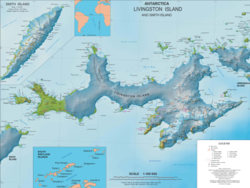
Livingston Island (Russian name Smolensk, 62°36′S 60°30′W / 62.600°S 60.500°W) is an Antarctic island in the Southern Ocean, part of the South Shetlands Archipelago, a group of Antarctic islands north of the Antarctic Peninsula. It was the first land discovered south of 60° south latitude in 1819, a historic event that marked the end of a centuries-long pursuit of the mythical Terra Australis Incognita and the beginning of the exploration and utilization of real Antarctica. The name Livingston, although of unknown derivation, has been well established in international usage since the early 1820s.
Livingston Island is situated in West Antarctica, 110 km (68 mi) northwest of Cape Roquemaurel on the Antarctic mainland, 809 km (503 mi) south-southeast of Cape Horn in South America, 796 km (495 mi) southeast of the Diego Ramírez Islands (the southernmost land of South America), 1,063 km (661 mi) due south of the Falkland Islands, 1,571 km (976 mi) southwest of South Georgia Islands, and 3,040 km (1,889 mi) from the South Pole.
The island is part of the South Shetlands archipelago, an islands chain extending 510 km (317 mi) in east-northeast to west-southwest direction, and separated from the nearby Antarctic Peninsula by Bransfield Strait, and from South America by the Drake Passage. The South Shetlands cover a total land area of 3,687 km2 or 1,424 sq mi (late 20th-century estimate; the current figure might be somewhat less than that due to coastal change), comprising (from east to west) the eleven principal islands of Clarence, Elephant, King George, Nelson, Robert, Greenwich, Livingston, Deception, Snow, Low and Smith, and a number of minor islands, islets and rocks.
Livingston is separated from neighbouring Greenwich Island to the east by the 3.3 km-wide (2.1 mi) McFarlane Strait, and from Snow Island to the west-southwest by the 5.9 km-wide (3.7 mi) Morton Strait. Deception Island, situated in Bransfield Strait barely 18 km (11.2 mi) southwest of Livingston's Barnard Point, is an active volcano last erupting in 1967, 1969 and 1970 whose flooded caldera forms the 9.8 km (6 mi) by 6.8 km (4 mi) sheltered harbour of Port Foster entered by a single 540 metres (590 yards) wide passage known as Neptune's Bellows. There are several extinct volcanoes on Livingston Island itself that were active in the Quaternary, such as Rezen Knoll, Gleaner Heights, Edinburgh Hill and Inott Point.
The island extends 73 km (45 mi) from Start Point in the west to Renier Point in the east, its width varying from 5 km (3.1 mi) at the neck between South Bay and Hero Bay to 36 km (22 mi) between Botev Point to the south and Williams Point to the north. Livingston is the second largest island in the archipelago after King George, with surface area of 798 km2 or 308 sq mi (early 21st-century estimate; the current figure might be somewhat smaller due to coastal change).
The coastline is irregular, with major indentations such as South Bay, False Bay, Moon Bay, Hero, Barclay, New Plymouth, Osogovo and Walker, and peninsulas such as Hurd (10 km or 6.2 mi long), Rozhen (9 km or 5.6 mi), Burgas (10.5 km or 6.5 mi), Varna (13 km or 8.1 mi), Ioannes Paulus II (12.8 km or 8.0 mi) and Byers (15 km or 9.3 mi). There are many islets and rocks lying in the surrounding waters, particularly off the north coast. More sizable among the adjacent minor islands are Rugged Island off Byers Peninsula, Half Moon Island in Moon Bay, Desolation Island in Hero Bay, and Zed Islands off Williams Point.
Ice cliffs, often withdrawing during recent decades to uncover new coves, beaches, spits, points and minor islands, form most of the coastline. Except for the ice-free Byers Peninsula and some isolated patches, the land surface is covered by an ice cap with ice domes and plateaus in the central and western areas, and a number of valley glaciers formed by the more mountainous relief of eastern Livingston. Certain areas of the ice cap, especially near glacier termini or over steeper slopes, are densely crevassed and almost inaccessible without specialized equipment. Elsewhere, the surface is smooth, hard and comfortable for walking, skiing or snowmobiling. However, the danger of falling into some hidden crevasse masked by a snow bridge is ever-present, including in frequently visited and supposedly well-known localities. Protracted periods of warmer weather tend to make the snow bridges more unstable and hazardous.
Typical of the island's glaciology are the conspicuous ash layers originating from volcanic activity on neighbouring Deception Island. The island hosts also several rock glaciers consisting of rock debris frozen in ice, such as those at Nusha Hill, MacKay Peak and Renier Point.
Livingston Island
Livingston Island (Russian name Smolensk, 62°36′S 60°30′W / 62.600°S 60.500°W) is an Antarctic island in the Southern Ocean, part of the South Shetlands Archipelago, a group of Antarctic islands north of the Antarctic Peninsula. It was the first land discovered south of 60° south latitude in 1819, a historic event that marked the end of a centuries-long pursuit of the mythical Terra Australis Incognita and the beginning of the exploration and utilization of real Antarctica. The name Livingston, although of unknown derivation, has been well established in international usage since the early 1820s.
Livingston Island is situated in West Antarctica, 110 km (68 mi) northwest of Cape Roquemaurel on the Antarctic mainland, 809 km (503 mi) south-southeast of Cape Horn in South America, 796 km (495 mi) southeast of the Diego Ramírez Islands (the southernmost land of South America), 1,063 km (661 mi) due south of the Falkland Islands, 1,571 km (976 mi) southwest of South Georgia Islands, and 3,040 km (1,889 mi) from the South Pole.
The island is part of the South Shetlands archipelago, an islands chain extending 510 km (317 mi) in east-northeast to west-southwest direction, and separated from the nearby Antarctic Peninsula by Bransfield Strait, and from South America by the Drake Passage. The South Shetlands cover a total land area of 3,687 km2 or 1,424 sq mi (late 20th-century estimate; the current figure might be somewhat less than that due to coastal change), comprising (from east to west) the eleven principal islands of Clarence, Elephant, King George, Nelson, Robert, Greenwich, Livingston, Deception, Snow, Low and Smith, and a number of minor islands, islets and rocks.
Livingston is separated from neighbouring Greenwich Island to the east by the 3.3 km-wide (2.1 mi) McFarlane Strait, and from Snow Island to the west-southwest by the 5.9 km-wide (3.7 mi) Morton Strait. Deception Island, situated in Bransfield Strait barely 18 km (11.2 mi) southwest of Livingston's Barnard Point, is an active volcano last erupting in 1967, 1969 and 1970 whose flooded caldera forms the 9.8 km (6 mi) by 6.8 km (4 mi) sheltered harbour of Port Foster entered by a single 540 metres (590 yards) wide passage known as Neptune's Bellows. There are several extinct volcanoes on Livingston Island itself that were active in the Quaternary, such as Rezen Knoll, Gleaner Heights, Edinburgh Hill and Inott Point.
The island extends 73 km (45 mi) from Start Point in the west to Renier Point in the east, its width varying from 5 km (3.1 mi) at the neck between South Bay and Hero Bay to 36 km (22 mi) between Botev Point to the south and Williams Point to the north. Livingston is the second largest island in the archipelago after King George, with surface area of 798 km2 or 308 sq mi (early 21st-century estimate; the current figure might be somewhat smaller due to coastal change).
The coastline is irregular, with major indentations such as South Bay, False Bay, Moon Bay, Hero, Barclay, New Plymouth, Osogovo and Walker, and peninsulas such as Hurd (10 km or 6.2 mi long), Rozhen (9 km or 5.6 mi), Burgas (10.5 km or 6.5 mi), Varna (13 km or 8.1 mi), Ioannes Paulus II (12.8 km or 8.0 mi) and Byers (15 km or 9.3 mi). There are many islets and rocks lying in the surrounding waters, particularly off the north coast. More sizable among the adjacent minor islands are Rugged Island off Byers Peninsula, Half Moon Island in Moon Bay, Desolation Island in Hero Bay, and Zed Islands off Williams Point.
Ice cliffs, often withdrawing during recent decades to uncover new coves, beaches, spits, points and minor islands, form most of the coastline. Except for the ice-free Byers Peninsula and some isolated patches, the land surface is covered by an ice cap with ice domes and plateaus in the central and western areas, and a number of valley glaciers formed by the more mountainous relief of eastern Livingston. Certain areas of the ice cap, especially near glacier termini or over steeper slopes, are densely crevassed and almost inaccessible without specialized equipment. Elsewhere, the surface is smooth, hard and comfortable for walking, skiing or snowmobiling. However, the danger of falling into some hidden crevasse masked by a snow bridge is ever-present, including in frequently visited and supposedly well-known localities. Protracted periods of warmer weather tend to make the snow bridges more unstable and hazardous.
Typical of the island's glaciology are the conspicuous ash layers originating from volcanic activity on neighbouring Deception Island. The island hosts also several rock glaciers consisting of rock debris frozen in ice, such as those at Nusha Hill, MacKay Peak and Renier Point.
Recent media
Recent media