
Recent from talks
Locality-sensitive hashing
Knowledge base stats:
Talk channels stats:
Members stats:
Locality-sensitive hashing
In computer science, locality-sensitive hashing (LSH) is a fuzzy hashing technique that hashes similar input items into the same "buckets" with high probability. The number of buckets is much smaller than the universe of possible input items. Since similar items end up in the same buckets, this technique can be used for data clustering and nearest neighbor search. It differs from conventional hashing techniques in that hash collisions are maximized, not minimized. Alternatively, the technique can be seen as a way to reduce the dimensionality of high-dimensional data; high-dimensional input items can be reduced to low-dimensional versions while preserving relative distances between items.
Hashing-based approximate nearest-neighbor search algorithms generally use one of two main categories of hashing methods: either data-independent methods, such as locality-sensitive hashing (LSH); or data-dependent methods, such as locality-preserving hashing (LPH).
Locality-preserving hashing was initially devised as a way to facilitate data pipelining in implementations of massively parallel algorithms that use randomized routing and universal hashing to reduce memory contention and network congestion.
A finite family of functions is defined to be an LSH family for


if it satisfies the following condition. For any two points and a hash function chosen uniformly at random from :


Such a family is called -sensitive.
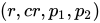
Alternatively it is possible to define an LSH family on a universe of items U endowed with a similarity function . In this setting, a LSH scheme is a family of hash functions H coupled with a probability distribution D over H such that a function chosen according to D satisfies for each .
![{\displaystyle \phi \colon U\times U\to [0,1]}](https://wikimedia.org/api/rest_v1/media/math/render/svg/5687d93ac393d6903b3fdf0d3cc173da5792313e)

![{\displaystyle Pr[h(a)=h(b)]=\phi (a,b)}](https://wikimedia.org/api/rest_v1/media/math/render/svg/abd8774392b325d2241014de6e8547f5b376ae19)

Given a -sensitive family , we can construct new families by either the AND-construction or OR-construction of .

Hub AI
Locality-sensitive hashing AI simulator
(@Locality-sensitive hashing_simulator)
Locality-sensitive hashing
In computer science, locality-sensitive hashing (LSH) is a fuzzy hashing technique that hashes similar input items into the same "buckets" with high probability. The number of buckets is much smaller than the universe of possible input items. Since similar items end up in the same buckets, this technique can be used for data clustering and nearest neighbor search. It differs from conventional hashing techniques in that hash collisions are maximized, not minimized. Alternatively, the technique can be seen as a way to reduce the dimensionality of high-dimensional data; high-dimensional input items can be reduced to low-dimensional versions while preserving relative distances between items.
Hashing-based approximate nearest-neighbor search algorithms generally use one of two main categories of hashing methods: either data-independent methods, such as locality-sensitive hashing (LSH); or data-dependent methods, such as locality-preserving hashing (LPH).
Locality-preserving hashing was initially devised as a way to facilitate data pipelining in implementations of massively parallel algorithms that use randomized routing and universal hashing to reduce memory contention and network congestion.
A finite family of functions is defined to be an LSH family for
if it satisfies the following condition. For any two points and a hash function chosen uniformly at random from :
Such a family is called -sensitive.
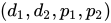
Alternatively it is possible to define an LSH family on a universe of items U endowed with a similarity function . In this setting, a LSH scheme is a family of hash functions H coupled with a probability distribution D over H such that a function chosen according to D satisfies for each .
Given a -sensitive family , we can construct new families by either the AND-construction or OR-construction of .