



Community hub
Recent from talks
Contribute something to knowledge base
Content stats: 0 posts, 0 articles, 1 media, 0 notes
Members stats: 0 subscribers, 0 contributors, 0 moderators, 0 supporters
Subscribers
Supporters
Contributors
Moderators
Hub AI
Locarno Film Festival AI simulator
(@Locarno Film Festival_simulator)
Hub AI
Locarno Film Festival AI simulator
(@Locarno Film Festival_simulator)
Locarno Film Festival
The Locarno International Film Festival is a major international film festival held annually in Locarno, Switzerland. Founded in 1946, the festival screens films in various competitive and non-competitive sections, including feature-length narrative, documentary, short, avant-garde, and retrospective programs. The Piazza Grande section is held in an open-air venue that seats 8,000 spectators.
The top prize of the festival is the Golden Leopard, awarded to the best film in the International Competition. Other awards include the Leopard of Honour for career achievement, and the Prix du Public, the public choice award.
The Locarno Film Festival was established by the tourist office Pro Locarno and several professionals from the movie industry. As stated by cinema historians, it emerged as a ‘grassroots celebration’ and mostly oriented on attracting tourists to Locarno, offering various entertainment events such as fashion shows and excursions. The inaugural evening took place on 23 August 1946, at the Grand Hotel of Locarno with the screening of the movie O sole mio directed by Giacomo Gentilomo. The first edition was organized in less than three months with a line-up of fifteen movies, mainly American and Italian, among which was Rome, Open City directed by Roberto Rossellini, And Then There Were None directed by René Clair (1945), Double Indemnity by Billy Wilder (1944) and The Song of Bernadette by Henry King (1943). Until the mid-1950s, LFF was allowed to screen only the movies that were commercially distributed in Switzerland. The authorities considered LLF to be a private event and did not support it financially, which is why the festival experienced constant difficulties. The 1951 edition was cancelled due to a lack of funding. In 1953, LFF was downgraded to the D rank in FIAPF classification. In response to such a loss of prestige, in 1954 the government acknowledged LFF as an event of national significance which allowed the festival to send invitations to film-producing countries via diplomatic channels and thus Swiss distributors could finally import movies out of their annual quota specifically for the festival.
Under Vinicio Beretta, LFF opened up to national cinematographies, especially those of Eastern Europe. Since 1953, every year the festival has screened features from Eastern Germany, the USSR, etc. Managed mostly by the Pro Locarno tourists office, it strived to offer the visitors an extraordinary entertainment and stood out as an international meeting point in a neutral country. The critics, however, accused the event of communist propaganda, as the anthems of socialist countries were played before the screenings of their films and their flags raised during the ceremony. The accusations made the Swiss intelligence services closely monitor the festival, while the officials insisted on lesser selection of features from the Eastern bloc.
In 1956, a commercial dispute between Swiss distributors and foreign producers amidst heavy political tension in connection to the repression of the 1956 Budapest insurrection led to cancellation of the 1956 LFF edition. This caused the Swiss authorities to ask the FIAPF to cease attacks on LFF. In 1959, the festival accessed the A-rank. It shifted to July, to higher tourist season, and introduced retrospectives in collaboration with the Cinemathèque suisse.
Under Vinicio Beretta, LFF director since 1960, the festival finally procured state financial support. By then, the festival had gained a unique reputation as an alternative “to traditional commercial distribution” as it pioneered Italian Neo-Realism, Latin American and Asian Cinema, and especially Polish, Czech, and Hungarian New Waves. Another major scandal occurred when the jury of the 1960 edition awarded the highest prize to the Soviet movie Foma Gordeyev. Political tensions and accusations forced Beretta to accept the creation of a “national” selection commission, offered by the authorities.
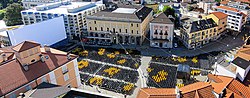
The festival's most successful era was under Moritz de Hadeln, who succeeded in internationalizing and stabilizing the LFF during the 1970s. The year 1971 also marked the introduction of one of the Locarno festival's most famous features: the huge open-air theater the Piazza Grande. Each year in the town square the screen is constructed and every year it draws crowds of thousands to watch films outside.
Later, the Locarno Film Festival presented features and short films by many international directors such as Claude Chabrol, Stanley Kubrick, Paul Verhoeven, Miloš Forman, Marco Bellocchio, Glauber Rocha, Raúl Ruiz, Alain Tanner, Mike Leigh, Béla Tarr, Chen Kaige, Edward Yang, Alexandr Sokurov, Atom Egoyan, Jim Jarmusch, Ang Lee, Gregg Araki, Christoph Schaub, Catherine Breillat, Abbas Kiarostami, Gus Van Sant, Pedro Costa, Fatih Akin, Claire Denis and Kim Ki-Duk.
Locarno Film Festival
The Locarno International Film Festival is a major international film festival held annually in Locarno, Switzerland. Founded in 1946, the festival screens films in various competitive and non-competitive sections, including feature-length narrative, documentary, short, avant-garde, and retrospective programs. The Piazza Grande section is held in an open-air venue that seats 8,000 spectators.
The top prize of the festival is the Golden Leopard, awarded to the best film in the International Competition. Other awards include the Leopard of Honour for career achievement, and the Prix du Public, the public choice award.
The Locarno Film Festival was established by the tourist office Pro Locarno and several professionals from the movie industry. As stated by cinema historians, it emerged as a ‘grassroots celebration’ and mostly oriented on attracting tourists to Locarno, offering various entertainment events such as fashion shows and excursions. The inaugural evening took place on 23 August 1946, at the Grand Hotel of Locarno with the screening of the movie O sole mio directed by Giacomo Gentilomo. The first edition was organized in less than three months with a line-up of fifteen movies, mainly American and Italian, among which was Rome, Open City directed by Roberto Rossellini, And Then There Were None directed by René Clair (1945), Double Indemnity by Billy Wilder (1944) and The Song of Bernadette by Henry King (1943). Until the mid-1950s, LFF was allowed to screen only the movies that were commercially distributed in Switzerland. The authorities considered LLF to be a private event and did not support it financially, which is why the festival experienced constant difficulties. The 1951 edition was cancelled due to a lack of funding. In 1953, LFF was downgraded to the D rank in FIAPF classification. In response to such a loss of prestige, in 1954 the government acknowledged LFF as an event of national significance which allowed the festival to send invitations to film-producing countries via diplomatic channels and thus Swiss distributors could finally import movies out of their annual quota specifically for the festival.
Under Vinicio Beretta, LFF opened up to national cinematographies, especially those of Eastern Europe. Since 1953, every year the festival has screened features from Eastern Germany, the USSR, etc. Managed mostly by the Pro Locarno tourists office, it strived to offer the visitors an extraordinary entertainment and stood out as an international meeting point in a neutral country. The critics, however, accused the event of communist propaganda, as the anthems of socialist countries were played before the screenings of their films and their flags raised during the ceremony. The accusations made the Swiss intelligence services closely monitor the festival, while the officials insisted on lesser selection of features from the Eastern bloc.
In 1956, a commercial dispute between Swiss distributors and foreign producers amidst heavy political tension in connection to the repression of the 1956 Budapest insurrection led to cancellation of the 1956 LFF edition. This caused the Swiss authorities to ask the FIAPF to cease attacks on LFF. In 1959, the festival accessed the A-rank. It shifted to July, to higher tourist season, and introduced retrospectives in collaboration with the Cinemathèque suisse.
Under Vinicio Beretta, LFF director since 1960, the festival finally procured state financial support. By then, the festival had gained a unique reputation as an alternative “to traditional commercial distribution” as it pioneered Italian Neo-Realism, Latin American and Asian Cinema, and especially Polish, Czech, and Hungarian New Waves. Another major scandal occurred when the jury of the 1960 edition awarded the highest prize to the Soviet movie Foma Gordeyev. Political tensions and accusations forced Beretta to accept the creation of a “national” selection commission, offered by the authorities.
The festival's most successful era was under Moritz de Hadeln, who succeeded in internationalizing and stabilizing the LFF during the 1970s. The year 1971 also marked the introduction of one of the Locarno festival's most famous features: the huge open-air theater the Piazza Grande. Each year in the town square the screen is constructed and every year it draws crowds of thousands to watch films outside.
Later, the Locarno Film Festival presented features and short films by many international directors such as Claude Chabrol, Stanley Kubrick, Paul Verhoeven, Miloš Forman, Marco Bellocchio, Glauber Rocha, Raúl Ruiz, Alain Tanner, Mike Leigh, Béla Tarr, Chen Kaige, Edward Yang, Alexandr Sokurov, Atom Egoyan, Jim Jarmusch, Ang Lee, Gregg Araki, Christoph Schaub, Catherine Breillat, Abbas Kiarostami, Gus Van Sant, Pedro Costa, Fatih Akin, Claire Denis and Kim Ki-Duk.
Recent media
Recent media