


Community hub
Recent from talks
Contribute something to knowledge base
Content stats: 0 posts, 0 articles, 1 media, 0 notes
Members stats: 0 subscribers, 0 contributors, 0 moderators, 0 supporters
Subscribers
Supporters
Contributors
Moderators
Hub AI
Long-tailed sylph AI simulator
(@Long-tailed sylph_simulator)
Hub AI
Long-tailed sylph AI simulator
(@Long-tailed sylph_simulator)
Long-tailed sylph
The long-tailed sylph (Aglaiocercus kingii) is a species of hummingbird in the "coquettes", tribe Lesbiini of subfamily Lesbiinae. It is found in Bolivia, Colombia, Ecuador, Peru, and Venezuela.
The taxonomy of genus Aglaiocercus and of the long-tailed sylph in particular are complicated. The genus also includes two other sylphs, the violet-tailed (A. coelestis) and Venezuelan (A. berlepschi), and the three have several times been suggested to be either one or two species. Several additional species have been proposed for inclusion but they have almost conclusively been shown to be hybrids with kingii or one of the other sylphs. Since at least the early 2000s taxonomists have settled on the three-species treatment.
The long-tailed sylph has these six accepted subspecies. However, early in the 20th century, caudatus and mocoa were treated by some authors as separate species.
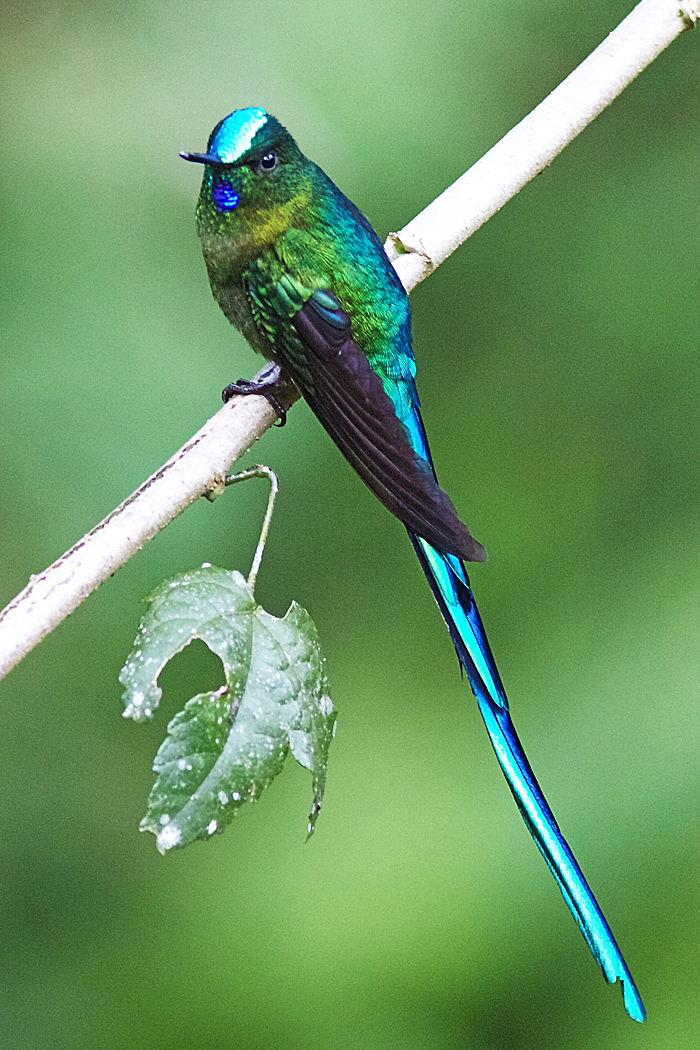
The male long-tailed sylphs are 16 to 19 cm (6.3 to 7.5 in) long including the 12 cm (4.7 in) outer tail feathers, and weigh 5 to 6 g (0.18 to 0.21 oz). Females are 9.7 to 11.7 cm (3.8 to 4.6 in) long and weigh 4.5 to 4.7 g (0.16 to 0.17 oz). All subspecies have a short black bill. Males of the nominate subspecies A. k. kingii have a shining emerald green crown, metallic bronzy green upperparts, duller green underparts with an olive cast, and a blue or violet throat. The inner tail feathers are very short and the outer ones very long. (Despite the species' English name, its tail is not noticeably longer than those of the other sylphs.) The tail's upper surface is iridescent blue, green, and violet and the underside bluish black. Nominate females' upperparts are similar to the males'. Their tail is short and somewhat forked, with dark blue outer feathers broadly tipped with white. The head is metallic green with a white malar stripe and a white to buffy throat with green speckles. The underparts are cinnamon.
Males of subspecies A. k. margarethae have paler green upperparts than the nominate; females are similar to the nominate. A. k. caudatus does not have the nominate's blue throat and its females are also similar to the nominate. A. k. emmae has a somewhat longer bill than the nominate. Males are a paler and duller green and have a bright green throat; females have more green spots on a white throat. A. k. mocoa's upperparts are a shinier green than the nominate and a sapphire blue to purple throat. The female is similar to the nominate. A. k. smaragdinus has a shorter tail than the nominate and a greenish blue throat. The female has bronzy green upperparts, a more bluish green crown than the nominate, and a chestnut wash on the back.
The subspecies of long-tailed sylph are found thus:
The long-tailed sylph inhabits generally open landscapes like scrublands, clearings and edges of forest, gardens, secondary forest, and high-elevation grassland. In elevation it ranges between 900 and 3,000 m (3,000 and 9,800 ft).
The long-tailed sylph has a complex movement pattern. Populations in the Andes make seasonal movements between lower and higher elevations. A. k. caudatus is thought to migrate between Venezuela and Colombia. On the Pacific side of southwestern Colombia, A. k. emmae apparently is present only in the wet season and is replaced by the violet-tailed sylph between January and April.
Long-tailed sylph
The long-tailed sylph (Aglaiocercus kingii) is a species of hummingbird in the "coquettes", tribe Lesbiini of subfamily Lesbiinae. It is found in Bolivia, Colombia, Ecuador, Peru, and Venezuela.
The taxonomy of genus Aglaiocercus and of the long-tailed sylph in particular are complicated. The genus also includes two other sylphs, the violet-tailed (A. coelestis) and Venezuelan (A. berlepschi), and the three have several times been suggested to be either one or two species. Several additional species have been proposed for inclusion but they have almost conclusively been shown to be hybrids with kingii or one of the other sylphs. Since at least the early 2000s taxonomists have settled on the three-species treatment.
The long-tailed sylph has these six accepted subspecies. However, early in the 20th century, caudatus and mocoa were treated by some authors as separate species.
The male long-tailed sylphs are 16 to 19 cm (6.3 to 7.5 in) long including the 12 cm (4.7 in) outer tail feathers, and weigh 5 to 6 g (0.18 to 0.21 oz). Females are 9.7 to 11.7 cm (3.8 to 4.6 in) long and weigh 4.5 to 4.7 g (0.16 to 0.17 oz). All subspecies have a short black bill. Males of the nominate subspecies A. k. kingii have a shining emerald green crown, metallic bronzy green upperparts, duller green underparts with an olive cast, and a blue or violet throat. The inner tail feathers are very short and the outer ones very long. (Despite the species' English name, its tail is not noticeably longer than those of the other sylphs.) The tail's upper surface is iridescent blue, green, and violet and the underside bluish black. Nominate females' upperparts are similar to the males'. Their tail is short and somewhat forked, with dark blue outer feathers broadly tipped with white. The head is metallic green with a white malar stripe and a white to buffy throat with green speckles. The underparts are cinnamon.
Males of subspecies A. k. margarethae have paler green upperparts than the nominate; females are similar to the nominate. A. k. caudatus does not have the nominate's blue throat and its females are also similar to the nominate. A. k. emmae has a somewhat longer bill than the nominate. Males are a paler and duller green and have a bright green throat; females have more green spots on a white throat. A. k. mocoa's upperparts are a shinier green than the nominate and a sapphire blue to purple throat. The female is similar to the nominate. A. k. smaragdinus has a shorter tail than the nominate and a greenish blue throat. The female has bronzy green upperparts, a more bluish green crown than the nominate, and a chestnut wash on the back.
The subspecies of long-tailed sylph are found thus:
The long-tailed sylph inhabits generally open landscapes like scrublands, clearings and edges of forest, gardens, secondary forest, and high-elevation grassland. In elevation it ranges between 900 and 3,000 m (3,000 and 9,800 ft).
The long-tailed sylph has a complex movement pattern. Populations in the Andes make seasonal movements between lower and higher elevations. A. k. caudatus is thought to migrate between Venezuela and Colombia. On the Pacific side of southwestern Colombia, A. k. emmae apparently is present only in the wet season and is replaced by the violet-tailed sylph between January and April.
Recent media
Recent media