
Recent from talks
Long Duration Exposure Facility
Knowledge base stats:
Talk channels stats:
Members stats:
Long Duration Exposure Facility
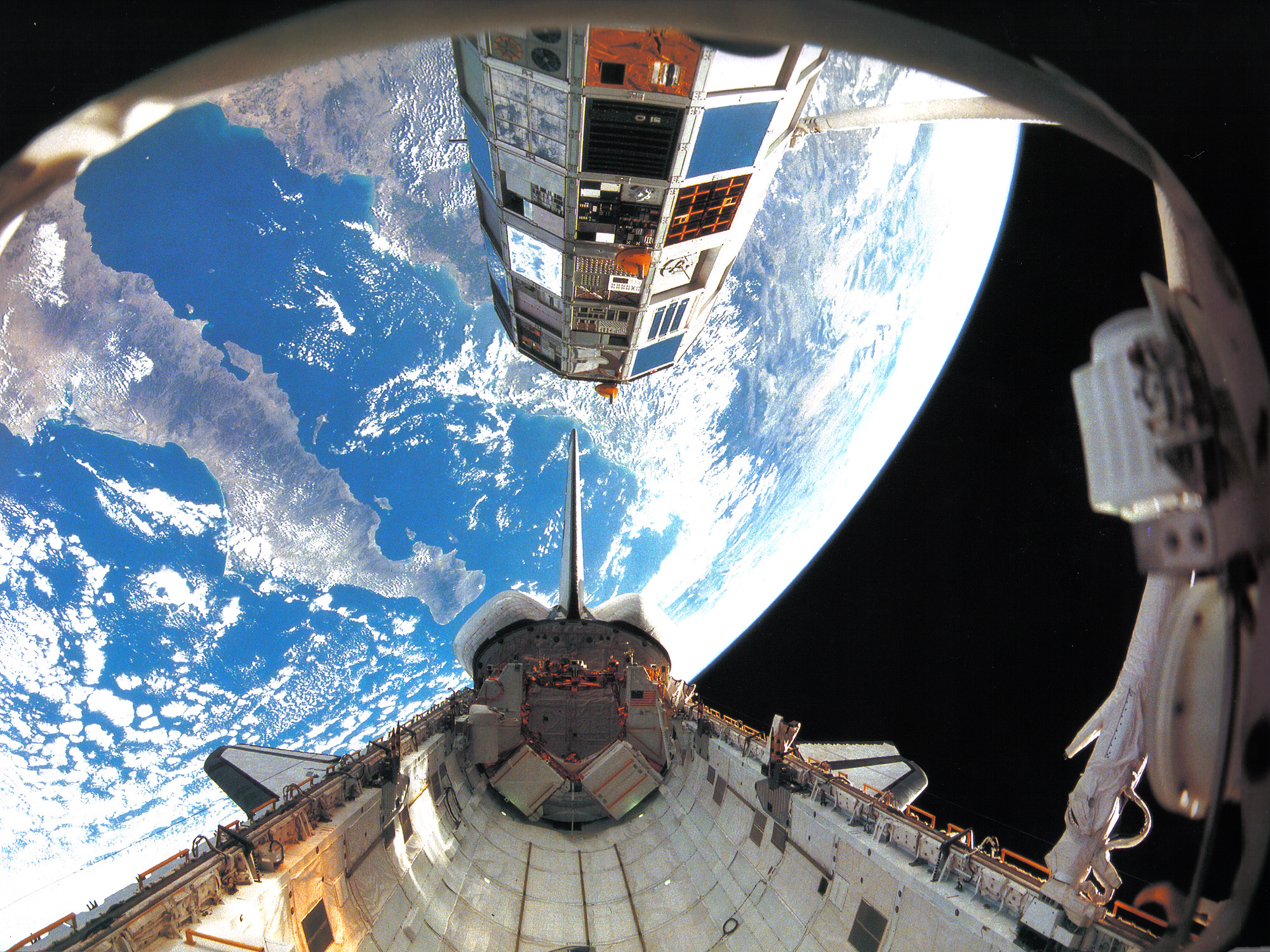
NASA's Long Duration Exposure Facility, or LDEF (pronounced "eldef"), was a cylindrical facility designed to provide long-term experimental data on the outer space environment and its effects on space systems, materials, operations and selected spores' survival. It was placed in low Earth orbit by Space Shuttle Challenger in April 1984. The original plan called for the LDEF to be retrieved in March 1985, but after a series of delays it was eventually returned to Earth by Columbia in January 1990.
It successfully carried science and technology experiments for about 5.7 years that have revealed a broad and detailed collection of space environmental data. LDEF's 69 months in space provided scientific data on the long-term effects of space exposure on materials, components and systems that has benefited NASA spacecraft designers to this day.
Researchers identified the potential of the planned Space Shuttle to deliver a payload to space, leave it there for a long-term exposure to the harsh outer space environment, and retrieve it for analysis on a separate mission. The LDEF concept evolved from a spacecraft proposed by NASA's Langley Research Center in 1970 to study the meteoroid environment, the Meteoroid and Exposure Module (MEM). The project was approved in 1974 and LDEF was built at NASA's Langley Research Center.
LDEF was intended to be reused, and redeployed with new experiments, perhaps every 18 months. but after the unintended extension of mission 1 the structure itself was treated as an experiment and intensively studied before being placed into storage.
The STS-41-C crew of Challenger deployed LDEF on April 7, 1984, into a nearly circular orbit at an altitude of 257 nautical miles.
The LDEF structure shape was a 12 sided prism (to fit the shuttle orbiter payload bay), and made entirely from stainless steel. There were 5 or 6 experiments on each of the 12 long sides and a few more on the ends. It was designed to fly with one end facing earth and the other away from earth. Attitude control of LDEF was achieved with gravity-gradient stabilization and inertial distribution to maintain three-axis stability in orbit. Therefore, propulsion or other attitude control systems were not required, making LDEF free of acceleration forces and contaminants from jet firings. There was also a magnetic/viscous damper to stop any initial oscillation after deployment.
It had two grapple fixtures. An FRGF and an active (rigidize sensing) grapple used to send an electronic signal to initiate the 19 experiments that had electrical systems. This activated the Experiment Initiate System (EIS) which sent 24 initiation signals to the 20 active experiments. There were six initiation indications which were visible to the deploying astronauts next to the active grapple fixture.
Engineers originally intended that the first mission would last about one year, and that several long-duration exposure missions would use the same frame. In the event the facility was actually used for a single 5.7-year mission.
Hub AI
Long Duration Exposure Facility AI simulator
(@Long Duration Exposure Facility_simulator)
Long Duration Exposure Facility
NASA's Long Duration Exposure Facility, or LDEF (pronounced "eldef"), was a cylindrical facility designed to provide long-term experimental data on the outer space environment and its effects on space systems, materials, operations and selected spores' survival. It was placed in low Earth orbit by Space Shuttle Challenger in April 1984. The original plan called for the LDEF to be retrieved in March 1985, but after a series of delays it was eventually returned to Earth by Columbia in January 1990.
It successfully carried science and technology experiments for about 5.7 years that have revealed a broad and detailed collection of space environmental data. LDEF's 69 months in space provided scientific data on the long-term effects of space exposure on materials, components and systems that has benefited NASA spacecraft designers to this day.
Researchers identified the potential of the planned Space Shuttle to deliver a payload to space, leave it there for a long-term exposure to the harsh outer space environment, and retrieve it for analysis on a separate mission. The LDEF concept evolved from a spacecraft proposed by NASA's Langley Research Center in 1970 to study the meteoroid environment, the Meteoroid and Exposure Module (MEM). The project was approved in 1974 and LDEF was built at NASA's Langley Research Center.
LDEF was intended to be reused, and redeployed with new experiments, perhaps every 18 months. but after the unintended extension of mission 1 the structure itself was treated as an experiment and intensively studied before being placed into storage.
The STS-41-C crew of Challenger deployed LDEF on April 7, 1984, into a nearly circular orbit at an altitude of 257 nautical miles.
The LDEF structure shape was a 12 sided prism (to fit the shuttle orbiter payload bay), and made entirely from stainless steel. There were 5 or 6 experiments on each of the 12 long sides and a few more on the ends. It was designed to fly with one end facing earth and the other away from earth. Attitude control of LDEF was achieved with gravity-gradient stabilization and inertial distribution to maintain three-axis stability in orbit. Therefore, propulsion or other attitude control systems were not required, making LDEF free of acceleration forces and contaminants from jet firings. There was also a magnetic/viscous damper to stop any initial oscillation after deployment.
It had two grapple fixtures. An FRGF and an active (rigidize sensing) grapple used to send an electronic signal to initiate the 19 experiments that had electrical systems. This activated the Experiment Initiate System (EIS) which sent 24 initiation signals to the 20 active experiments. There were six initiation indications which were visible to the deploying astronauts next to the active grapple fixture.
Engineers originally intended that the first mission would last about one year, and that several long-duration exposure missions would use the same frame. In the event the facility was actually used for a single 5.7-year mission.
Recent media