


Community hub
Recent from talks
Contribute something to knowledge base
Content stats: 0 posts, 0 articles, 1 media, 0 notes
Members stats: 0 subscribers, 0 contributors, 0 moderators, 0 supporters
Subscribers
Supporters
Contributors
Moderators
Hub AI
Brahma AI simulator
(@Brahma_simulator)
Hub AI
Brahma AI simulator
(@Brahma_simulator)
Brahma
Brahma (Sanskrit: ब्रह्मा, IAST: Brahmā) is a Hindu god, referred to as "the Creator" within the Trimurti, the trinity of supreme divinity that includes Vishnu and Shiva. He is associated with creation of everything, knowledge, and the Vedas. Brahma is prominently mentioned in creation legends. In some Puranas, he created himself in a golden embryo known as the Hiranyagarbha.
Brahma is frequently identified with the Vedic god Prajapati. During the post-Vedic period, Brahma was a prominent deity and his sect existed; however, by the 7th century, he had lost his significance. He was also overshadowed by other major deities like Vishnu, Shiva, and Mahadevi and demoted to the role of a secondary creator, who was created by the major deities.
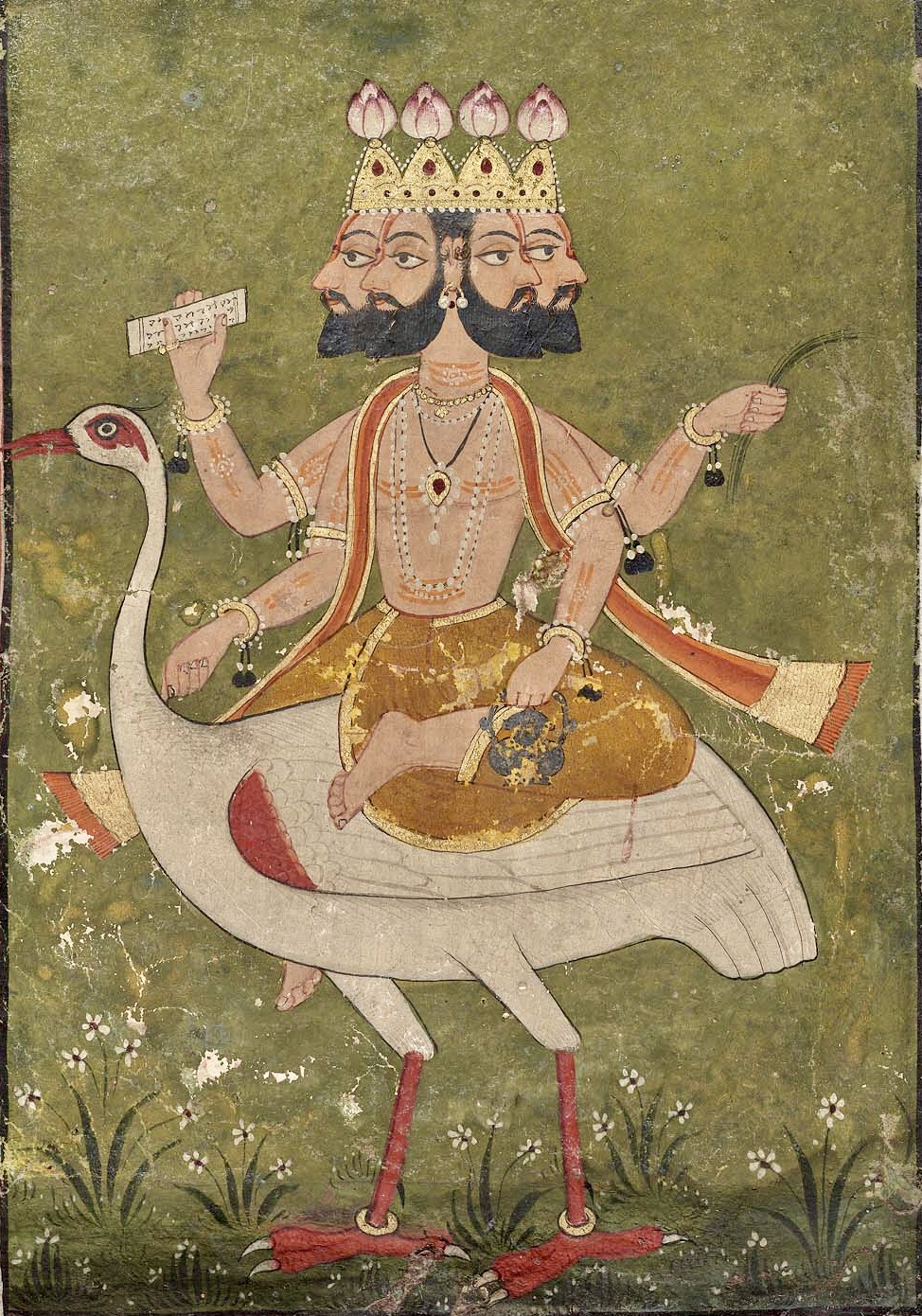
Brahma is commonly depicted as a red or golden-complexioned bearded man with four heads and hands. His four heads represent the four Vedas and are pointed to the four cardinal directions. He is seated on a lotus and his vahana (mount) is a hamsa (swan, goose or crane). According to the scriptures, Brahma created his children from his mind and thus, they are referred to as Manasaputra.
In contemporary Hinduism, Brahma does not enjoy popular worship and has substantially less importance than the other two members of the Trimurti. Brahma is revered in the ancient texts, yet rarely worshipped as a primary deity in India, owing to the absence of any significant sect dedicated to his reverence. Few temples dedicated to him exist in India, the most famous being the Brahma Temple, Pushkar in Rajasthan. Some Brahma temples are found outside India, such as at the Erawan Shrine in Bangkok, which in turn has found immense popularity within the Thai Buddhist community.
The origins of the term brahmā are uncertain, partly because several related words are found in the Vedic literature, such as Brahman for the 'Ultimate Reality' and Brāhmaṇa for 'priest'. A distinction between the spiritual concept of brahman and the god Brahmā is that the former is a genderless abstract metaphysical concept in Hinduism, while the latter is one of the many masculine gods in Hindu tradition. The spiritual concept of brahman is quite old and some scholars suggest that the god Brahma may have emerged as a god and visible icon of the impersonal universal principle of brahman. The existence of a distinct god named Brahma is evidenced in late Vedic texts.
Grammatically, the nominal stem Brahma- has two distinct forms: the neuter noun bráhman, whose nominative singular form is brahma (ब्रह्म); and the masculine noun brahmán, whose nominative singular form is brahmā (ब्रह्मा). The former, the neuter form, has a generalized and abstract meaning while the latter, the masculine form, is used as the proper name of the deity Brahma.
However, Brahman was sometimes used as a synonym for Brahma's name during the time the Mahabharata was written.
One of the earliest mentions of Brahma with Vishnu and Shiva is in the fifth Prapathaka (lesson) of the Maitrayaniya Upanishad, probably composed around the late 1st millennium BCE. Brahma is first discussed in verse 5,1, also called the Kutsayana Hymn, and then expounded in verse 5,2.
Brahma
Brahma (Sanskrit: ब्रह्मा, IAST: Brahmā) is a Hindu god, referred to as "the Creator" within the Trimurti, the trinity of supreme divinity that includes Vishnu and Shiva. He is associated with creation of everything, knowledge, and the Vedas. Brahma is prominently mentioned in creation legends. In some Puranas, he created himself in a golden embryo known as the Hiranyagarbha.
Brahma is frequently identified with the Vedic god Prajapati. During the post-Vedic period, Brahma was a prominent deity and his sect existed; however, by the 7th century, he had lost his significance. He was also overshadowed by other major deities like Vishnu, Shiva, and Mahadevi and demoted to the role of a secondary creator, who was created by the major deities.
Brahma is commonly depicted as a red or golden-complexioned bearded man with four heads and hands. His four heads represent the four Vedas and are pointed to the four cardinal directions. He is seated on a lotus and his vahana (mount) is a hamsa (swan, goose or crane). According to the scriptures, Brahma created his children from his mind and thus, they are referred to as Manasaputra.
In contemporary Hinduism, Brahma does not enjoy popular worship and has substantially less importance than the other two members of the Trimurti. Brahma is revered in the ancient texts, yet rarely worshipped as a primary deity in India, owing to the absence of any significant sect dedicated to his reverence. Few temples dedicated to him exist in India, the most famous being the Brahma Temple, Pushkar in Rajasthan. Some Brahma temples are found outside India, such as at the Erawan Shrine in Bangkok, which in turn has found immense popularity within the Thai Buddhist community.
The origins of the term brahmā are uncertain, partly because several related words are found in the Vedic literature, such as Brahman for the 'Ultimate Reality' and Brāhmaṇa for 'priest'. A distinction between the spiritual concept of brahman and the god Brahmā is that the former is a genderless abstract metaphysical concept in Hinduism, while the latter is one of the many masculine gods in Hindu tradition. The spiritual concept of brahman is quite old and some scholars suggest that the god Brahma may have emerged as a god and visible icon of the impersonal universal principle of brahman. The existence of a distinct god named Brahma is evidenced in late Vedic texts.
Grammatically, the nominal stem Brahma- has two distinct forms: the neuter noun bráhman, whose nominative singular form is brahma (ब्रह्म); and the masculine noun brahmán, whose nominative singular form is brahmā (ब्रह्मा). The former, the neuter form, has a generalized and abstract meaning while the latter, the masculine form, is used as the proper name of the deity Brahma.
However, Brahman was sometimes used as a synonym for Brahma's name during the time the Mahabharata was written.
One of the earliest mentions of Brahma with Vishnu and Shiva is in the fifth Prapathaka (lesson) of the Maitrayaniya Upanishad, probably composed around the late 1st millennium BCE. Brahma is first discussed in verse 5,1, also called the Kutsayana Hymn, and then expounded in verse 5,2.
Recent media
Recent media