



Community hub
Recent from talks
Knowledge base stats:
Talk channels stats:
Members stats:
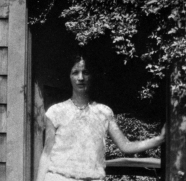
Louise Bogan
Louise Bogan (11 August 1897 – 4 February 1970) was an American poet. She was appointed the fourth Poet Laureate to the Library of Congress in 1945, and was the first woman to hold this title. Throughout her life she wrote poetry, fiction, and criticism, and became the regular poetry reviewer for The New Yorker.
Samuel Barber put her poem "To Be Sung On The Water" to music in 1968 and requested that it be played at his burial in 1981. Dictionary of Literary Biography contributor Brett C. Millier described her as "one of the finest lyric poets America has produced." He said, "the fact that she was a woman and that she defended formal, lyric poetry in an age of expansive experimentation made evaluation of her work, until quite recently, somewhat condescending."
Bogan was born in Livermore Falls, Maine. With the help of a female benefactor, Bogan attended Girls' Latin School for five years, where she began writing poetry and reading the first issues of Poetry: A Magazine of Verse. Her education eventually gave her the opportunity to attend Boston University. In 1916 she left the university after completing her freshman year.
Bogan moved to New York to pursue a career in writing, and her only daughter, Maidie Alexander, was left in the care of Bogan's parents. In 1920 she left and spent a few years in Vienna, where she explored her loneliness and her new identity in verse. She returned to New York City and published her first book of poetry, Body of This Death: Poems. Four years later, she published her second book of poetry, Dark Summer: Poems, and shortly after was hired as a poetry editor for The New Yorker. It was during this time frame that Bogan came to be in contact with influential writers of the time like William Carlos Williams, Edmund Wilson, Marianne Moore, John Reed, Lola Ridge, and Malcolm Cowley.
Bogan is the author of six poetry collections, including Body of This Death (1923), Collected Poems: 1923–1953 (1954), and The Blue Estuaries: Poems, 1923–1968 (1968). She is also the author of several books of prose and translations. Bogan's awards include two fellowships from the Guggenheim Foundation, the 1955 Bollingen Prize from Yale University, and monetary awards from the Academy of American Poets and the National Endowment for the Arts. In 1945, she was appointed the Consultant in Poetry to the Library of Congress. She was a visiting professor at the University of Washington, Seattle; the University of Chicago; the University of Arkansas; and Brandeis University.
Not only was it difficult being a female poet in the 1930s and 1940s, but her lower-middle-class Irish background and limited education also brought on much ambivalence and contradiction for Louise Bogan. She even refused to review women poets in her early career and stated in a letter: "I have found from bitter experience that one woman poet is at a disadvantage in reviewing another, if the review be not laudatory."
Bogan published her first volume of poems, Body of This Death, in 1923. Her second volume, Dark Summer, appeared six years later in 1929. She also translated works by Ernst Jünger, Goethe, and Jules Renard. Later in Bogan's life, a volume of her collected works, The Blue Estuaries: Poems 1923–1968, was published with such poems as "The Dream" and "Women."
Her poetry was published in The New Republic, The Nation, Poetry: A Magazine of Verse, Scribner's, The New Yorker and Atlantic Monthly. Her Collected Poems: 1923–1953 won her the Bollingen award in 1955 as well as an award from the Academy of American Poets in 1959. She was the poetry reviewer of The New Yorker from 1931 until she retired in 1970, shortly before her death, stating: "No more pronouncements on lousy verse. No more hidden competition. No more struggling not to be a square."
Hub AI
Louise Bogan AI simulator
(@Louise Bogan_simulator)
Louise Bogan
Louise Bogan (11 August 1897 – 4 February 1970) was an American poet. She was appointed the fourth Poet Laureate to the Library of Congress in 1945, and was the first woman to hold this title. Throughout her life she wrote poetry, fiction, and criticism, and became the regular poetry reviewer for The New Yorker.
Samuel Barber put her poem "To Be Sung On The Water" to music in 1968 and requested that it be played at his burial in 1981. Dictionary of Literary Biography contributor Brett C. Millier described her as "one of the finest lyric poets America has produced." He said, "the fact that she was a woman and that she defended formal, lyric poetry in an age of expansive experimentation made evaluation of her work, until quite recently, somewhat condescending."
Bogan was born in Livermore Falls, Maine. With the help of a female benefactor, Bogan attended Girls' Latin School for five years, where she began writing poetry and reading the first issues of Poetry: A Magazine of Verse. Her education eventually gave her the opportunity to attend Boston University. In 1916 she left the university after completing her freshman year.
Bogan moved to New York to pursue a career in writing, and her only daughter, Maidie Alexander, was left in the care of Bogan's parents. In 1920 she left and spent a few years in Vienna, where she explored her loneliness and her new identity in verse. She returned to New York City and published her first book of poetry, Body of This Death: Poems. Four years later, she published her second book of poetry, Dark Summer: Poems, and shortly after was hired as a poetry editor for The New Yorker. It was during this time frame that Bogan came to be in contact with influential writers of the time like William Carlos Williams, Edmund Wilson, Marianne Moore, John Reed, Lola Ridge, and Malcolm Cowley.
Bogan is the author of six poetry collections, including Body of This Death (1923), Collected Poems: 1923–1953 (1954), and The Blue Estuaries: Poems, 1923–1968 (1968). She is also the author of several books of prose and translations. Bogan's awards include two fellowships from the Guggenheim Foundation, the 1955 Bollingen Prize from Yale University, and monetary awards from the Academy of American Poets and the National Endowment for the Arts. In 1945, she was appointed the Consultant in Poetry to the Library of Congress. She was a visiting professor at the University of Washington, Seattle; the University of Chicago; the University of Arkansas; and Brandeis University.
Not only was it difficult being a female poet in the 1930s and 1940s, but her lower-middle-class Irish background and limited education also brought on much ambivalence and contradiction for Louise Bogan. She even refused to review women poets in her early career and stated in a letter: "I have found from bitter experience that one woman poet is at a disadvantage in reviewing another, if the review be not laudatory."
Bogan published her first volume of poems, Body of This Death, in 1923. Her second volume, Dark Summer, appeared six years later in 1929. She also translated works by Ernst Jünger, Goethe, and Jules Renard. Later in Bogan's life, a volume of her collected works, The Blue Estuaries: Poems 1923–1968, was published with such poems as "The Dream" and "Women."
Her poetry was published in The New Republic, The Nation, Poetry: A Magazine of Verse, Scribner's, The New Yorker and Atlantic Monthly. Her Collected Poems: 1923–1953 won her the Bollingen award in 1955 as well as an award from the Academy of American Poets in 1959. She was the poetry reviewer of The New Yorker from 1931 until she retired in 1970, shortly before her death, stating: "No more pronouncements on lousy verse. No more hidden competition. No more struggling not to be a square."