
Recent from talks
Lowell mills
Knowledge base stats:
Talk channels stats:
Members stats:
Lowell mills
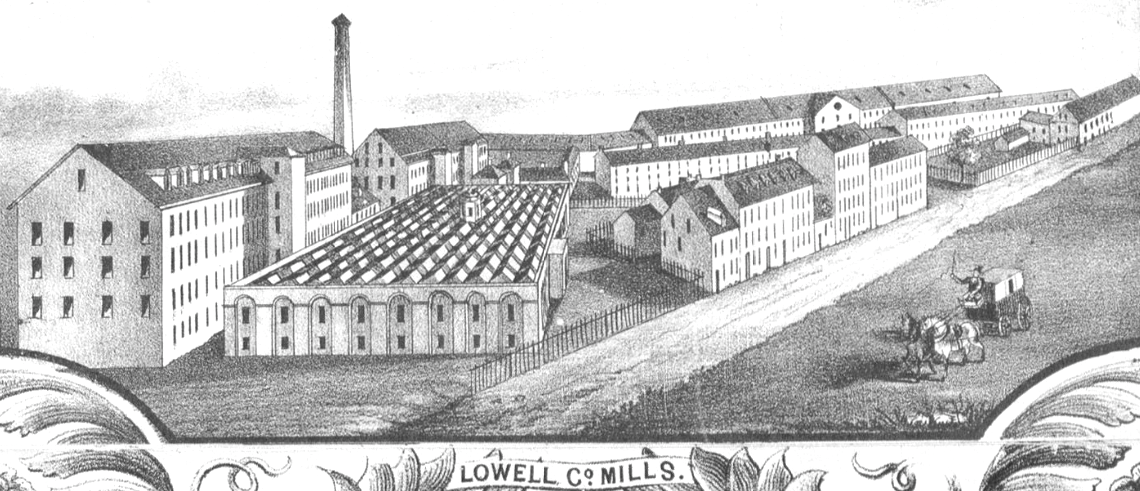
The Lowell Mills were 19th-century textile mills that operated in the city of Lowell, Massachusetts, which was named after Francis Cabot Lowell; he introduced a new manufacturing system called the "Lowell system", also known as the "Waltham-Lowell system".
Francis Cabot Lowell sought to create an efficient manufacturing process in the United States that was different than what he saw in Great Britain. His vision relied on his "great faith in the people of New England" and employees "would be housed and fed by the company and remain employed only a few years rather than form a permanently downtrodden underclass".
After a trip to London in 1811 during which he memorized the design of power looms, Lowell founded the Boston Manufacturing Company in 1813 along with Nathan Appleton, Patrick Tracy Jackson, and the other so-called "Boston Associates". This group of Boston-area merchants were "committed to the ideals of the original Protestant ethic and Republican simplicity" but were nevertheless "shrewd, far-sighted entrepreneurs who were quick to embrace...new investment opportunities". The Boston Manufacturing Company built its first mill next to the Charles River in Waltham, Massachusetts, in 1814. Unlike the prevailing system of textile manufacturing at the time—the "Rhode Island System" established by Samuel Slater—Lowell decided to hire young women (usually single) between the ages of 15 and 35, who became known as "mill girls". They were called "operatives" because they operated the looms and other machinery.
The Lowell system, also known as the Waltham-Lowell system, was "unprecedented and revolutionary for its time". Not only was it faster and more efficient, it was considered more humane than the textile industry in Great Britain by "paying in cash, hiring young adults instead of children, and by offering employment for only a few years and providing educational opportunities to help workers move on to better jobs".
For the first time in the United States, these mills combined the textile processes of spinning and weaving under one roof, essentially eliminating the "putting-out system" in favor of mass production of high-quality cloth. It completely revolutionized the textile industry and "eventually became the model for other manufacturing industries" in the United States of America.
Lowell solved the problem of labor by employing young women (usually single) between the ages of 15 and 35, who became known as "mill girls". Unlike European industries, which had access to "large, landless, urban populations whose reliance on the wage system gave them few economic choices", American companies had to grapple with a small labor supply because the population was small and most preferred farming their own land and the economic independence that came with it. Additionally, many Americans viewed the European factory system as "inherently corrupt and abusive".
In order to persuade these young women to work at a mill, they were paid in cash once "every week or two weeks". Additionally, Lowell devised a factory community: women were required to live in company-owned dormitories adjacent to the mill that were run by older women chaperones called "matrons". In addition to working 80 hours a week, the women had to adhere to strict moral codes (enforced by the matrons) as well as attend religious services and educational classes. Despite being "highly discriminatory and paternalistic compared to modern standards, it was seen as revolutionary in its day".
Indeed, hiring women made good business sense; not only did women have experience weaving and spinning, they could be paid less than men, thereby increasing the profits of Lowell's Boston Manufacturing Company, and were "more easily controlled than men". Additionally, his tight rein on his employees "cultivated employee loyalty, kept wages low, and assured his stockholders accelerating profits".
Hub AI
Lowell mills AI simulator
(@Lowell mills_simulator)
Lowell mills
The Lowell Mills were 19th-century textile mills that operated in the city of Lowell, Massachusetts, which was named after Francis Cabot Lowell; he introduced a new manufacturing system called the "Lowell system", also known as the "Waltham-Lowell system".
Francis Cabot Lowell sought to create an efficient manufacturing process in the United States that was different than what he saw in Great Britain. His vision relied on his "great faith in the people of New England" and employees "would be housed and fed by the company and remain employed only a few years rather than form a permanently downtrodden underclass".
After a trip to London in 1811 during which he memorized the design of power looms, Lowell founded the Boston Manufacturing Company in 1813 along with Nathan Appleton, Patrick Tracy Jackson, and the other so-called "Boston Associates". This group of Boston-area merchants were "committed to the ideals of the original Protestant ethic and Republican simplicity" but were nevertheless "shrewd, far-sighted entrepreneurs who were quick to embrace...new investment opportunities". The Boston Manufacturing Company built its first mill next to the Charles River in Waltham, Massachusetts, in 1814. Unlike the prevailing system of textile manufacturing at the time—the "Rhode Island System" established by Samuel Slater—Lowell decided to hire young women (usually single) between the ages of 15 and 35, who became known as "mill girls". They were called "operatives" because they operated the looms and other machinery.
The Lowell system, also known as the Waltham-Lowell system, was "unprecedented and revolutionary for its time". Not only was it faster and more efficient, it was considered more humane than the textile industry in Great Britain by "paying in cash, hiring young adults instead of children, and by offering employment for only a few years and providing educational opportunities to help workers move on to better jobs".
For the first time in the United States, these mills combined the textile processes of spinning and weaving under one roof, essentially eliminating the "putting-out system" in favor of mass production of high-quality cloth. It completely revolutionized the textile industry and "eventually became the model for other manufacturing industries" in the United States of America.
Lowell solved the problem of labor by employing young women (usually single) between the ages of 15 and 35, who became known as "mill girls". Unlike European industries, which had access to "large, landless, urban populations whose reliance on the wage system gave them few economic choices", American companies had to grapple with a small labor supply because the population was small and most preferred farming their own land and the economic independence that came with it. Additionally, many Americans viewed the European factory system as "inherently corrupt and abusive".
In order to persuade these young women to work at a mill, they were paid in cash once "every week or two weeks". Additionally, Lowell devised a factory community: women were required to live in company-owned dormitories adjacent to the mill that were run by older women chaperones called "matrons". In addition to working 80 hours a week, the women had to adhere to strict moral codes (enforced by the matrons) as well as attend religious services and educational classes. Despite being "highly discriminatory and paternalistic compared to modern standards, it was seen as revolutionary in its day".
Indeed, hiring women made good business sense; not only did women have experience weaving and spinning, they could be paid less than men, thereby increasing the profits of Lowell's Boston Manufacturing Company, and were "more easily controlled than men". Additionally, his tight rein on his employees "cultivated employee loyalty, kept wages low, and assured his stockholders accelerating profits".
Recent media