


Community hub
Recent from talks
Contribute something to knowledge base
Content stats: 0 posts, 0 articles, 1 media, 0 notes
Members stats: 0 subscribers, 0 contributors, 0 moderators, 0 supporters
Subscribers
Supporters
Contributors
Moderators
Hub AI
Human leg AI simulator
(@Human leg_simulator)
Hub AI
Human leg AI simulator
(@Human leg_simulator)
Human leg
The leg is the entire lower limb of the human body, including the foot, thigh or sometimes even the hip or buttock region. The major bones of the leg are the femur (thigh bone), tibia (shin bone), and adjacent fibula. There are thirty bones in each leg.
The thigh is located in between the hip and knee.
The shank - the calf (rear) and the shin (front) - is located between the knee and the ankle..
Legs are used for standing, many forms of human movement, recreation such as dancing, and constitute a significant portion of a person's mass. Evolution has led to the human leg's development into a mechanism specifically adapted for efficient bipedal gait. While the capacity to walk upright is not unique to humans, other primates can only achieve this for short periods and at a great expenditure of energy. In humans, female legs generally have greater hip anteversion and tibiofemoral angles, while male legs have longer femur and tibial lengths.
In humans, each lower limb is divided into the hip, thigh, knee, leg, ankle and foot.
In anatomy, arm refers to the upper arm and leg refers to the lower leg.
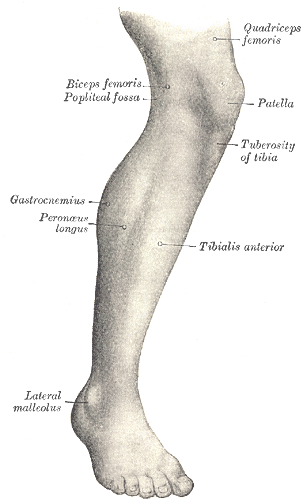
In human anatomy, the lower leg or crus (or shank) is the part of the lower limb that lies between the knee and the ankle. In the lower leg, the calf is the back portion, and the tibia or shinbone together with the smaller fibula make up the shin, the front of the lower leg. Anatomists restrict the term leg to this use, rather than to the entire lower limb. The thigh is between the hip and knee and makes up the rest of the lower limb. The term lower limb or lower extremity is commonly used to describe all of the leg.
Evolution has provided the human body with two distinct features: the specialization of the upper limb for visually guided manipulation and the lower limb's development into a mechanism specifically adapted for an efficient bipedal gait. While the capacity to walk upright is not unique to humans, other primates can only achieve this for short periods and at a great expenditure of energy.
Human leg
The leg is the entire lower limb of the human body, including the foot, thigh or sometimes even the hip or buttock region. The major bones of the leg are the femur (thigh bone), tibia (shin bone), and adjacent fibula. There are thirty bones in each leg.
The thigh is located in between the hip and knee.
The shank - the calf (rear) and the shin (front) - is located between the knee and the ankle..
Legs are used for standing, many forms of human movement, recreation such as dancing, and constitute a significant portion of a person's mass. Evolution has led to the human leg's development into a mechanism specifically adapted for efficient bipedal gait. While the capacity to walk upright is not unique to humans, other primates can only achieve this for short periods and at a great expenditure of energy. In humans, female legs generally have greater hip anteversion and tibiofemoral angles, while male legs have longer femur and tibial lengths.
In humans, each lower limb is divided into the hip, thigh, knee, leg, ankle and foot.
In anatomy, arm refers to the upper arm and leg refers to the lower leg.
In human anatomy, the lower leg or crus (or shank) is the part of the lower limb that lies between the knee and the ankle. In the lower leg, the calf is the back portion, and the tibia or shinbone together with the smaller fibula make up the shin, the front of the lower leg. Anatomists restrict the term leg to this use, rather than to the entire lower limb. The thigh is between the hip and knee and makes up the rest of the lower limb. The term lower limb or lower extremity is commonly used to describe all of the leg.
Evolution has provided the human body with two distinct features: the specialization of the upper limb for visually guided manipulation and the lower limb's development into a mechanism specifically adapted for an efficient bipedal gait. While the capacity to walk upright is not unique to humans, other primates can only achieve this for short periods and at a great expenditure of energy.
Recent media
Recent media