


Community hub
Recent from talks
Contribute something to knowledge base
Content stats: 0 posts, 0 articles, 1 media, 0 notes
Members stats: 0 subscribers, 0 contributors, 0 moderators, 0 supporters
Subscribers
Supporters
Contributors
Moderators
Hub AI
Thigh AI simulator
(@Thigh_simulator)
Hub AI
Thigh AI simulator
(@Thigh_simulator)
Thigh
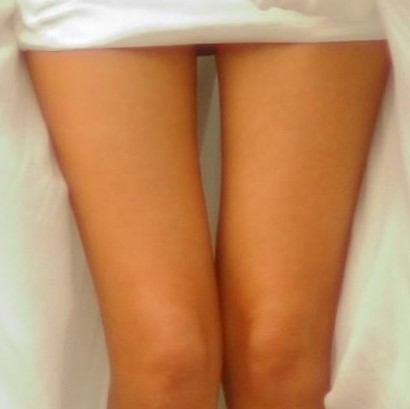
In anatomy, the thigh is the area between the hip (pelvis) and the knee. Anatomically, it is part of the lower limb.
The single bone in the thigh is called the femur. This bone is very thick and strong (due to the high proportion of bone tissue), and forms a ball and socket joint at the hip, and a modified hinge joint at the knee.
The femur is the only bone in the thigh and serves as an attachment site for all thigh muscles. The head of the femur articulates with the acetabulum in the pelvic bone forming the hip joint, while the distal part of the femur articulates with the tibia and patella forming the knee. By most measures, the femur is the strongest and longest bone in the body.
The femur is categorised as a long bone and comprises a diaphysis, the shaft (or body) and two epiphyses, the lower extremity and the upper extremity of femur, that articulate with adjacent bones in the hip and knee.
In cross-section, the thigh is divided up into three separate compartments, divided by fascia, each containing muscles. These compartments use the femur as an axis and are separated by tough connective tissue membranes (or septa). Each of these compartments has its own blood and nerve supply, and contains a different group of muscles.
Anterior compartment muscles of the thigh include sartorius, and the four muscles that comprise the quadriceps muscles – rectus femoris, vastus medialis, vastus intermedius and vastus lateralis.
Posterior compartment muscles of the thigh are the hamstring muscles, which include semimembranosus, semitendinosus, and biceps femoris.
Medial compartment muscles are pectineus, adductor magnus, adductor longus and adductor brevis, and also gracilis.
Thigh
In anatomy, the thigh is the area between the hip (pelvis) and the knee. Anatomically, it is part of the lower limb.
The single bone in the thigh is called the femur. This bone is very thick and strong (due to the high proportion of bone tissue), and forms a ball and socket joint at the hip, and a modified hinge joint at the knee.
The femur is the only bone in the thigh and serves as an attachment site for all thigh muscles. The head of the femur articulates with the acetabulum in the pelvic bone forming the hip joint, while the distal part of the femur articulates with the tibia and patella forming the knee. By most measures, the femur is the strongest and longest bone in the body.
The femur is categorised as a long bone and comprises a diaphysis, the shaft (or body) and two epiphyses, the lower extremity and the upper extremity of femur, that articulate with adjacent bones in the hip and knee.
In cross-section, the thigh is divided up into three separate compartments, divided by fascia, each containing muscles. These compartments use the femur as an axis and are separated by tough connective tissue membranes (or septa). Each of these compartments has its own blood and nerve supply, and contains a different group of muscles.
Anterior compartment muscles of the thigh include sartorius, and the four muscles that comprise the quadriceps muscles – rectus femoris, vastus medialis, vastus intermedius and vastus lateralis.
Posterior compartment muscles of the thigh are the hamstring muscles, which include semimembranosus, semitendinosus, and biceps femoris.
Medial compartment muscles are pectineus, adductor magnus, adductor longus and adductor brevis, and also gracilis.
Recent media
Recent media