Hubbry Logo
Luisa FeridaLuisa FeridaMain
Open search
Luisa Ferida
Community hub
Luisa Ferida
logo
8 pages, 0 posts
0 subscribers
Be the first to start a discussion here.
Luisa Ferida
Luisa Ferida
from Wikipedia

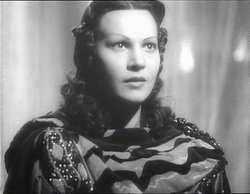
Luisa Ferida, real surname Manfrini (18 March 1914 – 30 April 1945), was an Italian stage and film actress. She was considered a diva in Italian cinema during 1935 to 1945 and was the highest paid movie star of that period.[1] Ferida is remembered for her death; immediately after the end of the Italian Civil War, she was executed together with her lover, the actor and member of Decima Flottiglia MAS Osvaldo Valenti, as both were judged guilty of participation in war crimes and torture in connection with so-called Koch gang. Years later she was deemed uninvolved to the Koch's crimes. Therefore a war pension was allocated to the mother, who had no other source of income.[2]

Key Information

Career

[edit]

Born Luisa Manfrini Farnet in Castel San Pietro Terme, near Bologna, Ferida started as a stage actress. In 1935 she made her first appearance in film with a supporting role in La Freccia d'oro. Because of her photogenic looks and talent as an actress, she soon graduated to leading roles by the end of the 1930s.

In 1939, while working on Un Avventura di Salvator Rosa (1940), directed by Alessandro Blasetti, she met the actor Osvaldo Valenti. The pair became romantically involved and had a son.

Death

[edit]

Ferida's romantic partner, Valenti had been linked to many fascist officials and people for years and he eventually joined the Italian Social Republic, and for this reason he was on the Italian resistance movement's (partisan's) hit list. In April 1945, Valenti was arrested in Milan, alongside a pregnant Ferida. They were both sentenced to death and were summarily executed in the street without any proper trial by partisans. The partisan chief who organized the execution, Giuseppe "Vero" Marozin, during a trial by Milano's tribunal, defended himself declaring that the partisan leader who by telephone ordered the two actors be executed was Sandro Pertini, who during the year 1978 became president of the Italian republic: this version is confirmed by Treccani.[3]

Cultural references

[edit]

Partial filmography

[edit]

References

[edit]
[edit]
Revisions and contributorsEdit on WikipediaRead on Wikipedia
from Grokipedia
''Luisa Ferida'' is an Italian stage and film actress known for her leading roles in Italian cinema during the late 1930s and early 1940s, as well as her tragic execution at the hands of partisans at the end of World War II. Born Luigia Manfrini on March 18, 1914, in Castel San Pietro Terme, she began her career in theater before making her screen debut in La Freccia d'oro (1935) and quickly rising to prominence as a popular leading lady. Her career highlights include performances in films such as Un'avventura di Salvator Rosa (1940) and La corona di ferro (1941) directed by Alessandro Blasetti, as well as Fari nella nebbia (1942), Fedora (1942), and La locandiera (1944). Ferida formed a successful on-screen partnership with actor Amedeo Nazzari in the late 1930s and later became romantically involved with Osvaldo Valenti, beginning on the set of Un'avventura di Salvator Rosa. During the final years of the war, Ferida and Valenti relocated to the Cinevillaggio film production center under the Italian Social Republic. On April 30, 1945, while pregnant, she was arrested in Milan and executed by firing squad alongside Valenti following a summary trial accusing them of collaborationism and involvement in torturing partisans. A subsequent investigation by the Carabinieri concluded that Ferida had no involvement in political violence or acts against the partisan movement. Her story has been depicted in the 2008 film Sanguepazzo (released internationally as Wild Blood).

Early life

Childhood and family background

Luisa Ferida was born Luigia Manfrini Frané on 18 March 1914 in Castel San Pietro Terme, a town in the province of Bologna within Italy's Emilia-Romagna region. Her birth name appears with slight variations across records, including Luigia Manfrini Farnè and Luisa Manfrini Farnet. Her father, Luigi Manfrini, was a landowner; he died during her childhood. Following his early death, she was sent to a convent boarding school for her education, though she did not complete her studies there. Described as a restless child from a family rooted in the Emilia-Romagna area, these early hardships contributed to her later pursuit of an independent path.

Education and entry into theater

After the death of her father, Luisa Ferida was sent to study in a boarding school run by nuns, though she did not complete her studies. Remembered as a restless young girl, she had her first acting experiences in the institute's amateur dramatics group (filodrammatica dell'istituto), marking the beginning of her interest in performance. She entered professional theater when she was hired by prestigious companies, including those led by Ruggero Ruggeri and Paola Borboni, initially taking small parts that allowed her to gain stage experience and recognition. These early engagements with notable companies provided her with foundational training and helped shape her dramatic temperament through practical involvement in live performances. Her success on stage led to a natural transition into cinema in 1935.

Film career

Debut and early roles (1935–1939)

Luisa Ferida made her screen debut in 1935 with a supporting role as Evelyn in the crime film La Freccia d'oro (Golden Arrow), directed by Piero Ballerini and Corrado D'Errico. She started her cinematic career after working as a stage actress, and her photogenic looks and acting talent enabled her to progress rapidly from supporting parts to more prominent roles by the end of the decade. During this early period, Ferida appeared in a series of films that showcased her growing presence in Italian cinema, including Il re Burlone (1935), Lo smemorato (1936), Amazzoni bianche (1936), La fossa degli angeli (1937), and Animali pazzi (1939). She shared the screen with actor Amedeo Nazzari in La fossa degli angeli and I fratelli Castiglioni, contributing to her visibility in the industry through these on-screen pairings. Her early work highlighted her appeal and versatility in supporting and emerging leading roles within the Italian film industry of the late 1930s. In 1939, while working on Un'avventura di Salvator Rosa, she first met Osvaldo Valenti, marking a professional encounter that would later become significant.

Breakthrough and peak stardom (1940–1943)

Luisa Ferida achieved her major breakthrough in 1940 with the historical adventure film Un'avventura di Salvator Rosa, directed by Alessandro Blasetti, where she portrayed Lucrezia, a courageous and sincere peasant girl who fights for the rights of the people and wins the love of the painter Salvator Rosa. This role brought her significant critical and public affirmation, allowing her to stand out alongside established actors such as Gino Cervi and Rina Morelli in a successful example of Italian "cappa e spada" cinema. She consolidated her rising status the following year with another collaboration with Blasetti in La corona di ferro (1941), playing the fierce warrior princess Tundra, a character who avenges wrongs done to her family and appears in male attire throughout much of the film. The film won the Coppa Mussolini as best Italian film at the Venice Film Festival, further elevating her profile as a leading actress in prestigious productions. The year 1942 represented the peak of Ferida's stardom, with a series of acclaimed roles that showcased her range from tragic and dramatic parts to more complex characterizations. She delivered a memorable performance as the proud and grieving Agrippina in Gelosia, directed by Ferdinando Maria Poggioli and adapted from Luigi Capuana's novel. In Fedora, directed by Camillo Mastrocinque and based on Victorien Sardou's play, she interpreted the demanding tragic title role with notable ease and depth. Her work in Fari nella nebbia, directed by Gianni Franciolini, stood out as one of her finest, portraying a melancholic victim in a modern petit-bourgeois love triangle opposite Fosco Giachetti; for this role she received the award as best Italian actress of the year. She also appeared in the popular historical film La cena delle beffe, directed by Blasetti, as well as in La bella addormentata, where she played a character seduced and abandoned. Ferida frequently shared the screen with Osvaldo Valenti during this period, forming one of the most prominent on-screen couples in Italian cinema and appearing together in several key films of the era. She was regarded as one of the highest-paid and most popular stars working in Cinecittà at the time, reflecting her diva status in late-1930s and early-1940s Italian film. This phase is considered the most inspired and artistically mature of her career.

Final films and wartime production (1944–1945)

After the armistice of September 1943 and the establishment of the Italian Social Republic, part of the Italian film industry relocated to the Cinevillaggio studios in Venice, where production continued under the new regime's auspices. Luisa Ferida and Osvaldo Valenti moved to Venice in 1944 to work at this facility, becoming among the few prominent stars who continued filming there during the final phase of the war. Ferida's final films were produced in this Venice-based context. She starred in La locandiera (1944), directed by Luigi Chiarini, an adaptation of Carlo Goldoni's play in which she played the lead role of the innkeeper Mirandolina, appearing alongside Valenti. Her last completed role came in Fatto di cronaca (1945), directed by Piero Ballerini, again co-starring Valenti. This marked the end of her screen work amid the wartime disruptions.

Personal life

Romantic relationships and family

She later gave birth to a son named Kim Valenti in 1942, who died five days after birth from asphyxia. In 1944, she experienced a spontaneous abortion. Her primary long-term relationship was with Osvaldo Valenti.

Partnership with Osvaldo Valenti

Luisa Ferida began a long-term romantic partnership with fellow actor Osvaldo Valenti after they met on the set of Alessandro Blasetti's historical adventure film Un'avventura di Salvator Rosa (1940). The pair quickly became romantically involved and remained inseparable in both their personal lives and professional careers, cohabiting for the duration of their relationship. Ferida and Valenti frequently collaborated on screen during the early 1940s, appearing together in several notable films. These included Fedora (1942) and La locandiera (1944), among others, reflecting their close professional and personal bond. Their partnership was marked by shared projects and a glamorous lifestyle typical of leading figures in Italian cinema at the time. At the time of her death in April 1945, Ferida was in the fourth month of pregnancy with the couple's child.

Wartime involvement

Move to the Italian Social Republic

After the armistice of Cassibile on 8 September 1943, Luisa Ferida and Osvaldo Valenti left Rome and relocated to the territory of the Italian Social Republic (RSI), moving to Venice where the regime had established Cinevillaggio as a center for film production in the north. This relocation allowed film industry personnel aligned with the RSI to continue professional activities away from Allied-occupied areas. In 1944 Valenti enlisted in the Xª Flottiglia MAS, attaining the rank of lieutenant and serving in a liaison capacity. Ferida accompanied him but held no formal military or political role in the RSI, with no documented evidence of her direct participation in such activities. The couple continued their involvement in film-related work in northern Italy during this period. Their association with the RSI later gave rise to accusations of collaboration.

Accusations of association with the Banda Koch

Luisa Ferida was accused of having collaborated with the Banda Koch, the special police unit led by Pietro Koch that carried out arrests, interrogations, and tortures at Villa Triste in Milan during the Italian Social Republic period. Some testimonies from survivors, including Carlo Corbella (known as El Medaja), indicated that Ferida stayed at Villa Triste for a period (approximately 15 days) and was aware of the tortures and cruelties but kept away from them. These accusations have been widely contested. Historical accounts indicate that the claims likely originated from the actions of other women in the Banda Koch—particularly Dusnella (Daisy) Marchi (Koch's lover) and Alba Giusti Cimini—who physically resembled Ferida and deliberately impersonated her to deceive prisoners in the dim cells of Villa Triste. This mistaken identity is cited as the source of many postwar calumnies against Ferida. Postwar analyses and an official investigation by the Carabinieri in the 1950s found no conclusive evidence of Ferida's direct participation in the Banda Koch's crimes or any acts of violence against partisans, concluding that she remained extraneous to political violence after 8 September 1943. The accusations against her are therefore considered disputed and largely unproven by historians. Ferida and Valenti were among those targeted following the collapse of the Republic of Salò.

Execution

Arrest and summary execution in Milan

In April 1945, as Allied forces advanced and the Italian Social Republic collapsed, Luisa Ferida and Osvaldo Valenti were arrested in Milan by partisans amid accusations of their involvement with fascist institutions, including the Decima Mas and Villa Triste, headquarters of the Banda Koch. Osvaldo Valenti turned himself in to Giuseppe "Vero" Marozin, commander of the Pasubio Brigade, in an effort to prove his innocence, and Ferida soon joined him in custody. Marozin initially attempted to arrange a prisoner exchange with German forces but was unsuccessful. The couple underwent a summary process without a formal legal trial or proper judicial procedure, leading to a death sentence. On the night leading into 30 April 1945, they were transported to via Poliziano in Milan, near the Ippodromo di San Siro, where partisans of the Pasubio Brigade executed them by firing squad. Ferida, who was four months pregnant, was killed while holding a blue woollen shoe belonging to her deceased infant son Kim, kept as a personal memento. Their bodies were discovered on the outskirts of Milan at dawn on 30 April 1945.

Circumstances and immediate aftermath

Following the execution of Luisa Ferida and Osvaldo Valenti on 30 April 1945, their bodies were buried in Campo 10 (also denoted as Campo X) of the Cimitero Maggiore di Milano, commonly known as the Musocco cemetery. The burial occurred under Ferida's real name, Luisa Manfrini, with the shared gravestone recording the date of death as 30 April 1945 for both. In the immediate aftermath, partisans inscribed accusatory messages on the bodies before disposal, labeling Ferida as "Giustiziata perché collaboratrice del seviziatore Osvaldo Valenti" and Valenti as having been "giustiziato" by the Pasubio partisan division. Their Milan apartment was also looted by partisans shortly thereafter. During subsequent criminal proceedings against him, the partisan commander Giuseppe Marozin (known as "Vero") stated that Ferida bore no personal guilt: «La Ferida non aveva fatto niente, veramente niente. Ma era con Valenti. La rivoluzione travolge tutti.» This declaration underscored that her death stemmed from association with Valenti rather than direct involvement in wartime crimes.

Legacy

Postwar investigations and exoneration

In the 1950s, following requests related to benefits for relatives, the Carabinieri of Milan conducted a detailed investigation into Luisa Ferida's activities after the armistice of 8 September 1943. The inquiry concluded that Ferida, whose real name was Luigia Manfrini, had remained extraneous to the political events of the time and was not involved in acts of terrorism or violence against the Italian population or the partisan movement. This finding led to the official recognition of Ferida's non-involvement, resulting in the award of a war pension to her mother, Luigia Pansini, including the payment of arrears. Historians have described the accusations associating Ferida with criminal activities during the Italian Social Republic as unfounded calumnies and legends originating from the immediate postwar period.

Cultural depictions and historical reassessment

Luisa Ferida's most prominent cultural depiction appears in the 2008 biographical film Sanguepazzo (internationally released as Wild Blood), directed by Marco Tullio Giordana, where Monica Bellucci portrays the actress. The film follows Ferida and Osvaldo Valenti's rise as celebrated stars of Italian cinema during the Fascist era, their glamorous yet tormented personal lives marked by drug use and a destructive relationship, and their involvement with the Italian Social Republic before their capture and execution by partisans in 1945. In the portrayal, Bellucci presents Ferida as initially calm and subtly subservient, evolving into a figure of seething energy, deep devotion, and powerful expressions of anger, capturing her ambition, sensuality, and emotional intensity amid the chaos of war and fascism. The narrative emphasizes the couple's self-destructive choices and personal tragedies over purely political motivations, framing their story as a doomed, dramatic downfall rather than offering redemption or outright condemnation. This cinematic treatment contributes to a broader historical reassessment of Ferida, which highlights her tragic fate and the summary nature of her execution while presenting her as a complex victim of circumstance rather than a central perpetrator of wartime crimes. Building on postwar investigations that exonerated her from certain accusations, such depictions underscore the personal toll of the era's political divisions without endorsing definitive judgments on her legacy.

References

Add your contribution
Related Hubs
User Avatar
No comments yet.