



Community hub
Recent from talks
Knowledge base stats:
Talk channels stats:
Members stats:
Luisa Miller
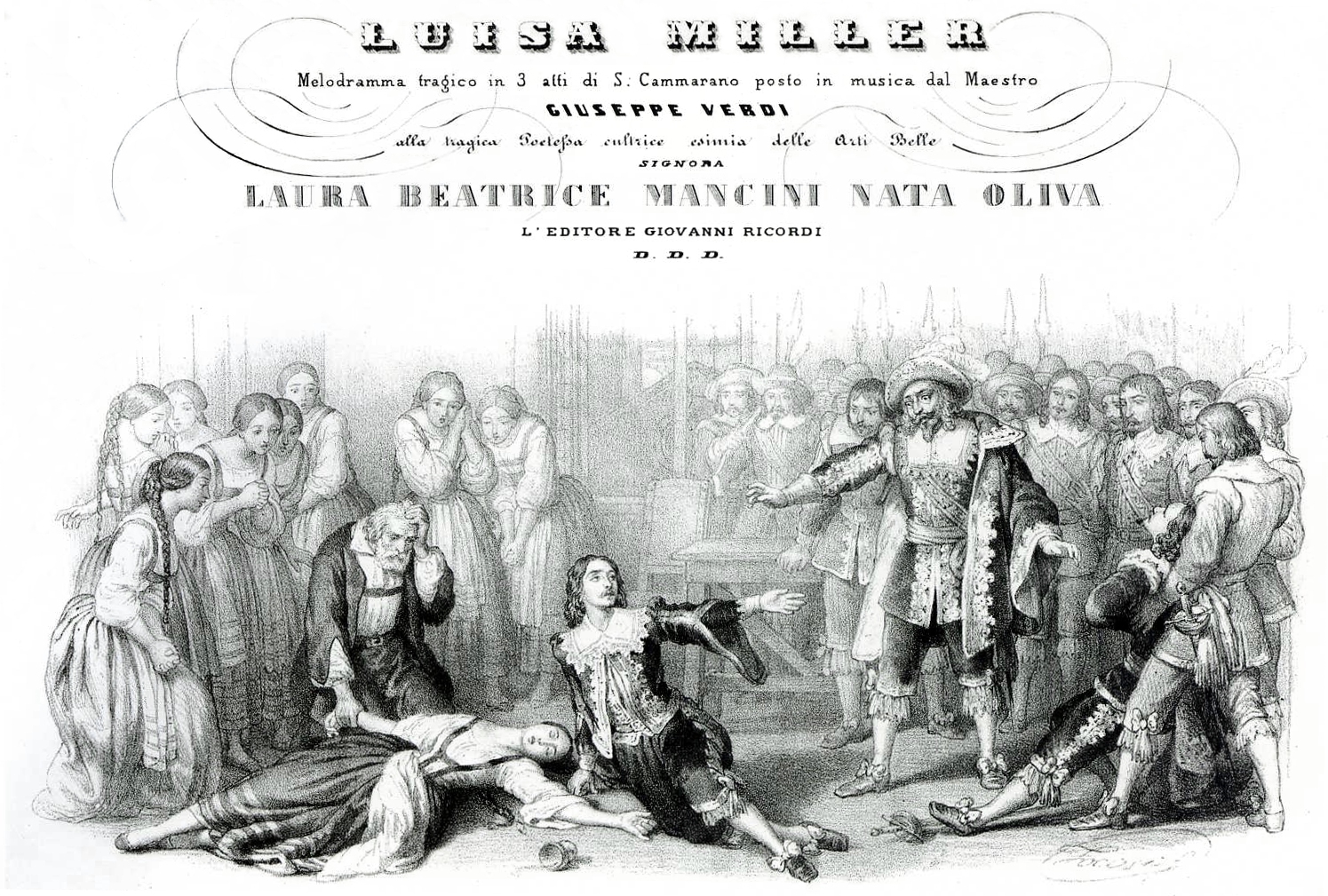
Luisa Miller is an opera in three acts by Giuseppe Verdi to an Italian libretto by Salvadore Cammarano, based on the play Kabale und Liebe (Intrigue and Love) by the German dramatist Friedrich von Schiller.
Verdi's initial idea for a new opera – for which he had a contract going back over several years – was rejected by the Teatro San Carlo in Naples. He attempted to negotiate his way out of this obligation and, when that failed, Cammarano came up with the idea of adapting the Schiller play, with which Verdi was familiar. The process was set in motion, with Verdi still living and working on initial ideas from Paris, where he had been living for almost two years before moving back to his home town of Busseto in the summer of 1849. It was from there that he wrote the music and traveled to Naples for rehearsals. The first performance was given on 8 December 1849.
This was Verdi's 15th opera (counting Jérusalem, the French translation and revision of I Lombardi alla prima crociata), and it is regarded as the beginning of the composer's "middle period".
In August 1848, Verdi had written to the Naples opera house cancelling his contract of three years previous, in which he had agreed to write an opera for them. However, the management held him to it by threatening his librettist for failing to provide a libretto, and Verdi relented, encouraging Cammarano to develop "a brief drama with plenty of interest, action and above all feeling – which would make it easier to set to music".
In Verdi's mind, he had the perfect subject, to be based on the novel L'assedio di Firenze ("The Siege of Florence") by Francesco Domenico Guerrazzi, which glorified the life of the 16th-century Florentine soldier Francesco Ferruccio. This new subject was also a patriotic piece: Verdi had taken to heart the admonitions of the poet Giuseppe Giusti, who had pleaded with him after Macbeth and after Milan's political turmoil of March 1848 and its aftermath to "do what you can to nourish the [sorrow of the Italian people], to strengthen it, and direct it to its goal".
Attempting to get a new libretto underway, Verdi approached Francesco Maria Piave, found him engaged as a soldier for the new Venetian republic, and so contacted Cammarano in Naples with the idea of L'assedio. But, as it turned out, Cammarano had to tell Verdi that the Naples censors rejected the outline of a subject which had interested Verdi very much since the time he prepared his previous opera, La battaglia di Legnano. His inability to continue to develop the project came as a blow. Verdi's biographer Julian Budden notes that "next to Re Lear (King Lear), this was to be the most fascinating of Verdi unrealized subjects"; another biographer Mary Jane Phillips-Matz adds that she regards L'assedio di Firenze as "one of Verdi's most important uncomposed works."
Cammarano advised the composer to avoid a story which had any sort of revolutionary tinge, and he came back with an idea which Verdi himself had once proposed in 1846 when he was recovering from his illness and in the company of Andrea Maffei (who was writing the libretto for I masnadieri): to adapt Schiller's Kabale und Liebe. Therefore, he sent a synopsis of Luisa Miller (which he called Eloisa Miller) to Verdi on 14 May 1849.
Verdi's reply to Cammarano on 17 May outlines some of his concerns; these revolved around the shift of some elements (especially in act 2) and the addition of a duet for Walter and Wurm. As Budden notes, "the only one of these points on which Verdi got his way was the new duet" (because the librettist raised various objections regarding the conditions at the San Carlo and various others), but Budden emphasizes the "spirit of give and take" which prevailed through their relationship. One example regarded the ending of act 1 where Verdi emphasized that there should no stretta, and the librettist agreed provided that "the act did not end in slow tempo but should quicken towards an animated finish."(See "Music" below).
Hub AI
Luisa Miller AI simulator
(@Luisa Miller_simulator)
Luisa Miller
Luisa Miller is an opera in three acts by Giuseppe Verdi to an Italian libretto by Salvadore Cammarano, based on the play Kabale und Liebe (Intrigue and Love) by the German dramatist Friedrich von Schiller.
Verdi's initial idea for a new opera – for which he had a contract going back over several years – was rejected by the Teatro San Carlo in Naples. He attempted to negotiate his way out of this obligation and, when that failed, Cammarano came up with the idea of adapting the Schiller play, with which Verdi was familiar. The process was set in motion, with Verdi still living and working on initial ideas from Paris, where he had been living for almost two years before moving back to his home town of Busseto in the summer of 1849. It was from there that he wrote the music and traveled to Naples for rehearsals. The first performance was given on 8 December 1849.
This was Verdi's 15th opera (counting Jérusalem, the French translation and revision of I Lombardi alla prima crociata), and it is regarded as the beginning of the composer's "middle period".
In August 1848, Verdi had written to the Naples opera house cancelling his contract of three years previous, in which he had agreed to write an opera for them. However, the management held him to it by threatening his librettist for failing to provide a libretto, and Verdi relented, encouraging Cammarano to develop "a brief drama with plenty of interest, action and above all feeling – which would make it easier to set to music".
In Verdi's mind, he had the perfect subject, to be based on the novel L'assedio di Firenze ("The Siege of Florence") by Francesco Domenico Guerrazzi, which glorified the life of the 16th-century Florentine soldier Francesco Ferruccio. This new subject was also a patriotic piece: Verdi had taken to heart the admonitions of the poet Giuseppe Giusti, who had pleaded with him after Macbeth and after Milan's political turmoil of March 1848 and its aftermath to "do what you can to nourish the [sorrow of the Italian people], to strengthen it, and direct it to its goal".
Attempting to get a new libretto underway, Verdi approached Francesco Maria Piave, found him engaged as a soldier for the new Venetian republic, and so contacted Cammarano in Naples with the idea of L'assedio. But, as it turned out, Cammarano had to tell Verdi that the Naples censors rejected the outline of a subject which had interested Verdi very much since the time he prepared his previous opera, La battaglia di Legnano. His inability to continue to develop the project came as a blow. Verdi's biographer Julian Budden notes that "next to Re Lear (King Lear), this was to be the most fascinating of Verdi unrealized subjects"; another biographer Mary Jane Phillips-Matz adds that she regards L'assedio di Firenze as "one of Verdi's most important uncomposed works."
Cammarano advised the composer to avoid a story which had any sort of revolutionary tinge, and he came back with an idea which Verdi himself had once proposed in 1846 when he was recovering from his illness and in the company of Andrea Maffei (who was writing the libretto for I masnadieri): to adapt Schiller's Kabale und Liebe. Therefore, he sent a synopsis of Luisa Miller (which he called Eloisa Miller) to Verdi on 14 May 1849.
Verdi's reply to Cammarano on 17 May outlines some of his concerns; these revolved around the shift of some elements (especially in act 2) and the addition of a duet for Walter and Wurm. As Budden notes, "the only one of these points on which Verdi got his way was the new duet" (because the librettist raised various objections regarding the conditions at the San Carlo and various others), but Budden emphasizes the "spirit of give and take" which prevailed through their relationship. One example regarded the ending of act 1 where Verdi emphasized that there should no stretta, and the librettist agreed provided that "the act did not end in slow tempo but should quicken towards an animated finish."(See "Music" below).