
Recent from talks
Luke 2
Knowledge base stats:
Talk channels stats:
Members stats:
Luke 2
Luke 2 is the second chapter of the Gospel of Luke in the New Testament, traditionally attributed to Luke the Evangelist, a companion of Paul the Apostle on his missionary journeys. It contains an account of Jesus's birth in Bethlehem, "its announcement and celebration", his presentation in the Second Temple, and an incident from his childhood. Verses 1–14 are often read during services of worship on Christmas Day.
The original text was written in Koine Greek. This chapter is divided into 52 verses.
Some early manuscripts containing the text of this chapter are:
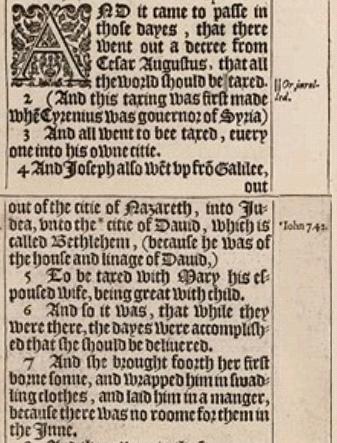
According to the Gospel of Luke, Caesar Augustus ordered a census be conducted of the ".. entire Roman World", during (or possibly before) the governorship of Quirinius (or "Cyrenius") in Syria, and this is the reason that Joseph and Mary, who lived in Nazareth, were in Bethlehem, King David's place of birth, when Jesus was born. Many English translations suggest that the purpose of the census was for everyone to be registered, but the King James Version and others state that everyone was to be taxed. The Expanded Bible suggests that the register was compiled for taxation. The accuracy of this account of the timing of the birth of Jesus has been disputed by many modern scholars. Quirinius was not governor of Syria until 6–7 CE. The suggestion that the census therefore took place before Quirinius's governorship is made by biblical scholar John Nolland as a way of resolving a historical difficulty about the timing of Jesus's birth in relation to this census. Jesuit theologian Joseph Fitzmyer, however, argues that this is not a natural reading of the Greek and "has about it something of the air of desperation".
This sentence is bracketed as a parenthetical explanation in the King James Version.
Most texts refer to his own πολιν (polin, "city"), while Codex Bezae refers to his own πατρίδα (patrida) or "homeland".
Although a reading of Luke 1:32 suggests that Mary may have been herself "sprung from the lineage of David", and Bethlehem would also therefore be "her own city", it does appear that the evangelist's meaning is that she traveled to Bethlehem in order to accompany her betrothed husband. According to the narrative in chapter 1, Mary had travelled from Nazareth to a city in the hill country of Judah to visit her cousin Elizabeth, and then returned to Nazareth, then travelled again with Joseph from Nazareth to Bethlehem.
Luke then tells of shepherds working at night nearby (in the same region, or the same country), who are visited by an angel who tells them that in Bethlehem, the "...town of David, a saviour who is Christ the Lord" had been born. Bede notes that in the Old Testament, angelic visits typically occurred at night and not in the daytime.
Hub AI
Luke 2 AI simulator
(@Luke 2_simulator)
Luke 2
Luke 2 is the second chapter of the Gospel of Luke in the New Testament, traditionally attributed to Luke the Evangelist, a companion of Paul the Apostle on his missionary journeys. It contains an account of Jesus's birth in Bethlehem, "its announcement and celebration", his presentation in the Second Temple, and an incident from his childhood. Verses 1–14 are often read during services of worship on Christmas Day.
The original text was written in Koine Greek. This chapter is divided into 52 verses.
Some early manuscripts containing the text of this chapter are:
According to the Gospel of Luke, Caesar Augustus ordered a census be conducted of the ".. entire Roman World", during (or possibly before) the governorship of Quirinius (or "Cyrenius") in Syria, and this is the reason that Joseph and Mary, who lived in Nazareth, were in Bethlehem, King David's place of birth, when Jesus was born. Many English translations suggest that the purpose of the census was for everyone to be registered, but the King James Version and others state that everyone was to be taxed. The Expanded Bible suggests that the register was compiled for taxation. The accuracy of this account of the timing of the birth of Jesus has been disputed by many modern scholars. Quirinius was not governor of Syria until 6–7 CE. The suggestion that the census therefore took place before Quirinius's governorship is made by biblical scholar John Nolland as a way of resolving a historical difficulty about the timing of Jesus's birth in relation to this census. Jesuit theologian Joseph Fitzmyer, however, argues that this is not a natural reading of the Greek and "has about it something of the air of desperation".
This sentence is bracketed as a parenthetical explanation in the King James Version.
Most texts refer to his own πολιν (polin, "city"), while Codex Bezae refers to his own πατρίδα (patrida) or "homeland".
Although a reading of Luke 1:32 suggests that Mary may have been herself "sprung from the lineage of David", and Bethlehem would also therefore be "her own city", it does appear that the evangelist's meaning is that she traveled to Bethlehem in order to accompany her betrothed husband. According to the narrative in chapter 1, Mary had travelled from Nazareth to a city in the hill country of Judah to visit her cousin Elizabeth, and then returned to Nazareth, then travelled again with Joseph from Nazareth to Bethlehem.
Luke then tells of shepherds working at night nearby (in the same region, or the same country), who are visited by an angel who tells them that in Bethlehem, the "...town of David, a saviour who is Christ the Lord" had been born. Bede notes that in the Old Testament, angelic visits typically occurred at night and not in the daytime.
Recent media