



Community hub
Recent from talks
Knowledge base stats:
Talk channels stats:
Members stats:
Spinal fusion
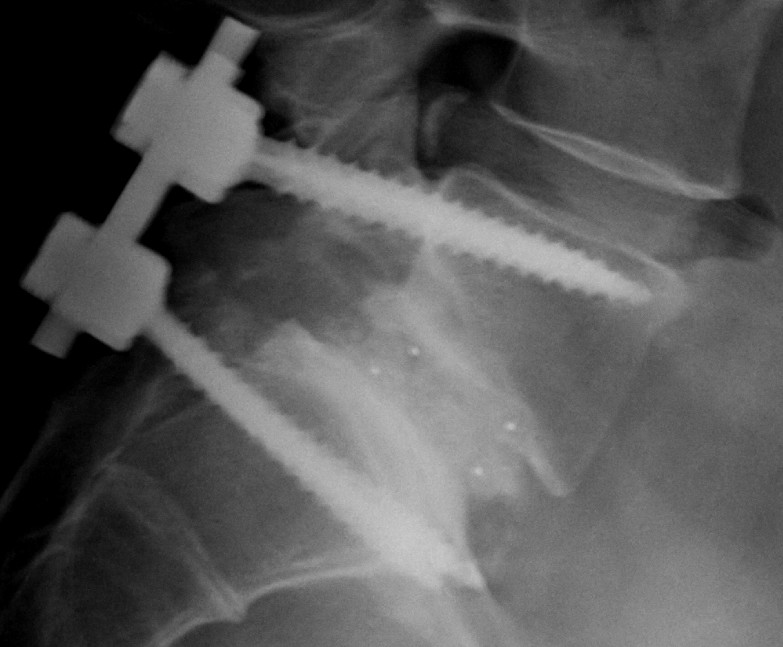
Spinal fusion, also called spondylodesis or spondylosyndesis, is a surgery performed by orthopaedic surgeons or neurosurgeons that joins two or more vertebrae. This procedure can be performed at any level in the spine (cervical, thoracic, lumbar, or sacral) and prevents any movement between the fused vertebrae. There are many types of spinal fusion and each technique involves using bone grafting—either from the patient (autograft), donor (allograft), or artificial bone substitutes—to help the bones heal together. Additional hardware (screws, plates, or cages) is often used to hold the bones in place while the graft fuses the two vertebrae together. The placement of hardware can be guided by fluoroscopy, navigation systems, or robotics.
Spinal fusion is most commonly performed to relieve the pain and pressure from mechanical pain of the vertebrae or on the spinal cord that results when a disc (cartilage between two vertebrae) wears out (degenerative disc disease). It is also used as a backup procedure for total disc replacement surgery (intervertebral disc arthroplasty), in case patient anatomy prevents replacement of the disc. Other common pathological conditions that are treated by spinal fusion include spinal stenosis, spondylolisthesis, spondylosis, spinal fractures, scoliosis, and kyphosis.
Like any surgery, complications may include infection, blood loss, and nerve damage. Fusion also changes the normal motion of the spine and results in more stress on the vertebrae above and below the fused segments. As a result, long-term complications include degeneration at these adjacent spine segments.
Spinal fusion can be used to treat a variety of conditions affecting any level of the spine—lumbar, cervical and thoracic. In general, spinal fusion is performed to decompress and stabilize the spine. The greatest benefit appears to be in spondylolisthesis, while evidence is weaker for spinal stenosis.
The most common cause of pressure on the spinal cord/nerves is degenerative disc disease. Other common causes include disc herniation, spinal stenosis, trauma, and spinal tumors. Spinal stenosis results from bony growths (osteophytes) or thickened ligaments that cause narrowing of the spinal canal over time. This causes leg pain with increased activity, a condition called neurogenic claudication. Pressure on the nerves as they exit the spinal cord (radiculopathy) causes pain in the area where the nerves originated (leg for lumbar pathology, arm for cervical pathology). In severe cases, this pressure can cause neurologic deficits, like numbness, tingling, bowel/bladder dysfunction, and paralysis.
Lumbar and cervical spinal fusions are more commonly performed than thoracic fusions. Degeneration happens more frequently at these levels due to increased motion and stress. The thoracic spine is more immobile, so most fusions are performed due to trauma or deformities like scoliosis, kyphosis, and lordosis.
Conditions where spinal fusion may be considered include the following:
Bone morphogenetic protein (rhBMP) should not be routinely used in any type of anterior cervical spine fusion, such as with anterior cervical discectomy and fusion. There are reports of this therapy causing soft tissue swelling, which in turn can cause life-threatening complications due to difficulty swallowing and pressure on the respiratory tract.
Hub AI
Spinal fusion AI simulator
(@Spinal fusion_simulator)
Spinal fusion
Spinal fusion, also called spondylodesis or spondylosyndesis, is a surgery performed by orthopaedic surgeons or neurosurgeons that joins two or more vertebrae. This procedure can be performed at any level in the spine (cervical, thoracic, lumbar, or sacral) and prevents any movement between the fused vertebrae. There are many types of spinal fusion and each technique involves using bone grafting—either from the patient (autograft), donor (allograft), or artificial bone substitutes—to help the bones heal together. Additional hardware (screws, plates, or cages) is often used to hold the bones in place while the graft fuses the two vertebrae together. The placement of hardware can be guided by fluoroscopy, navigation systems, or robotics.
Spinal fusion is most commonly performed to relieve the pain and pressure from mechanical pain of the vertebrae or on the spinal cord that results when a disc (cartilage between two vertebrae) wears out (degenerative disc disease). It is also used as a backup procedure for total disc replacement surgery (intervertebral disc arthroplasty), in case patient anatomy prevents replacement of the disc. Other common pathological conditions that are treated by spinal fusion include spinal stenosis, spondylolisthesis, spondylosis, spinal fractures, scoliosis, and kyphosis.
Like any surgery, complications may include infection, blood loss, and nerve damage. Fusion also changes the normal motion of the spine and results in more stress on the vertebrae above and below the fused segments. As a result, long-term complications include degeneration at these adjacent spine segments.
Spinal fusion can be used to treat a variety of conditions affecting any level of the spine—lumbar, cervical and thoracic. In general, spinal fusion is performed to decompress and stabilize the spine. The greatest benefit appears to be in spondylolisthesis, while evidence is weaker for spinal stenosis.
The most common cause of pressure on the spinal cord/nerves is degenerative disc disease. Other common causes include disc herniation, spinal stenosis, trauma, and spinal tumors. Spinal stenosis results from bony growths (osteophytes) or thickened ligaments that cause narrowing of the spinal canal over time. This causes leg pain with increased activity, a condition called neurogenic claudication. Pressure on the nerves as they exit the spinal cord (radiculopathy) causes pain in the area where the nerves originated (leg for lumbar pathology, arm for cervical pathology). In severe cases, this pressure can cause neurologic deficits, like numbness, tingling, bowel/bladder dysfunction, and paralysis.
Lumbar and cervical spinal fusions are more commonly performed than thoracic fusions. Degeneration happens more frequently at these levels due to increased motion and stress. The thoracic spine is more immobile, so most fusions are performed due to trauma or deformities like scoliosis, kyphosis, and lordosis.
Conditions where spinal fusion may be considered include the following:
Bone morphogenetic protein (rhBMP) should not be routinely used in any type of anterior cervical spine fusion, such as with anterior cervical discectomy and fusion. There are reports of this therapy causing soft tissue swelling, which in turn can cause life-threatening complications due to difficulty swallowing and pressure on the respiratory tract.