
Recent from talks
Degenerative disc disease
Knowledge base stats:
Talk channels stats:
Members stats:
Degenerative disc disease
Degenerative disc disease (DDD) is a medical condition typically brought on by the aging process in which there are anatomic changes and possibly a loss of function of one or more intervertebral discs of the spine. DDD can take place with or without symptoms, but is typically identified once symptoms arise. The root cause is thought to be loss of soluble proteins within the fluid contained in the disc with resultant reduction of the oncotic pressure, which in turn causes loss of fluid volume. Normal downward forces cause the affected disc to lose height, and the distance between vertebrae is reduced. The anulus fibrosus, the tough outer layers of a disc, also weakens. This loss of height causes laxity of the longitudinal ligaments, which may allow anterior, posterior, or lateral shifting of the vertebral bodies, causing facet joint malalignment and arthritis; scoliosis; cervical hyperlordosis; thoracic hyperkyphosis; lumbar hyperlordosis; narrowing of the space available for the spinal tract within the vertebra (spinal stenosis); or narrowing of the space through which a spinal nerve exits (vertebral foramen stenosis) with resultant inflammation and impingement of a spinal nerve, causing a radiculopathy.
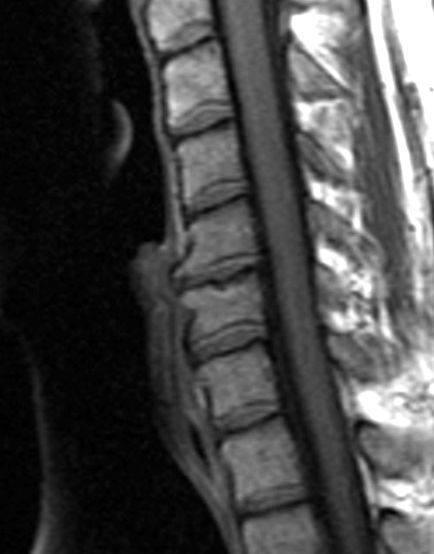
DDD can cause mild to severe pain, either acute or chronic, near the involved disc, as well as neuropathic pain if an adjacent spinal nerve root is involved. Diagnosis is suspected when typical symptoms and physical findings are present; and confirmed by x-rays of the vertebral column. Occasionally the radiologic diagnosis of disc degeneration is made incidentally when a cervical x-ray, chest x-ray, or abdominal x-ray is taken for other reasons, and the abnormalities of the vertebral column are recognized. The diagnosis of DDD is not a radiologic diagnosis, since the interpreting radiologist is not aware whether there are symptoms present or not. Typical radiographic findings include disc space narrowing, displacement of vertebral bodies, fusion of adjacent vertebral bodies, and development of bone in adjacent soft tissue (osteophyte formation). An MRI is typically reserved for those with symptoms, signs, and x-ray findings suggesting the need for surgical intervention.
Treatment may include physical therapy for pain relief, ROM (range of motion), and appropriate muscle/strength training with emphasis on correcting abnormal posture, assisting the paravertebral (paraspinous) muscles in stabilizing the spine, and core muscle strengthening; stretching exercises; massage therapy; oral analgesia with non-steroidal anti-inflammatory agents (NSAIDS); and topical analgesia with lidocaine, ice and heat. Immediate surgery may be indicated if the symptoms are severe or sudden in onset, or there is a sudden worsening of symptoms. Elective surgery may be indicated after six months of conservative therapy with unsatisfactory relief of symptoms.
Degenerative disc disease can result in lower back or upper neck pain. The amount of degeneration does not correlate well with the amount of pain patients experience. Many people experience no pain, while others with the same amount of damage have severe, chronic pain. Whether a patient experiences pain or not largely depends on the location of the affected disc and the amount of pressure that is being put on the spinal column and surrounding nerve roots.
Degenerative disc disease is one of the most common sources of back pain and affects approximately 30 million people every year. With symptomatic degenerative disc disease, the pain can vary depending on the location of the affected disc. A degenerated disc in the lower back can result in lower back pain, sometimes radiating to the hips, and pain in the buttocks, thighs, or legs. If pressure is being placed on the nerves by exposed nucleus pulposus, sporadic tingling or weakness through the knees and legs can occur.
A degenerated disc in the upper neck will often result in pain to the neck, arm, shoulders and hands; tingling in the fingers may also result if nerve impingement is occurring. Pain is most commonly felt or worsened by movements such as sitting, bending, lifting, and twisting.
After an injury, some discs become painful because of inflammation and the pain comes and goes. Some people have nerve endings that penetrate more deeply into the anulus fibrosus (outer layer of the disc) than others, making discs more likely to generate pain. The healing of trauma to the outer anulus fibrosus may also result in the innervation of the scar tissue and pain impulses from the disc, as these nerves become inflamed by nucleus pulposus material. Degenerative disc disease can lead to a chronic debilitating condition and can reduce a person's quality of life. When pain from degenerative disc disease is severe, traditional nonoperative treatment may be ineffective.
There is a disc between each of the vertebrae in the spine. A healthy, well-hydrated disc will contain a great deal of water in its center, known as the nucleus pulposus, which provides cushioning and flexibility for the spine. Much of the mechanical stress that is caused by everyday movements is transferred to the discs within the spine and the water content within them allows them to effectively absorb the shock. At birth, a typical human nucleus pulposus will contain about 80% water. However natural daily stresses and minor injuries can cause these discs to gradually lose water as the annulus fibrosus, or the tough outer fibrous material of a disc, weakens. Because degenerative disc disease is largely due to natural daily stresses, the American Academy of Orthopaedic Manual Physical Therapists have suggested it is not truly a "disease" process.
Hub AI
Degenerative disc disease AI simulator
(@Degenerative disc disease_simulator)
Degenerative disc disease
Degenerative disc disease (DDD) is a medical condition typically brought on by the aging process in which there are anatomic changes and possibly a loss of function of one or more intervertebral discs of the spine. DDD can take place with or without symptoms, but is typically identified once symptoms arise. The root cause is thought to be loss of soluble proteins within the fluid contained in the disc with resultant reduction of the oncotic pressure, which in turn causes loss of fluid volume. Normal downward forces cause the affected disc to lose height, and the distance between vertebrae is reduced. The anulus fibrosus, the tough outer layers of a disc, also weakens. This loss of height causes laxity of the longitudinal ligaments, which may allow anterior, posterior, or lateral shifting of the vertebral bodies, causing facet joint malalignment and arthritis; scoliosis; cervical hyperlordosis; thoracic hyperkyphosis; lumbar hyperlordosis; narrowing of the space available for the spinal tract within the vertebra (spinal stenosis); or narrowing of the space through which a spinal nerve exits (vertebral foramen stenosis) with resultant inflammation and impingement of a spinal nerve, causing a radiculopathy.
DDD can cause mild to severe pain, either acute or chronic, near the involved disc, as well as neuropathic pain if an adjacent spinal nerve root is involved. Diagnosis is suspected when typical symptoms and physical findings are present; and confirmed by x-rays of the vertebral column. Occasionally the radiologic diagnosis of disc degeneration is made incidentally when a cervical x-ray, chest x-ray, or abdominal x-ray is taken for other reasons, and the abnormalities of the vertebral column are recognized. The diagnosis of DDD is not a radiologic diagnosis, since the interpreting radiologist is not aware whether there are symptoms present or not. Typical radiographic findings include disc space narrowing, displacement of vertebral bodies, fusion of adjacent vertebral bodies, and development of bone in adjacent soft tissue (osteophyte formation). An MRI is typically reserved for those with symptoms, signs, and x-ray findings suggesting the need for surgical intervention.
Treatment may include physical therapy for pain relief, ROM (range of motion), and appropriate muscle/strength training with emphasis on correcting abnormal posture, assisting the paravertebral (paraspinous) muscles in stabilizing the spine, and core muscle strengthening; stretching exercises; massage therapy; oral analgesia with non-steroidal anti-inflammatory agents (NSAIDS); and topical analgesia with lidocaine, ice and heat. Immediate surgery may be indicated if the symptoms are severe or sudden in onset, or there is a sudden worsening of symptoms. Elective surgery may be indicated after six months of conservative therapy with unsatisfactory relief of symptoms.
Degenerative disc disease can result in lower back or upper neck pain. The amount of degeneration does not correlate well with the amount of pain patients experience. Many people experience no pain, while others with the same amount of damage have severe, chronic pain. Whether a patient experiences pain or not largely depends on the location of the affected disc and the amount of pressure that is being put on the spinal column and surrounding nerve roots.
Degenerative disc disease is one of the most common sources of back pain and affects approximately 30 million people every year. With symptomatic degenerative disc disease, the pain can vary depending on the location of the affected disc. A degenerated disc in the lower back can result in lower back pain, sometimes radiating to the hips, and pain in the buttocks, thighs, or legs. If pressure is being placed on the nerves by exposed nucleus pulposus, sporadic tingling or weakness through the knees and legs can occur.
A degenerated disc in the upper neck will often result in pain to the neck, arm, shoulders and hands; tingling in the fingers may also result if nerve impingement is occurring. Pain is most commonly felt or worsened by movements such as sitting, bending, lifting, and twisting.
After an injury, some discs become painful because of inflammation and the pain comes and goes. Some people have nerve endings that penetrate more deeply into the anulus fibrosus (outer layer of the disc) than others, making discs more likely to generate pain. The healing of trauma to the outer anulus fibrosus may also result in the innervation of the scar tissue and pain impulses from the disc, as these nerves become inflamed by nucleus pulposus material. Degenerative disc disease can lead to a chronic debilitating condition and can reduce a person's quality of life. When pain from degenerative disc disease is severe, traditional nonoperative treatment may be ineffective.
There is a disc between each of the vertebrae in the spine. A healthy, well-hydrated disc will contain a great deal of water in its center, known as the nucleus pulposus, which provides cushioning and flexibility for the spine. Much of the mechanical stress that is caused by everyday movements is transferred to the discs within the spine and the water content within them allows them to effectively absorb the shock. At birth, a typical human nucleus pulposus will contain about 80% water. However natural daily stresses and minor injuries can cause these discs to gradually lose water as the annulus fibrosus, or the tough outer fibrous material of a disc, weakens. Because degenerative disc disease is largely due to natural daily stresses, the American Academy of Orthopaedic Manual Physical Therapists have suggested it is not truly a "disease" process.
Recent media