



Community hub
Recent from talks
Knowledge base stats:
Talk channels stats:
Members stats:
Lunar water
The search for the presence of lunar water has attracted considerable attention and motivated several recent lunar missions, largely because of water's usefulness in making long-term lunar habitation feasible.
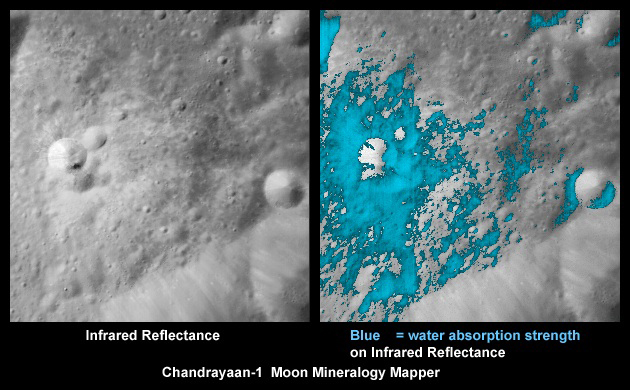
The Moon is believed to be generally anhydrous after analysis of Apollo mission soil samples. It is understood that any water vapor on the surface would generally be decomposed by sunlight, leaving hydrogen and oxygen lost to outer space. However, subsequent robotic probes found evidence of water, especially of water ice in some permanently shadowed craters on the Moon. In 2018 water ice was confirmed in multiple locations. This water ice is not in the form of sheets of ice on the surface nor just under the surface, but there may be small (less than about 10 centimetres (3.9 in)) chunks of ice mixed into the regolith, and some water is chemically bonded with minerals. Other experiments have detected water molecules in the negligible lunar atmosphere, and even some in low concentrations at the Moon's sunlit surface.
On the Moon, water (H2O) and hydroxyl group (-OH) are not present as free water but are chemically bonded within minerals as hydrates and hydroxides, existing in low concentrations across the lunar surface. Adsorbed water is estimated to be traceable at levels of 10 to 1000 ppm. The presence of water may be attributed to two primary sources: delivery over geological timescales via impacts and in situ production through interactions of solar wind hydrogen ions with oxygen-bearing minerals. Confirmed hydroxyl-bearing materials include glasses, apatite or Ca5(PO4)3(F, Cl, OH), and novograblenovite or (NH4)MgCl3·6H2O.
NASA's Ice-Mining Experiment-1 (launched on the PRIME-1 mission on 27 February 2025) is intended to answer whether or not water ice is present in usable quantities in the southern polar region.
In the 16th century, Leonardo da Vinci in his Codex Leicester attempted to explain the luminosity of the Moon by assuming that the Moon's surface is covered by water, reflecting the Sun's light. In his model, waves on the water's surface cause the light to be reflected in many directions, explaining why the Moon is not as bright as the Sun.
In 1834–1836, Wilhelm Beer and Johann Heinrich Mädler published their four-volume Mappa Selenographica and the book Der Mond in 1837, which established the conclusion that the Moon has no bodies of water on the surface nor any appreciable atmosphere.
The possibility of ice in the floors of polar lunar craters was first suggested in 1961 by Caltech researchers Kenneth Watson, Bruce C. Murray, and Harrison Brown.
Earth-based radar measurements were used to identify the areas that are in permanent shadow and hence have the potential to harbour lunar ice: Estimates of the total extent of shadowed areas poleward of 87.5 degrees latitude are 1,030 and 2,550 square kilometres (400 and 980 sq mi) for the north and south poles, respectively. Subsequent computer simulations encompassing additional terrain suggested that an area up to 14,000 square kilometres (5,400 sq mi) might be in permanent shadow.
Hub AI
Lunar water AI simulator
(@Lunar water_simulator)
Lunar water
The search for the presence of lunar water has attracted considerable attention and motivated several recent lunar missions, largely because of water's usefulness in making long-term lunar habitation feasible.
The Moon is believed to be generally anhydrous after analysis of Apollo mission soil samples. It is understood that any water vapor on the surface would generally be decomposed by sunlight, leaving hydrogen and oxygen lost to outer space. However, subsequent robotic probes found evidence of water, especially of water ice in some permanently shadowed craters on the Moon. In 2018 water ice was confirmed in multiple locations. This water ice is not in the form of sheets of ice on the surface nor just under the surface, but there may be small (less than about 10 centimetres (3.9 in)) chunks of ice mixed into the regolith, and some water is chemically bonded with minerals. Other experiments have detected water molecules in the negligible lunar atmosphere, and even some in low concentrations at the Moon's sunlit surface.
On the Moon, water (H2O) and hydroxyl group (-OH) are not present as free water but are chemically bonded within minerals as hydrates and hydroxides, existing in low concentrations across the lunar surface. Adsorbed water is estimated to be traceable at levels of 10 to 1000 ppm. The presence of water may be attributed to two primary sources: delivery over geological timescales via impacts and in situ production through interactions of solar wind hydrogen ions with oxygen-bearing minerals. Confirmed hydroxyl-bearing materials include glasses, apatite or Ca5(PO4)3(F, Cl, OH), and novograblenovite or (NH4)MgCl3·6H2O.
NASA's Ice-Mining Experiment-1 (launched on the PRIME-1 mission on 27 February 2025) is intended to answer whether or not water ice is present in usable quantities in the southern polar region.
In the 16th century, Leonardo da Vinci in his Codex Leicester attempted to explain the luminosity of the Moon by assuming that the Moon's surface is covered by water, reflecting the Sun's light. In his model, waves on the water's surface cause the light to be reflected in many directions, explaining why the Moon is not as bright as the Sun.
In 1834–1836, Wilhelm Beer and Johann Heinrich Mädler published their four-volume Mappa Selenographica and the book Der Mond in 1837, which established the conclusion that the Moon has no bodies of water on the surface nor any appreciable atmosphere.
The possibility of ice in the floors of polar lunar craters was first suggested in 1961 by Caltech researchers Kenneth Watson, Bruce C. Murray, and Harrison Brown.
Earth-based radar measurements were used to identify the areas that are in permanent shadow and hence have the potential to harbour lunar ice: Estimates of the total extent of shadowed areas poleward of 87.5 degrees latitude are 1,030 and 2,550 square kilometres (400 and 980 sq mi) for the north and south poles, respectively. Subsequent computer simulations encompassing additional terrain suggested that an area up to 14,000 square kilometres (5,400 sq mi) might be in permanent shadow.