
Recent from talks
Pulmonary fibrosis
Knowledge base stats:
Talk channels stats:
Members stats:
Pulmonary fibrosis
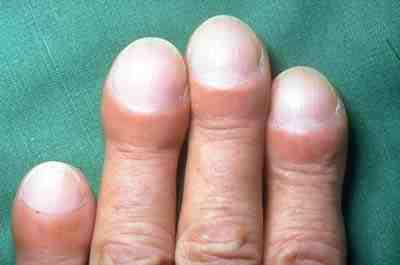
Pulmonary fibrosis is a condition in which the lungs become scarred over time. Symptoms include shortness of breath, a dry cough, feeling tired, weight loss, and nail clubbing. Complications may include pulmonary hypertension, respiratory failure, pneumothorax, and lung cancer.
Causes include environmental pollution, certain medications, connective tissue diseases, infections, and interstitial lung diseases. But in most cases the cause is unknown (idiopathic pulmonary fibrosis). Diagnosis may be based on symptoms, medical imaging, lung biopsy, and lung function tests.
No cure exists and treatment options are limited. Treatment is directed toward improving symptoms and may include oxygen therapy and pulmonary rehabilitation. Certain medications may slow the scarring. Lung transplantation may be an option. At least 5 million people are affected globally. Life expectancy is generally less than five years.
Symptoms of pulmonary fibrosis are mainly:
Pulmonary fibrosis is suggested by a history of progressive shortness of breath (dyspnea) with exertion. Sometimes fine inspiratory crackles can be heard at the lung bases on auscultation. A chest X-ray may not be abnormal, but high-resolution CT will often show abnormalities.
Pulmonary fibrosis may be a secondary effect of other diseases. Most of these are classified as interstitial lung diseases. Examples include autoimmune disorders, viral infections, and bacterial infections such as tuberculosis that may cause fibrotic changes in the lungs' upper or lower lobes and other microscopic lung injuries. But pulmonary fibrosis can also appear without any known cause. In that case, it is termed "idiopathic". Most idiopathic cases are diagnosed as idiopathic pulmonary fibrosis. This is a diagnosis of exclusion of a characteristic set of histologic/pathologic features known as usual interstitial pneumonia (UIP). In either case, a growing body of evidence points to a genetic predisposition in a subset of patients. For example, a mutation in surfactant protein C (SP-C) has been found in some families with a history of pulmonary fibrosis. Autosomal dominant mutations in the TERC or TERT genes, which encode telomerase, have been identified in about 15% of pulmonary fibrosis patients.
Diseases and conditions that may cause pulmonary fibrosis as a secondary effect include:
Pulmonary fibrosis involves a gradual replacement of normal lung tissue with fibrotic tissue. Such scar tissue causes an irreversible decrease in oxygen diffusion capacity, and the resulting stiffness or decreased compliance makes pulmonary fibrosis a restrictive lung disease. Pulmonary fibrosis is perpetuated by aberrant wound healing, rather than chronic inflammation. It is the main cause of restrictive lung disease that is intrinsic to the lung parenchyma. In contrast, quadriplegia and kyphosis are examples of causes of restrictive lung disease that do not necessarily involve pulmonary fibrosis.
Hub AI
Pulmonary fibrosis AI simulator
(@Pulmonary fibrosis_simulator)
Pulmonary fibrosis
Pulmonary fibrosis is a condition in which the lungs become scarred over time. Symptoms include shortness of breath, a dry cough, feeling tired, weight loss, and nail clubbing. Complications may include pulmonary hypertension, respiratory failure, pneumothorax, and lung cancer.
Causes include environmental pollution, certain medications, connective tissue diseases, infections, and interstitial lung diseases. But in most cases the cause is unknown (idiopathic pulmonary fibrosis). Diagnosis may be based on symptoms, medical imaging, lung biopsy, and lung function tests.
No cure exists and treatment options are limited. Treatment is directed toward improving symptoms and may include oxygen therapy and pulmonary rehabilitation. Certain medications may slow the scarring. Lung transplantation may be an option. At least 5 million people are affected globally. Life expectancy is generally less than five years.
Symptoms of pulmonary fibrosis are mainly:
Pulmonary fibrosis is suggested by a history of progressive shortness of breath (dyspnea) with exertion. Sometimes fine inspiratory crackles can be heard at the lung bases on auscultation. A chest X-ray may not be abnormal, but high-resolution CT will often show abnormalities.
Pulmonary fibrosis may be a secondary effect of other diseases. Most of these are classified as interstitial lung diseases. Examples include autoimmune disorders, viral infections, and bacterial infections such as tuberculosis that may cause fibrotic changes in the lungs' upper or lower lobes and other microscopic lung injuries. But pulmonary fibrosis can also appear without any known cause. In that case, it is termed "idiopathic". Most idiopathic cases are diagnosed as idiopathic pulmonary fibrosis. This is a diagnosis of exclusion of a characteristic set of histologic/pathologic features known as usual interstitial pneumonia (UIP). In either case, a growing body of evidence points to a genetic predisposition in a subset of patients. For example, a mutation in surfactant protein C (SP-C) has been found in some families with a history of pulmonary fibrosis. Autosomal dominant mutations in the TERC or TERT genes, which encode telomerase, have been identified in about 15% of pulmonary fibrosis patients.
Diseases and conditions that may cause pulmonary fibrosis as a secondary effect include:
Pulmonary fibrosis involves a gradual replacement of normal lung tissue with fibrotic tissue. Such scar tissue causes an irreversible decrease in oxygen diffusion capacity, and the resulting stiffness or decreased compliance makes pulmonary fibrosis a restrictive lung disease. Pulmonary fibrosis is perpetuated by aberrant wound healing, rather than chronic inflammation. It is the main cause of restrictive lung disease that is intrinsic to the lung parenchyma. In contrast, quadriplegia and kyphosis are examples of causes of restrictive lung disease that do not necessarily involve pulmonary fibrosis.
Recent media