
Recent from talks
Lung transplantation
Knowledge base stats:
Talk channels stats:
Members stats:
Lung transplantation
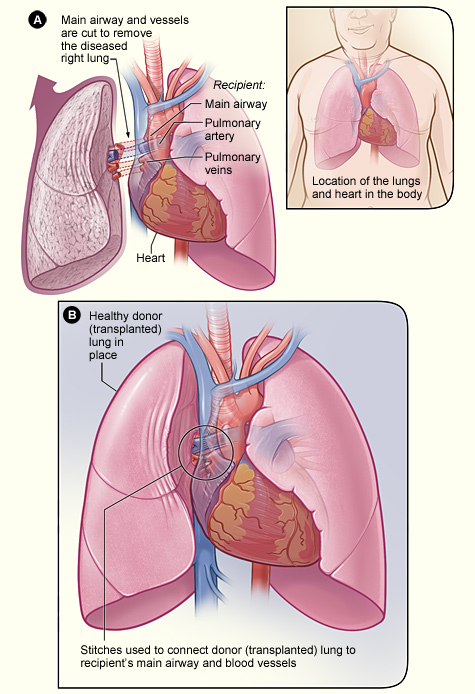
Lung transplantation, or pulmonary transplantation, is a surgical procedure in which one or both lungs are replaced by lungs from a donor. Donor lungs can be retrieved from a living or deceased donor. A living donor can only donate one lung lobe. With some lung diseases, a recipient may only need to receive a single lung. With other lung diseases such as cystic fibrosis, it is imperative that a recipient receive two lungs. While lung transplants carry certain associated risks, they can also extend life expectancy and enhance the quality of life for those with end stage pulmonary disease.
Lung transplantation is the therapeutic measure of last resort for patients with end-stage lung disease who have exhausted all other available treatments without improvement. A variety of conditions may make such surgery necessary. The most common indications for a lung transplant are pulmonary fibrosis, chronic obstructive pulmonary disease (COPD), cystic fibrosis, and pulmonary vascular disease including pulmonary hypertension or pulmonary arterial hypertension.
Despite the severity of a patient's respiratory condition, certain pre-existing conditions may make a person a poor candidate for lung transplantation. Absolute contraindications for undergoing a lung transplant include:
Candidates for lung transplantation are selected and assessed by a medical team including pulmonologists, transplant surgeons, primary care physicians, pulmonary rehabilitation specialists. Generally, to be considered for a lung transplant, a candidate has to have an estimated risk of dying from lung disease greater than 50% within 2 years, and a likelihood of being alive in the period after a transplant of at least 80%.
The history of organ transplants began with several attempts that were unsuccessful due to transplant rejection. Animal experimentation by various researchers, including Vladimir Demikhov and Henry Metras, during the 1940s and 1950s first demonstrated that the procedure was technically feasible. James Hardy of the University of Mississippi performed the first human lung transplant on June 11, 1963. Following a single-lung transplantation, the patient, identified later as convicted murderer John Richard Russell, survived for 18 days. From 1963 to 1978, multiple attempts at lung transplantation failed because of rejection and problems with anastomotic bronchial healing (i.e. reconnection of Bronchial passages). It was only after the invention of the heart-lung machine, coupled with the development of immunosuppressive drugs such as ciclosporin, that organs such as the lungs could be transplanted with a reasonable chance of patient recovery.
The first successful transplant surgery involving the lungs was a heart-lung transplant, performed by Dr. Bruce Reitz of Stanford University in 1981 on a woman who had idiopathic pulmonary hypertension. Subsequent advances in the 1980s led to the first single and double lung transplants by thoracic surgeon Joel Cooper. Cooper completed the first successful long-term single lung transplant in 1983 (in patient Tom Hall), the first successful long-term double lung transplant in 1986 (in Ann Harrison) and the first successful long-term double lung transplant for a person with cystic fibrosis in 1988.
In 1988, Vera Dwyer, a woman from County Sligo in Ireland, was diagnosed with an irreversible, chronic and fibrotic lung disease. Later on that year, she received a single lung transplant in the UK. In November 2018, Ms. Dwyer was recognized as the world's longest surviving single lung transplant recipient in an event at the Mater Hospital in Dublin. She died in 2021, thirty-three years after her transplant.
In 2021, the team at Cedars-Sinai in Los Angeles, California completed the world's first robotic lung transplant, allowing a minimally invasive approach to the procedure.
Hub AI
Lung transplantation AI simulator
(@Lung transplantation_simulator)
Lung transplantation
Lung transplantation, or pulmonary transplantation, is a surgical procedure in which one or both lungs are replaced by lungs from a donor. Donor lungs can be retrieved from a living or deceased donor. A living donor can only donate one lung lobe. With some lung diseases, a recipient may only need to receive a single lung. With other lung diseases such as cystic fibrosis, it is imperative that a recipient receive two lungs. While lung transplants carry certain associated risks, they can also extend life expectancy and enhance the quality of life for those with end stage pulmonary disease.
Lung transplantation is the therapeutic measure of last resort for patients with end-stage lung disease who have exhausted all other available treatments without improvement. A variety of conditions may make such surgery necessary. The most common indications for a lung transplant are pulmonary fibrosis, chronic obstructive pulmonary disease (COPD), cystic fibrosis, and pulmonary vascular disease including pulmonary hypertension or pulmonary arterial hypertension.
Despite the severity of a patient's respiratory condition, certain pre-existing conditions may make a person a poor candidate for lung transplantation. Absolute contraindications for undergoing a lung transplant include:
Candidates for lung transplantation are selected and assessed by a medical team including pulmonologists, transplant surgeons, primary care physicians, pulmonary rehabilitation specialists. Generally, to be considered for a lung transplant, a candidate has to have an estimated risk of dying from lung disease greater than 50% within 2 years, and a likelihood of being alive in the period after a transplant of at least 80%.
The history of organ transplants began with several attempts that were unsuccessful due to transplant rejection. Animal experimentation by various researchers, including Vladimir Demikhov and Henry Metras, during the 1940s and 1950s first demonstrated that the procedure was technically feasible. James Hardy of the University of Mississippi performed the first human lung transplant on June 11, 1963. Following a single-lung transplantation, the patient, identified later as convicted murderer John Richard Russell, survived for 18 days. From 1963 to 1978, multiple attempts at lung transplantation failed because of rejection and problems with anastomotic bronchial healing (i.e. reconnection of Bronchial passages). It was only after the invention of the heart-lung machine, coupled with the development of immunosuppressive drugs such as ciclosporin, that organs such as the lungs could be transplanted with a reasonable chance of patient recovery.
The first successful transplant surgery involving the lungs was a heart-lung transplant, performed by Dr. Bruce Reitz of Stanford University in 1981 on a woman who had idiopathic pulmonary hypertension. Subsequent advances in the 1980s led to the first single and double lung transplants by thoracic surgeon Joel Cooper. Cooper completed the first successful long-term single lung transplant in 1983 (in patient Tom Hall), the first successful long-term double lung transplant in 1986 (in Ann Harrison) and the first successful long-term double lung transplant for a person with cystic fibrosis in 1988.
In 1988, Vera Dwyer, a woman from County Sligo in Ireland, was diagnosed with an irreversible, chronic and fibrotic lung disease. Later on that year, she received a single lung transplant in the UK. In November 2018, Ms. Dwyer was recognized as the world's longest surviving single lung transplant recipient in an event at the Mater Hospital in Dublin. She died in 2021, thirty-three years after her transplant.
In 2021, the team at Cedars-Sinai in Los Angeles, California completed the world's first robotic lung transplant, allowing a minimally invasive approach to the procedure.
Recent media