
Recent from talks
Māui dolphin
Knowledge base stats:
Talk channels stats:
Members stats:
Māui dolphin
Māui dolphin, Maui's dolphin, or Popoto (Cephalorhynchus hectori maui) is a subspecies of the Hector's dolphin (Cephalorhynchus hectori)—New Zealand's only endemic cetacean. It is one of the rarest and smallest dolphins in the world. Māui dolphins are only found off the west coast of New Zealand's North Island, and are now one of the rarest and smallest dolphin subspecies globally. A 2021 report issued by the New Zealand government suggests the population rests at 54 individuals, but when taking into account recent mortalities, the population could sit at fewer than 40 individuals. Both the Māui dolphin and South Island Hector's dolphin are threatened by commercial fisheries, including set-netting and trawling, recreational netting, and disease including toxoplasmosis and brucellosis. Low food availability may also be an issue for Māui dolphins, which may increase their susceptibility to climate change.
The word "Māui" in the dolphin's name comes from Te Ika-a-Māui, the Māori name for New Zealand's North Island. Māui, in both respects, refers to the Māori demigod Māui. The Māori word for a dolphin is popoto.
In English, there is currently not a consistent spelling; "Maui's dolphin" was the original spelling, but all four of "Maui's dolphin", "Maui dolphin", "Māui's dolphin", and "Māui dolphin" have been used in recent publications, reflecting a shift towards the use of macrons in New Zealand English. The standard spelling currently preferred by the New Zealand Department of Conservation is "Māui dolphin".
In 2002, Māui dolphins were classified as a subspecies of Cephalorhynchus hectori. Previously, they had been known as the North Island Hector's dolphin. Alan Baker found genetic and skeletal differences dolphins which made them distinct from South Island Hector's dolphins. These significant differences over a small geographical distance have not been found in any other studies of marine mammals. So far, 26 different mitochondrial DNA identification haplotypes have been found in Cephalorhynchus hectori, the Māui 'G' haplotype being one of them.
In 2002, Hector's dolphins were not known to be capable of swimming from the South Island to the North Island and co-existing with Māui dolphins. Instead, the deep waters of the strait were understood to have been an effective barrier between South Island Hector's and North Island Māui subspecies for between 15,000 and 16,000 years. The 2012 Auckland University/Department of Conservation boat survey tissue sampling of Māui in core range, which included historical samples, revealed three Hector's dolphins identified in this range area (two of them alive) along with another five Hector's being disclosed or sampled between Wellington and Oakura between 1967 and 2012.
No evidence so far indicates the Hector's and Māui dolphins interbreed, but given their close genetic composition, they likely could. Interbreeding may increase the numbers of dolphins in the Māui range and reduce the risk of inbreeding depression, but such interbreeding could eventually result in a hybridisation of the Māui back into the Hector's species and lead to a reclassification of Māui as again the North Island Hector's. Hybridisation in this manner threatens the Otago black stilt and the Chatham Islands' Forbes parakeet and has eliminated the South Island brown teal as a subspecies. Researchers have also identified potential interbreeding as threatening the Māui with hybrid breakdown and outbreeding depression.
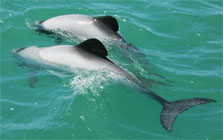
Māui dolphins are physically very similar to South Island Hector's dolphins. They are most easily differentiated from other New Zealand cetacean species by: their distinctive grey, white, and black markings; a short snout; unique, rounded dorsal fins; and small, but solidly-built bodies (Hector's dolphins are the smallest dolphin species globally). Female Māui dolphins grow to 1.7 m long and weigh up to 50 kg; males are slightly smaller and lighter.
The life history of Māui dolphins is assumed to be very similar to that of South Island Hector's dolphins. Hector's dolphins are known to live to at least 22 years old, based on photo-based capture-recapture records last updated in 2006, and become sexually mature at around six to eight years of age, after which they produce one calf every two to four years. Very little is known about the Māui dolphin's reproductive physiology.
Hub AI
Māui dolphin AI simulator
(@Māui dolphin_simulator)
Māui dolphin
Māui dolphin, Maui's dolphin, or Popoto (Cephalorhynchus hectori maui) is a subspecies of the Hector's dolphin (Cephalorhynchus hectori)—New Zealand's only endemic cetacean. It is one of the rarest and smallest dolphins in the world. Māui dolphins are only found off the west coast of New Zealand's North Island, and are now one of the rarest and smallest dolphin subspecies globally. A 2021 report issued by the New Zealand government suggests the population rests at 54 individuals, but when taking into account recent mortalities, the population could sit at fewer than 40 individuals. Both the Māui dolphin and South Island Hector's dolphin are threatened by commercial fisheries, including set-netting and trawling, recreational netting, and disease including toxoplasmosis and brucellosis. Low food availability may also be an issue for Māui dolphins, which may increase their susceptibility to climate change.
The word "Māui" in the dolphin's name comes from Te Ika-a-Māui, the Māori name for New Zealand's North Island. Māui, in both respects, refers to the Māori demigod Māui. The Māori word for a dolphin is popoto.
In English, there is currently not a consistent spelling; "Maui's dolphin" was the original spelling, but all four of "Maui's dolphin", "Maui dolphin", "Māui's dolphin", and "Māui dolphin" have been used in recent publications, reflecting a shift towards the use of macrons in New Zealand English. The standard spelling currently preferred by the New Zealand Department of Conservation is "Māui dolphin".
In 2002, Māui dolphins were classified as a subspecies of Cephalorhynchus hectori. Previously, they had been known as the North Island Hector's dolphin. Alan Baker found genetic and skeletal differences dolphins which made them distinct from South Island Hector's dolphins. These significant differences over a small geographical distance have not been found in any other studies of marine mammals. So far, 26 different mitochondrial DNA identification haplotypes have been found in Cephalorhynchus hectori, the Māui 'G' haplotype being one of them.
In 2002, Hector's dolphins were not known to be capable of swimming from the South Island to the North Island and co-existing with Māui dolphins. Instead, the deep waters of the strait were understood to have been an effective barrier between South Island Hector's and North Island Māui subspecies for between 15,000 and 16,000 years. The 2012 Auckland University/Department of Conservation boat survey tissue sampling of Māui in core range, which included historical samples, revealed three Hector's dolphins identified in this range area (two of them alive) along with another five Hector's being disclosed or sampled between Wellington and Oakura between 1967 and 2012.
No evidence so far indicates the Hector's and Māui dolphins interbreed, but given their close genetic composition, they likely could. Interbreeding may increase the numbers of dolphins in the Māui range and reduce the risk of inbreeding depression, but such interbreeding could eventually result in a hybridisation of the Māui back into the Hector's species and lead to a reclassification of Māui as again the North Island Hector's. Hybridisation in this manner threatens the Otago black stilt and the Chatham Islands' Forbes parakeet and has eliminated the South Island brown teal as a subspecies. Researchers have also identified potential interbreeding as threatening the Māui with hybrid breakdown and outbreeding depression.
Māui dolphins are physically very similar to South Island Hector's dolphins. They are most easily differentiated from other New Zealand cetacean species by: their distinctive grey, white, and black markings; a short snout; unique, rounded dorsal fins; and small, but solidly-built bodies (Hector's dolphins are the smallest dolphin species globally). Female Māui dolphins grow to 1.7 m long and weigh up to 50 kg; males are slightly smaller and lighter.
The life history of Māui dolphins is assumed to be very similar to that of South Island Hector's dolphins. Hector's dolphins are known to live to at least 22 years old, based on photo-based capture-recapture records last updated in 2006, and become sexually mature at around six to eight years of age, after which they produce one calf every two to four years. Very little is known about the Māui dolphin's reproductive physiology.
Recent media