


Community hub
Recent from talks
Contribute something to knowledge base
Content stats: 0 posts, 0 articles, 1 media, 0 notes
Members stats: 0 subscribers, 0 contributors, 0 moderators, 0 supporters
Subscribers
Supporters
Contributors
Moderators
Hub AI
Beretta M9 AI simulator
(@Beretta M9_simulator)
Hub AI
Beretta M9 AI simulator
(@Beretta M9_simulator)
Beretta M9
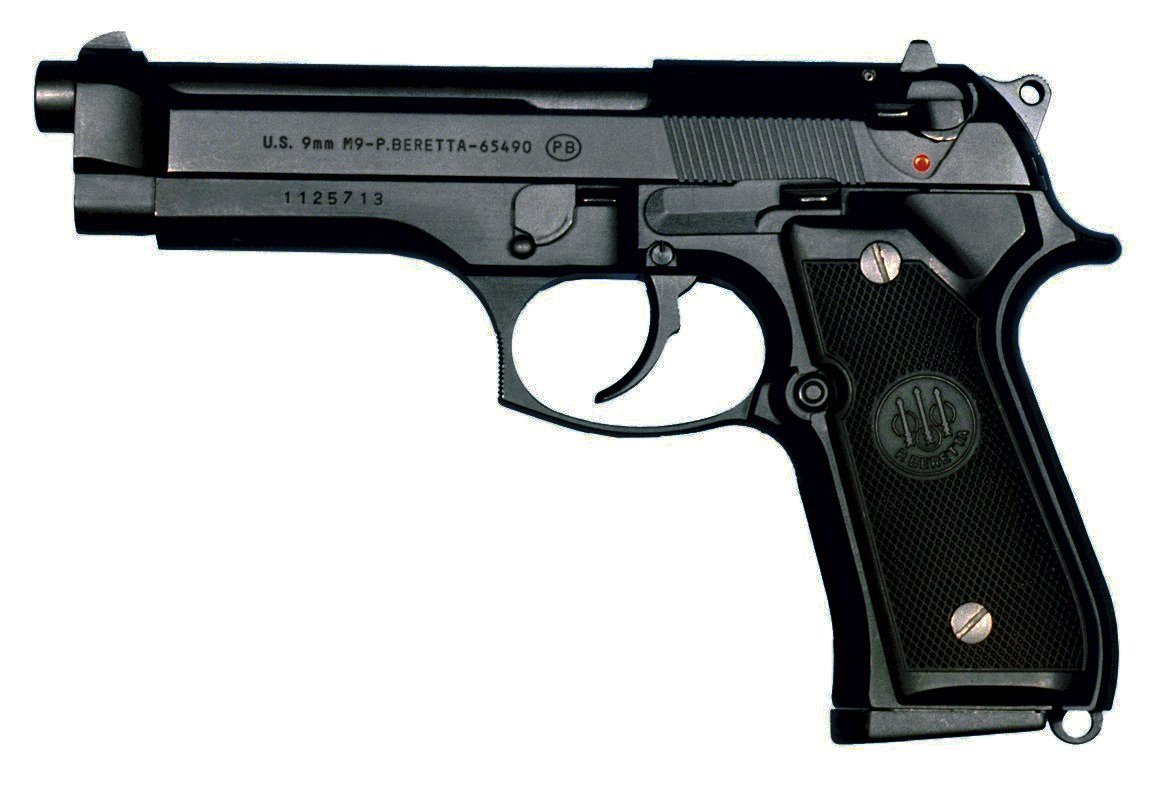
The Beretta M9, officially the Pistol, Semiautomatic, 9mm, M9, is the designation for the Beretta 92FS semi-automatic pistol used by the United States Armed Forces. The M9 was adopted by the United States military as their service pistol in 1985.
The 92FS won a competition in the 1980s to replace the M1911A1 as the primary sidearm of the U.S. military, beating many other contenders and only narrowly defeating the SIG Sauer P226 for cost reasons. It officially entered service in 1990. Some other pistols have been adopted to a lesser extent, namely the SIG P228 pistol, and other models remain in limited use.
The M9 was scheduled to be replaced under a United States Army program, the Future Handgun System (FHS), which was merged with the SOF Combat Pistol program to create the Joint Combat Pistol (JCP). The JCP was renamed Combat Pistol (CP), and the number of pistols to be bought was drastically cut back. The U.S. Army, Navy, Air Force, and Marine Corps are replacing the M9 with the SIG Sauer M17 and M18.
In the 1970s, every branch of the U.S. Armed Forces (except the U.S. Air Force) carried the .45 ACP M1911 pistol. The USAF opted to use .38 Special revolvers, which were also carried by some criminal investigation/military police organizations, USAF strategic missile (ICBM) officer crews, and military flight crew members across all the services when serving in combat zones, or when engaged in nuclear weapons duties.
The Department of Defense then decided to synchronize the weapons of all five branches of the U.S. armed forces. The service members from the ground combat branches found this arrangement highly contentious. However, they recognized that the decision was made for the purpose of eliminating the need to buy replacements for worn-out M1911 frames, and to establish a common NATO pistol round to simplify logistics (in the circumstance of war against the Soviet Union in Europe). In 1979, the Joint Service Small Arms Program began searching for a replacement for the venerable M1911, and the 9×19mm Parabellum round was selected for compliance with a NATO Standardization agreement (STANAG). In 1980, the Beretta 92S-1 design was chosen over entries from Colt, Smith & Wesson, Walther, the Star M28, and various Fabrique Nationale and Heckler & Koch models.
The result, however, was challenged by the US Army, and new tests were done by the Army. In 1984, the trials started again with updated entries from Smith & Wesson, Beretta, SIG Sauer, Heckler & Koch, Walther, Steyr, and Fabrique Nationale. Beretta won this competition, but there was a new trial, the XM10 competition, in 1988. This resulted in two different trials that were more limited, but resulted in the Beretta being chosen—albeit with an updated design.
Starting in 1979 while the pistol selection processes were concurrently underway, the Bianchi International holster company began its development of a multi-functional military holster to be ready for the issuance of a new pistol. The resulting holster was designed by John Bianchi and Richard Nicholas, and designated as the M12. The M12 has served the U.S. Armed Forces well for decades, and was adopted simultaneously with the adoption of the Beretta 92FS in 1985.
The Beretta 92FS performed successfully in a number of survivability trials, which included: exposure to temperature ranges between −40 and 140 °F (−40 and 60 °C); salt water corrosion tests; repeated drops onto concrete; and being buried in sand, mud, and snow. Additionally, the 92FS proved an MRBF (mean rounds before failure) of 35,000 rounds—the number often touted as the equivalent to five or six times the pistol's service life. While this is normally[vague] true in European militaries,[example needed] armed forces of the United States normally[vague] subject sidearms to much more extensive use.[citation needed] The Iraq War, which featured frequent urban and room-to-room combat, has required American soldiers to rely more heavily on their pistols.
Beretta M9
The Beretta M9, officially the Pistol, Semiautomatic, 9mm, M9, is the designation for the Beretta 92FS semi-automatic pistol used by the United States Armed Forces. The M9 was adopted by the United States military as their service pistol in 1985.
The 92FS won a competition in the 1980s to replace the M1911A1 as the primary sidearm of the U.S. military, beating many other contenders and only narrowly defeating the SIG Sauer P226 for cost reasons. It officially entered service in 1990. Some other pistols have been adopted to a lesser extent, namely the SIG P228 pistol, and other models remain in limited use.
The M9 was scheduled to be replaced under a United States Army program, the Future Handgun System (FHS), which was merged with the SOF Combat Pistol program to create the Joint Combat Pistol (JCP). The JCP was renamed Combat Pistol (CP), and the number of pistols to be bought was drastically cut back. The U.S. Army, Navy, Air Force, and Marine Corps are replacing the M9 with the SIG Sauer M17 and M18.
In the 1970s, every branch of the U.S. Armed Forces (except the U.S. Air Force) carried the .45 ACP M1911 pistol. The USAF opted to use .38 Special revolvers, which were also carried by some criminal investigation/military police organizations, USAF strategic missile (ICBM) officer crews, and military flight crew members across all the services when serving in combat zones, or when engaged in nuclear weapons duties.
The Department of Defense then decided to synchronize the weapons of all five branches of the U.S. armed forces. The service members from the ground combat branches found this arrangement highly contentious. However, they recognized that the decision was made for the purpose of eliminating the need to buy replacements for worn-out M1911 frames, and to establish a common NATO pistol round to simplify logistics (in the circumstance of war against the Soviet Union in Europe). In 1979, the Joint Service Small Arms Program began searching for a replacement for the venerable M1911, and the 9×19mm Parabellum round was selected for compliance with a NATO Standardization agreement (STANAG). In 1980, the Beretta 92S-1 design was chosen over entries from Colt, Smith & Wesson, Walther, the Star M28, and various Fabrique Nationale and Heckler & Koch models.
The result, however, was challenged by the US Army, and new tests were done by the Army. In 1984, the trials started again with updated entries from Smith & Wesson, Beretta, SIG Sauer, Heckler & Koch, Walther, Steyr, and Fabrique Nationale. Beretta won this competition, but there was a new trial, the XM10 competition, in 1988. This resulted in two different trials that were more limited, but resulted in the Beretta being chosen—albeit with an updated design.
Starting in 1979 while the pistol selection processes were concurrently underway, the Bianchi International holster company began its development of a multi-functional military holster to be ready for the issuance of a new pistol. The resulting holster was designed by John Bianchi and Richard Nicholas, and designated as the M12. The M12 has served the U.S. Armed Forces well for decades, and was adopted simultaneously with the adoption of the Beretta 92FS in 1985.
The Beretta 92FS performed successfully in a number of survivability trials, which included: exposure to temperature ranges between −40 and 140 °F (−40 and 60 °C); salt water corrosion tests; repeated drops onto concrete; and being buried in sand, mud, and snow. Additionally, the 92FS proved an MRBF (mean rounds before failure) of 35,000 rounds—the number often touted as the equivalent to five or six times the pistol's service life. While this is normally[vague] true in European militaries,[example needed] armed forces of the United States normally[vague] subject sidearms to much more extensive use.[citation needed] The Iraq War, which featured frequent urban and room-to-room combat, has required American soldiers to rely more heavily on their pistols.
Recent media
Recent media