Hubbry Logo
MB-tracMB-tracMain
Open search
MB-trac
Community hub
MB-trac
logo
8 pages, 0 posts
0 subscribers
Be the first to start a discussion here.
MB-trac
MB-trac
from Wikipedia
MB-trac
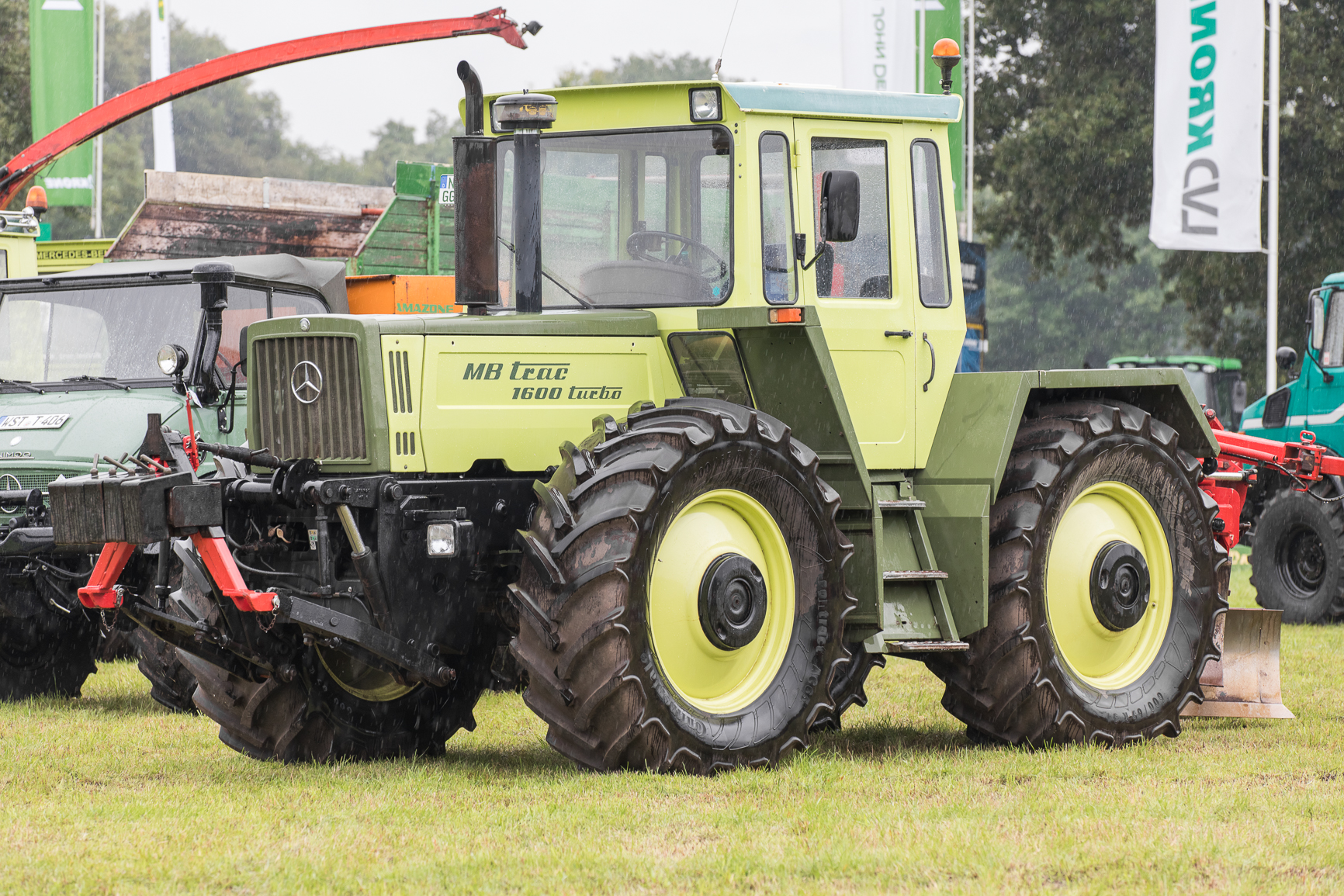
MB-trac 1600 turbo
Typeagricultural
ManufacturerDaimler-Benz AG
Production1973–1991
PropulsionEqual-size wheels

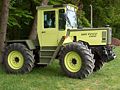
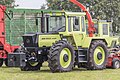
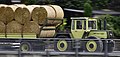
MB-trac is a range of agricultural tractors developed and produced from 1973 until 1991 by Mercedes-Benz Group, formerly known as Daimler-Benz. It is based on the trac design principle for tractors and shares its drivetrain with the Unimog. Mercedes-Benz offered the MB-trac in light duty, medium-duty, and heavy-duty versions in four different type series: 440, 441, 442, and 443. About 41,000 MB-tracs were made by former Daimler-Benz,[1] before the manufacture was sold to Werner Forsttechnik in the early 1990s, who developed the WF trac skidder from the MB-trac.

MB-trac types and model family

[edit]

Naming scheme

[edit]
MB-trac turbo 900

In total, four type series (440, 441, 442, and 443) and twenty-one different series-production types of MB-trac were made, with either ten or sixteen models, depending on whether the Turbo-designated models are considered separate from the non-Turbo-designated models. The naming scheme of the MB-trac is mostly homogeneous, with MB trac followed by a number roughly indicative of the engine's DIN-PS power output times ten. Models equipped with a turbocharger have a turbo suffix in their model name, and models with an additional intercooler have an intercooler suffix instead. The exceptions to this naming scheme are the MB-trac 65/70, which has a power-output figure indicative of the DIN-PS/SAE-hp power output, MB-trac 900, MB-trac 1300 and MB-trac 1500, which have no turbo suffix despite being turbocharged, and the MB-trac turbo 900, which has a turbo prefix rather than a suffix. The MB-trac name is spelled MB-trac in technical documents, but MB trac on the tractors' bonnets.[2]

Model overview

[edit]

Light-duty (440 series)

[edit]
Model Type designation Engine type Displacement dm³ Rated power in kW (PS)

at min−1

Torque N·m

at min−1

Production Number built
MB-trac 65/70 440.161 OM 314 3.784 48 (65)

2,400

216

1600

1973–1975 2.714
MB-trac 700 440.162 OM 314 3.784 48 (65)

2,400

216

1600

1976–1982 1.364
MB-trac 700 440.167 OM 314.LIII 3.784 48 (65)

2,400

226

1400

1982–1987 1.569
MB-trac 700 440.171 OM 364.V 3.972 50 (68)

2,400

235

1800–1900

1987–1991 899
MB-trac 800 440.163 OM 314 3.784 53 (72)
2.550
from 06/79: 55 (75)
2.600
221

1600

1975–1982 8.717
MB-trac 800 440.168 OM 314.LII 3.784 55 (75)

2,600

245

1600

1982–1987 1.990
MB-trac turbo 900 440.169 OM 314A 3.784 63 (85)

2,400

294

1600

1982–1987 3.277
MB-trac 800 440.172 OM 364 3.972 57 (78)

2,400

263

1500–1800

1987–1991 835
MB-trac 900 440.164 OM 314A 3.784 63 (85)

2,400

294

Skkssksks

1981–1982 1.090
MB-trac 900 turbo 440.173 OM 364A.II/1 3.972 66 (90)

2,400

313

1400–1800

1987–1991 2.148

Medium-duty (441 series)

[edit]
Model Type designation Engine type Displacement dm³ Rated power in kW (PS)

at min−1

Torque N·m

at min−1

Production Number built
MB-trac 1000 441.161 OM 352 5.675 70 (95)

2,400

324

1700

1982–1987 4.346
MB-trac 1000 441.162 OM 366.XV 5.958 74 (100)

2,400

350

1500–1800

1987–1991 2.613
MB-trac 1100 441.163 OM 366 5.958 81 (110)

2,400

375

1500–1800

1987–1991 1.283

Heavy-duty (442 and 443 series)

[edit]
Model Type designation Engine type Displacement dm³ Rated power in kW (PS)

at min−1

Torque N·m

at min−1

Production Number built
MB-trac 1100 442.161 OM 352.XIX 5.675 81 (110)

2,600

364

1,800

1976–1984 551
MB-trac 1100 443.160 OM 352.XIX 5.675 81 (110)

2,600

364

1,800

1984–1987 72
MB-trac 1300 443.161 OM 352.XIX 5.675 92 (125)

2,500

412

1,700

1976–1987 2.908
MB-trac 1300 turbo 443.163 OM 366A.IV/1 5.958 92 (125)

2,400

425

1,600–1,800

1987–1991 474
MB-trac 1500 443.162 OM 352A.LIII/3 5.675 110 (150)

2,500

from 03/82: 510

1500

1980–1987 2,855
MB-trac 1400 turbo 443.164 OM 366A.V/1 5.958 100 (136)

2,400

470

1600–1800

1987–1991 398
MB-trac 1600 turbo 443.166 OM 366A.VI/1 5.958 115 (156)

2,400

530

1600–1800

1987–1991 1,072
MB-trac 1800 intercooler 443.166 OM 366LA 5.958 132 (180)

2,400

645

1600–1800

1990–1991 190

[2]

History

[edit]
MB-trac 65/70

Former Daimler-Benz had been making the Unimog, a tractor-like implement carrier vehicle, since 1951. Mercedes-Benz customers however sought a dedicated agricultural and silvicultural tractor. Thus, Daimler-Benz, on 25 March 1968 issued a development order for an agricultural tractor that would share various components with the Unimog 403. Throughout the development phase, various prototypes were built; these were designated the AM 60. During the development phase, a 150 PS (110 kW) version with a rotating steering-column and driver seat was considered, but originally not put forward.[2]

Eventually, the 440 series MB-trac was presented at the 1972 DLG fair as the MB-trac 65/70. Series production started on 1 July 1973 at the Mercedes-Benz Gaggenau plant [de], alongside the Unimog. Until 31 December 1973, 520 units of the MB-trac were produced. The original colour was pebble-grey with red wheels.[2] In March 1976, the heavy-duty 442 and 443 series MB-trac production commenced, which shares various components with the Unimog 425.[2]

MB-trac 1800 intercooler

In 1987, Daimler-Benz entered into a strategic cooperation with Deutz, who at the time built the Deutz Intrac, a similar trac-like tractor. Joint development was carried out by Daimler-Benz (40 %) and Deutz (60 %) owned Trac-Technik-Entwicklungsgesellschaft (TTE) throughout the late 1980s, however, due to cost concerns, development was cancelled, and it was decided at Daimler-Benz to cancel the MB-trac as a result.[3]

In 1990, the MB-trac lineup saw its last and most powerful addition, the MB-trac 1800 intercooler. It was based on a 1600 turbo, but had an additional intercooler installed. Production ended in 1991, and Daimler-Benz sold the manufacture to Werner Forsttechnik, who developed the WF trac from the MB-trac.[4]

Technical description

[edit]

The MB-trac comprises four different series which have distinct technical differences. The following description thus only gives a basic overview of the MB-trac.

In general, the MB-trac is a trac type of agricultural tractor which is characterised by four same-size wheels, a frame undercarriage for the engine and front axle, and steerable wheels rather than articulated steering. The cab is installed in the center of the vehicle. This design allows the MB-trac to mount implements in front, on the rear axle behind the cab, and behind the rear axle.

Despite sharing its drivetrain with the Unimog 403 or Unimog 425, the MB-trac is not a modified Unimog. It is distinctly different and much more suited for agricultural use, for example, due to its larger wheels.[5] Unusual for an agricultural tractor, the MB-trac's front axle is coil sprung, which improves its on-road handling characteristics.

Light-duty MB-trac models were equipped with the Mercedes-Benz OM 314 or Mercedes-Benz OM 364 four-cylinder Diesel engines and use a gearbox with 16 forward and 8 reverse gears.[6] The gears are shifted using a conventional H-shift lever which is fitted with a splitter device. A separate gear lever is used to engage forward or reverse, and the same lever is also used to shift into a high-speed forward range, which does not exist in reverse. Medium-duty models are technically similar to the light-duty models but feature the Mercedes-Benz OM 352 or OM 366 six-cylinder engines. The heavy-duty MB-trac models were equipped with the Mercedes-Benz OM 352 or Mercedes-Benz OM 366 six-cylinder Diesel engines,[2] and have a dedicated reverse-drive feature with a reversible cab and gearbox.[6]

Bibliography

[edit]

References

[edit]
Revisions and contributorsEdit on WikipediaRead on Wikipedia
from Grokipedia
The MB-trac is a series of versatile, all-wheel-drive tractors produced by from 1973 to 1991, designed primarily for demanding applications in , , and related fields such as road construction and winter services. Featuring four equal-sized wheels for balanced weight distribution and exceptional traction, these high-power machines were engineered with a distinctive boxy cab and three attachment points—front, rear, and on the body—for flexible implement mounting, including optional at both ends. Capable of speeds up to 50 km/h, the MB-trac stood out as one of the earliest tractors to achieve such roadworthy performance while maintaining robust off-road capabilities. Developed in the late 1960s at Mercedes-Benz's plant, the MB-trac originated as a in 1969 and drew heavily on technology, including components from the Unimog U 406 series, to ensure cost efficiency, parts commonality, and ease of maintenance. The first model, the MB-trac 65/70 (part of the 440 series), debuted at the German Agricultural Society exhibition in in 1972, with series production commencing on July 1, 1973. Over its nearly two-decade run, the lineup expanded to 11 models, ranging from the lighter-duty MB-trac 65/70 with around 65-70 horsepower to the heavy-duty MB-trac 1800 delivering 180 hp for towing and intensive operations. Although initially considered for military use by the , the design evolved into a specialized " " tailored for civilian productivity. Production ceased in 1991 amid shifting agricultural market dynamics and the rise of specialized competitors, after which rights were sold to Werner Forsttechnik in for rebranding as the WF-trac. Despite its discontinuation, the MB-trac garnered a for its durability and innovative engineering, becoming a sought-after collector's item; its 50th anniversary was marked in 2023 with special exhibitions and merchandise. Elements of its design, such as modular attachments and all-wheel drive, continue to influence modern implement carriers used in similar versatile roles.

History and Development

Origins (1960s–1972)

In the late 1960s, sought to diversify its portfolio beyond automotive and commercial vehicles by entering the agricultural market, leveraging its experience with the versatile platform to address the increasing demand for high-power, multi-purpose farming equipment. This move was motivated by the Unimog's original agricultural roots, which had evolved into broader applications, creating an opportunity for a dedicated line that could compete in efficiency and durability. Development of the MB-trac prototype began in 1969 at the Mercedes-Benz plant in , , where engineers focused on adapting proven U 406 components to minimize costs and enable parts standardization for easier maintenance. Key design objectives included a robust frame undercarriage to enhance longevity under heavy loads and four equal-sized wheels with all-wheel drive to provide superior traction on uneven terrain, distinguishing it from conventional tractors with smaller front wheels that often struggled in demanding conditions. The trac-type configuration emphasized track-like stability and power distribution, prioritizing conceptual reliability over traditional row-crop layouts. The MB-trac 65/70 prototype, representing the initial 440 series, debuted publicly at the German Agricultural Society (DLG) exhibition in from May 28 to June 4, 1972, marking Mercedes-Benz's formal introduction to specialized and forestry machinery. This all-wheel-drive model, built on influences for foundational engineering, garnered attention as a significant due to its balanced wheel setup and frame design, which promised better field performance and road speeds compared to existing competitors.

Production Era (1972–1991)

The production era of the MB-trac began with the public debut of the 440 series prototype, the MB-trac 65/70, at the DLG agricultural show in from May 28 to June 4, 1972, evolving from initial development work initiated in 1969 at the plant in . Series production of these light-duty models ramped up on July 1, 1973, at the same facility, where assembly lines were adapted to incorporate the tractor's design and all-wheel-drive system alongside ongoing manufacturing. This integration streamlined operations, enabling efficient output growth and establishing as the dedicated hub for MB-trac production through skilled workforce specialization in heavy-duty components. The lineup expanded in 1976 to meet medium- and heavy-duty market needs, with the 442 series heavy-duty models launching in July via the MB-trac 1000, produced at and quickly uprated to the MB-trac 1100 for improved engine performance. This was followed in October 1976 by the initial 443 series offering, the MB-trac 1300, further diversifying the range for demanding agricultural tasks. In 1982, the medium-duty 441 series was introduced with the MB-trac 1000, showcased at the DLG show in as a versatile bridge between lighter and heavier variants, enhancing the factory's assembly flexibility. Throughout the 1980s, Gaggenau operations adapted to rising demands for enhanced performance, incorporating turbocharging to boost power outputs, as seen in the 1980 MB-trac 1500 with its 110 kW diesel engine. These evolutionary updates addressed market shifts toward higher efficiency and compliance with tightening emissions regulations in Europe, culminating in the 1987 expansion to eight models, including the turbocharged MB-trac 1600 (443 series) with a 115 kW six-cylinder engine, presented at the SIMA trade fair in Paris. By the end of active Mercedes-Benz production in 1991, the Gaggenau plant had assembled approximately 41,000 units across all series, underscoring the MB-trac's role as a robust agricultural staple.

Discontinuation and Aftermath

By the late , intensifying competition from specialized agricultural tractor manufacturers in and beyond, combined with the 1987 joint venture between and Klöckner-Humboldt-Deutz (KHD) to develop new tractor models, pressured to reassess its position in the sector, ultimately leading to the decision to end MB-trac production. This shift reflected broader market consolidation, where the collaboration proved unprofitable, prompting to streamline its offerings amid declining demand for versatile, portal-axle tractors like the MB-trac. The final MB-trac, an 1800 Intercooler model, rolled off the assembly line at the plant on December 17, 1991, marking the official close of nearly two decades of production that totaled approximately 41,000 units since 1972. In the immediate aftermath, Daimler-Benz sold the manufacturing rights and production line to Werner Forsttechnik in , , allowing for the continuation of the platform under new ownership. Under Werner Forsttechnik, initial production of MB-trac derivatives resumed in 1993, with a primary focus on adapting the design for applications, rebranded as the WF-trac series to suit specialized woodland tasks like timber handling and terrain navigation. This transition preserved elements of the original engineering while tailoring them to niche markets. The discontinuation prompted Mercedes-Benz's agricultural division to pivot resources toward expanding the lineup, enhancing its appeal for farming and multi-purpose use to fill the gap left by the MB-trac. This strategic refocus integrated variants more deeply into agricultural roles, leveraging their off-road capabilities without the dedicated production infrastructure.

Model Range

Naming Convention

The MB-trac naming convention follows a systematic structure that combines a brand prefix with numeric and alphanumeric indicators to denote power output, duty class, and specific features. The prefix "MB-trac" signifies the tractor series, derived from its origins in the platform and intended for versatile agricultural and industrial use. This is followed by a numeric representing approximate in metric horsepower (Pferdestärke, or PS), such as "65/70" for models delivering 65 to 70 PS or "1000" for around 100 PS, providing a quick reference to the tractor's capability without exhaustive specifications. Series designations further classify models by duty level and structural design, using three-digit codes like 440 for light-duty variants suited to general farming tasks, 441 for medium-duty models bridging lighter and heavier applications, and 442 or 443 for heavy-duty configurations optimized for demanding operations such as or large-scale . These series numbers reflect internal type classifications at , evolving to accommodate progressive enhancements in frame strength and component integration. For instance, the initial 440 series models emphasized agility, while 442 and 443 series incorporated reinforced elements for higher loads. Variants are distinguished by suffixes appended to the base name, such as "Turbo" for models equipped with turbocharged engines to boost performance, or "S" denoting special editions with customized features like enhanced cabs or equipment packages. These suffixes highlight optional upgrades without altering the core power or series designation. The naming also indirectly ties to and intended applications; for example, the "1000" designation corresponds to models with approximately 6.0-liter six-cylinder engines, tailored for medium-duty roles requiring balanced and versatility. Over time, the convention evolved from the debut of the 65/70 prototype in 1972, which established the foundational series format, to 1980s refinements that introduced turbo suffixes and expanded series like 443 for higher-output heavy-duty models, reflecting advancements in engine technology and market demands for greater efficiency. This progression maintained consistency in denoting power and class while allowing for iterative improvements.

440 Series (Light-Duty)

The 440 series comprised the light-duty models of the MB-trac lineup, introduced in 1972 with the prototype MB-trac 65/70 at the DLG in . These entry-level tractors were engineered for smaller farms and lighter agricultural operations, building on the Unimog's all-wheel-drive for versatility in fieldwork. Production commenced in 1973 at the Gaggenau plant, marking Mercedes-Benz's entry into the agricultural market with a focus on durability and multi-purpose capability. Equipped with Mercedes-Benz OM 314 or OM 364 four-cylinder diesel engines, the 440 series featured displacements of 3.8 to 4.0 liters and power outputs ranging from 65 to 85 horsepower, depending on the variant and turbocharging. For instance, the initial MB-trac 65/70 delivered 65 hp from its 3.8-liter OM 314 engine, while later models like the MB-trac 800 provided 78 hp from a 4.0-liter OM 364. Key specifications included a of approximately 2.4 meters, an operating weight of 3,270 to 3,840 kg, and a top speed of 25 km/h (40 km/h optional in later configurations). The series excelled in applications such as general fieldwork, mowing, and light plowing, where its compact size and balanced supported tasks on smaller operations without the need for heavier machinery. Subsequent models, including the MB-trac , , and turbo introduced from the late 1970s onward, incorporated minor power tweaks—such as increased output through turbo variants—and optional enclosed cabs for enhanced operator protection during extended use in the . The naming scheme reflected approximate power in horsepower, as seen in designations like for around 70 hp models.

441 Series (Medium-Duty)

The 441 Series represented Mercedes-Benz's medium-duty offering in the MB-trac lineup, introduced in 1982 to fill the gap between lighter models and heavier variants, providing balanced performance for versatile agricultural tasks on mid-sized farms. The series debuted with the MB-trac 1000 at the DLG show in , expanding from the earlier 440 Series light-duty tractors by incorporating more robust capabilities for demanding yet not extreme operations. Core models encompassed the 1000, 1100, and 1300, all equipped with inline 6-cylinder diesel engines of roughly 6.0-liter displacement, delivering power outputs from 100 to 125 horsepower to handle plowing, hauling, and other mid-range duties efficiently. These engines, such as the OM 352 and OM 366 variants, emphasized reliability and in a compact inline configuration. With a of approximately 2.6 meters and operating weights around 5,500 kg, the tractors offered stable handling and sufficient traction for medium-scale fieldwork without the bulk of heavy-duty designs. They featured as standard, contributing to their adaptability across varied terrains. Enhanced formed a hallmark, with systems providing up to 60 liters per minute pump flow and rear lift capacities exceeding 4,700 kg to accommodate a wide array of implements like mowers and loaders. Optional all-wheel improved precision in tight spaces, while the enclosed cab with available ensured operator comfort during extended use. The series remained in production through 1991, with mid-1980s updates including the 1300 Turbo variant introduced in 1987, which boosted output via turbocharging for enhanced torque in challenging conditions.

442/443 Series (Heavy-Duty)

The 442 and 443 series formed the heavy-duty segment of the MB-trac lineup, designed for intensive agricultural and industrial applications requiring superior power and robustness. Production of the initial models in this series began in July 1976 at the Gaggenau plant with the MB-trac 1000 (442 series, naturally aspirated 100 hp), which was soon uprated to the MB-trac 1100 (110 hp), followed by the MB-trac 1300 (443 series, 125 hp) in October 1976. Later expansions included the MB-trac 1500 (150 hp) in 1980 and the MB-trac 1400 Turbo (136 hp) and 1600 Turbo (156 hp) models introduced in 1987 as part of a reworked range. Further late-1980s additions comprised the MB-trac 1700 Turbo (170 hp, 1989) and the flagship MB-trac 1800 (180 hp, 1989). These tractors shared components with the Unimog 425, enhancing their durability for demanding operations. Initial models featured naturally aspirated six-cylinder diesel engines, with later variants equipped with turbocharged engines (some with intercoolers); displacements ranged from 5.7 to 6.0 liters (later up to 6.7 liters), delivering power outputs from 100 to 180 horsepower. The MB-trac 1500 utilized the OM 352A engine at 150 hp, while the flagship MB-trac 1800 employed the OM 442A with 180 hp at 2,400 rpm. Transmission options included a 14-speed setup for versatile speed control in heavy work. The reinforced chassis supported a wheelbase of 2.65 meters and operating weights up to approximately 6,500 kg, with rear lift capacities reaching 6,500 kg (up to 7,000 kg on later models) to handle substantial implements. Key innovations in the later 443 series models emphasized enhanced performance under prolonged heavy loads, including turbocharging across the lineup and an on select and higher variants for improved efficiency and cooling. These features allowed the tractors to excel in tasks such as deep and heavy material hauling, where sustained power and thermal management were critical. The series' all-wheel-drive configuration and portal axles further contributed to their stability on uneven . Production of these heavy-duty models continued until 1991.

Technical Specifications

Frame and Suspension

The MB-trac series tractors employed a robust welded channel frame with tubular cross-members, providing exceptional durability and the ability to handle heavier loads than typical agricultural tractors of the era. This construction ensured a high load capacity, with the frame supporting operational weights exceeding 10 tons when fitted with implements, while maintaining structural integrity under demanding field conditions. The was derived from the platform, incorporating a central tube chassis element for enhanced torsional flexibility and stability. Portal axles, rigidly mounted to the , formed the core of the suspension system, delivering superior off-road performance through hub reduction gearing that elevated the driveline for increased ground clearance, typically ranging from 40 to 53 cm depending on the model and tire configuration. The front axle featured independent suspension with a tube, , and maintenance-free heavy-duty springs, allowing for long-travel articulation while keeping all wheels in contact with uneven . This setup contributed to a balanced ride, with the rear axle similarly benefiting from the portal design for consistent load handling. All MB-trac models utilized four equal-sized wheels, often with rim diameters of 26 to 34 inches fitted with radial tires such as 16.9R26 or 18.4R34, which distributed weight evenly to achieve uniformly low ground pressure and minimize . The tractors achieved approximately 60/40 (front/rear) under static conditions, enhancing traction and stability across varied surfaces through all-wheel drive and differential locks on both axles. This even distribution, combined with the portal axles' elevation, enabled effective operation in tall crops and rough fields without excessive sinking or slippage.

Engines and Transmission

The MB-trac series featured a lineup of robust diesel engines from Mercedes-Benz's OM family, primarily the OM 314, OM 352, OM 362, and OM 364 series, all liquid-cooled inline configurations with either four or six cylinders depending on the model duty rating. These engines employed pre-chamber injection fuel systems, delivering reliable performance suited for agricultural demands, with specific fuel consumption typically around 250 g/kWh under load, reflecting Mercedes-Benz's emphasis on efficiency in diesel engineering. Power outputs across the series ranged from 65 hp in light-duty models like the Trac 700, equipped with the 3.8 L OM 314 four-cylinder engine producing 216 Nm of , to 180 hp in heavy-duty variants such as the Trac 1800, powered by a turbocharged 6.0 L six-cylinder unit generating up to 645 Nm. Torque curves generally peaked between 1,300 and 1,800 rpm, providing strong low-end pull for and transport tasks, with displacements centering on 4.0 L for four-cylinder setups and 5.7–6.0 L for six-cylinder options. Transmissions were synchronized gearboxes offering 8 to 24 forward speeds, with configurations varying by model—such as 12 forward and 6 reverse in base light-duty units or 16 forward and 8 reverse in medium-duty models like the Trac 1000—allowing versatile speed matching from creeping ratios under 2 km/h to road speeds up to 50 km/h depending on model and configuration. Optional powershift mechanisms, often ZF-sourced with four-speed shifts, enabled clutchless gear changes without power interruption, enhancing operator productivity during field operations. All MB-trac models incorporated permanent with lockable front and rear differentials, ensuring superior traction on uneven terrain.

Hydraulics, PTO, and Accessories

The MB-trac tractors utilized an open-center hydraulic system to support efficient implement operation, with pump flows ranging from 40 to 60 L/min across the model series to accommodate varying demands. This system operated at a maximum pressure of 200 bar for the 3-point hitch, enabling robust performance in lifting and positioning tasks. The rear 3-point hitch provided lift capacities of 4,000 to 7,000 kg at the hitch ends, scaling with the tractor's series—lower for light-duty 440 models and higher for heavy-duty 442/443 variants—to handle diverse agricultural implements effectively. The power take-off (PTO) system featured an independent rear configuration, selectable at 540 or 1,000 rpm to match standard implement requirements, with an optional front PTO for versatile front-mounted tools. This setup allowed for power transfer up to 130 hp, ensuring compatibility with high-demand attachments without compromising tractor stability. Accessories included a 12V electrical system with charging for powering lights and implement controls, enhancing operational and convenience in field conditions. Optional heavy-duty winches, such as those from Werner, were available for specialized tasks like or recovery. interlocks prevented unintended engagement of or PTO, while optional flow dividers enabled synchronized operation of multiple implements by evenly distributing hydraulic flow. Controls for these systems could be integrated into the cab for intuitive access during extended use.

Legacy

Market Impact and Collectibility

The MB-trac series experienced notable commercial success primarily within the European market, where it was widely adopted for agricultural, , and applications due to its versatile all-wheel-drive design and robust performance. Sales were concentrated in key countries such as and , reflecting the tractor's manufacturing base in , , and its alignment with regional demands for high-power, multi-purpose machinery. Limited exports extended to and , though units in these markets remain scarce today. Users praised the MB-trac for its exceptional reliability, particularly in challenging wet and muddy conditions, where its differential locks, all-wheel drive, and heavy-duty tires provided superior traction and stability compared to conventional tractors. The standardized components shared with the lineup facilitated efficient repairs and maintenance, contributing to strong user adoption across demanding sectors. Additionally, the series demonstrated solid resale value retention, bolstered by its durable construction and reputation for longevity. In contemporary times, the MB-trac has attained cult status among collectors and enthusiasts, supported by active restoration communities that preserve and showcase these tractors at gatherings and events. Its collectibility is underscored by high demand at auctions, where well-preserved examples command premium prices; for instance, a 1985 MB-trac 1500 sold for €61,290 in 2023, and a 1991 MB-trac 1600 fetched £94,336 in 2024. The model's enduring appeal was highlighted by its 50th anniversary celebrations in 2023, culminating in a dedicated at the Museum in in 2023, which drew international attention to its historical significance.

Successors and Derivatives

Following the discontinuation of MB-trac production in 1991, Mercedes-Benz shifted focus toward the series as spiritual successors for multi-purpose applications, particularly emphasizing implement carrier variants like the U400 and U500 models. These modern Unimogs retain key MB-trac design principles, including high-speed road capabilities, a dedicated platform behind the cab for attachments, and portal axles for superior ground clearance and traction in agricultural and off-road environments. The implement carrier is positioned by as a direct evolution, adapting the versatile, all-wheel-drive concept to contemporary demands in farming, , and while incorporating advanced and features. In the early , Daimler-Benz sold the MB-trac production to Werner Forsttechnik, a German specialist in and industrial machinery, enabling the development of derivative models under the banner starting in 1993. These forestry-oriented tractors, such as the 1100 and later series like the 1840 and 2345, build directly on the MB-trac's robust and , featuring cab-forward configurations for optimal visibility and maneuverability in dense woodland operations. The lineup prioritizes skidding and winching tasks, with 4x4 and 6x6 drivetrains, integrated cranes, and attachments tailored for timber handling, thus extending the MB-trac's multi-role heritage into specialized heavy-duty without significant structural overhauls. The MB-trac's innovative approach to high-speed, suspended tractors found a conceptual parallel in the series, introduced in 1991 as production of the MB-trac wound down. Both designs emphasize rapid between fields—up to 50 km/h for the MB-trac and up to 60 km/h or more for the Fastrac—along with full suspension for comfort and stability during heavy , marking a shared evolution toward faster, more versatile rather than a direct lineage. This similarity highlights the MB-trac's influence on broader industry trends, where cab-over engineering and all-wheel drive enabled efficient multi-tasking in large-scale farming. Contemporary adaptations of surviving MB-trac units demonstrate their enduring versatility in niche applications, such as conversions for precision spraying in row crops or custom attachments for specialized fieldwork, often retaining the original portal axles and systems for enhanced durability in rugged terrains. While no official Daimler revival of the MB-trac name has occurred, its technological legacy persists in Mercedes-Benz's current special vehicles, including Unimog-based carriers that echo the original's modular and off-road prowess for response and industrial tasks.

References

Add your contribution
Related Hubs
User Avatar
No comments yet.