


Community hub
Recent from talks
Contribute something to knowledge base
Content stats: 0 posts, 0 articles, 1 media, 0 notes
Members stats: 0 subscribers, 0 contributors, 0 moderators, 0 supporters
Subscribers
Supporters
Contributors
Moderators
MGM-51 Shillelagh
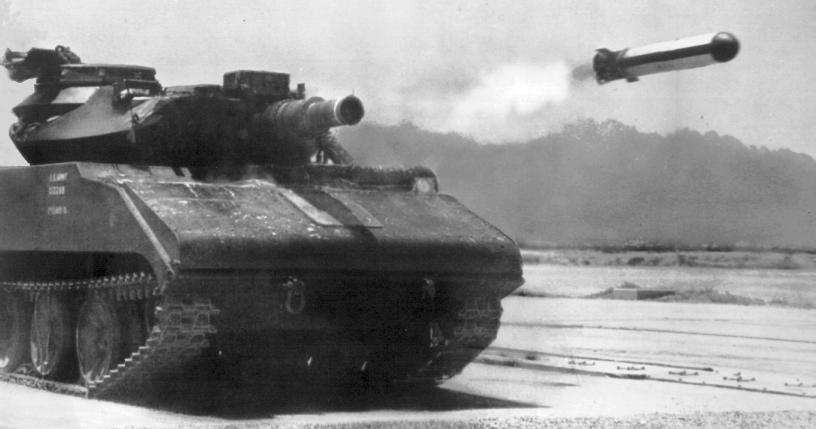
The Ford MGM-51 Shillelagh was an American anti-tank guided missile designed to be launched from a conventional gun (cannon). It was originally intended to be the medium-range portion of a short, medium, and long-range system for armored fighting vehicles in the 1960s and '70s to defeat future armor without an excessively large gun. Developing a system that could fire both shells and missiles reliably proved complex and largely unworkable for the United States.
It was originally developed for the experimental but never produced MBT-70 tank and served most notably as a primary weapon of the M551 Sheridan light tank, but the missile system was not issued to units serving in South Vietnam and was retired in 1996. It was also used on the M60A2 "Starship", which was phased out by 1981. Ultimately, very few of the 88,000 rounds produced were ever fired in combat, and the system was largely succeeded by the later BGM-71 TOW wire-guided missile, which was fielded in 1970. Western forces largely gave up on the gun-launched missile concept, although it remains in use on former Soviet Union designs.
The name of the system is that of a traditional wooden club from Ireland.
With the rapid increase in armor thickness during World War II, tanks were becoming increasingly able to survive rounds fired from even the largest of World War II-era anti-tank guns. A new generation of guns, notably the British 105 mm Royal Ordnance L7, were able to cope with newer tanks, but it appeared that in another generation the guns needed would be too large to be practical.
To overcome this potential difficulty, the US Army began to favor high-explosive anti-tank (HEAT), or shaped charge rounds in the 1950s. A shaped charge's penetration is not strongly dependent on the speed of the round, allowing rounds to be fired at much lower velocities, and thus from much lighter guns. They also work better at larger diameters, and a large-diameter low-velocity gun makes for an excellent assault gun that can be mounted on light or medium-weight vehicles. However, the low speed of the round makes it hard to aim over longer distances. The US Army sought to overcome this problem by developing guided missiles that had shaped charge warheads and were accurate beyond a few hundred yards.
In 1958, the Army thought that existing knowledge was sufficient to begin work on a guided missile with a HEAT warhead, and in June 1959 Sperry and Ford Aeronutronic were asked for designs to fill the shorter range role. Ford won the contract and started work on the XM13. The first test shots were fired in 1960, and limited production started in 1964. The missile was then known as the MGM-51A.
The basic system was quite advanced for its day. The missile body consisted of a long tube with fold-out fins at the extreme rear, which was propelled from the new M81 gun with a small charge strapped on the rear. Once clear of the gun, the fins popped open and the engine ignited. To keep the missile from spinning while in the gun due to the rifling, a small "key" fitted into a straight groove in the rifled gun. Aiming the missile was simple; the gunner simply kept his gunsight on the target, while electronics in the sighting system tracked the missile optically and sent corrections through an IR link, similarly to a TV remote control. In general the gunners were able to achieve excellent hit rates.
The main problem with the system is firing the main gun with a projectile vs. a missile. The recoil from the gun throws all the missile optics off, limiting the use of the M551 to either anti-tank or bunker buster.
MGM-51 Shillelagh
The Ford MGM-51 Shillelagh was an American anti-tank guided missile designed to be launched from a conventional gun (cannon). It was originally intended to be the medium-range portion of a short, medium, and long-range system for armored fighting vehicles in the 1960s and '70s to defeat future armor without an excessively large gun. Developing a system that could fire both shells and missiles reliably proved complex and largely unworkable for the United States.
It was originally developed for the experimental but never produced MBT-70 tank and served most notably as a primary weapon of the M551 Sheridan light tank, but the missile system was not issued to units serving in South Vietnam and was retired in 1996. It was also used on the M60A2 "Starship", which was phased out by 1981. Ultimately, very few of the 88,000 rounds produced were ever fired in combat, and the system was largely succeeded by the later BGM-71 TOW wire-guided missile, which was fielded in 1970. Western forces largely gave up on the gun-launched missile concept, although it remains in use on former Soviet Union designs.
The name of the system is that of a traditional wooden club from Ireland.
With the rapid increase in armor thickness during World War II, tanks were becoming increasingly able to survive rounds fired from even the largest of World War II-era anti-tank guns. A new generation of guns, notably the British 105 mm Royal Ordnance L7, were able to cope with newer tanks, but it appeared that in another generation the guns needed would be too large to be practical.
To overcome this potential difficulty, the US Army began to favor high-explosive anti-tank (HEAT), or shaped charge rounds in the 1950s. A shaped charge's penetration is not strongly dependent on the speed of the round, allowing rounds to be fired at much lower velocities, and thus from much lighter guns. They also work better at larger diameters, and a large-diameter low-velocity gun makes for an excellent assault gun that can be mounted on light or medium-weight vehicles. However, the low speed of the round makes it hard to aim over longer distances. The US Army sought to overcome this problem by developing guided missiles that had shaped charge warheads and were accurate beyond a few hundred yards.
In 1958, the Army thought that existing knowledge was sufficient to begin work on a guided missile with a HEAT warhead, and in June 1959 Sperry and Ford Aeronutronic were asked for designs to fill the shorter range role. Ford won the contract and started work on the XM13. The first test shots were fired in 1960, and limited production started in 1964. The missile was then known as the MGM-51A.
The basic system was quite advanced for its day. The missile body consisted of a long tube with fold-out fins at the extreme rear, which was propelled from the new M81 gun with a small charge strapped on the rear. Once clear of the gun, the fins popped open and the engine ignited. To keep the missile from spinning while in the gun due to the rifling, a small "key" fitted into a straight groove in the rifled gun. Aiming the missile was simple; the gunner simply kept his gunsight on the target, while electronics in the sighting system tracked the missile optically and sent corrections through an IR link, similarly to a TV remote control. In general the gunners were able to achieve excellent hit rates.
The main problem with the system is firing the main gun with a projectile vs. a missile. The recoil from the gun throws all the missile optics off, limiting the use of the M551 to either anti-tank or bunker buster.
Recent media
Recent media