
Recent from talks
MIM-46 Mauler
Knowledge base stats:
Talk channels stats:
Members stats:
MIM-46 Mauler
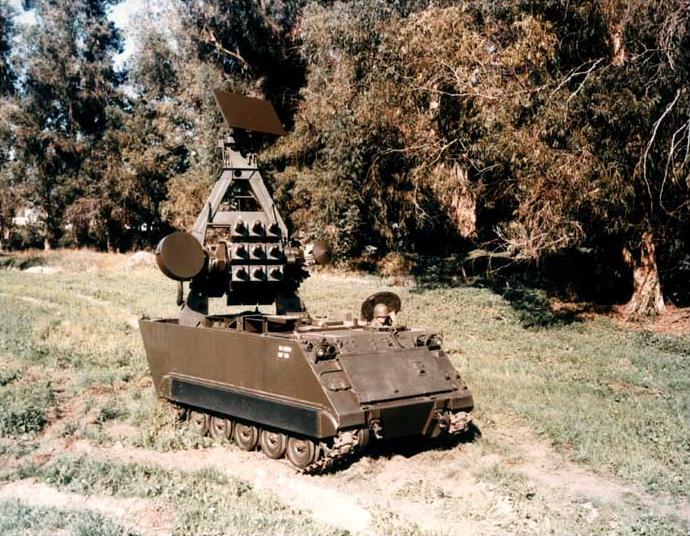
The General Dynamics Mauler was a self-propelled anti-aircraft missile system[citation needed] designed to a late 1950s US Army requirement for a system to combat low-flying high-performance tactical fighters and short-range ballistic missiles.
The system was a XM546 vehicle, based on the M113 chassis, carrying nine MIM-46 missiles in launch canisters, a tracking and illumination continuous wave radar, and the fire control system.
An ambitious design for its era, the Mauler ran into intractable problems during development, and was eventually canceled in November 1965. Cancellation of Mauler left the US Army with no modern anti-aircraft weapon, and they rushed development of the much simpler MIM-72 Chaparral and M163 Tracked Vulcan to fill this niche. These weapons were much less capable than Mauler, and were intended solely as a stop-gap solution until more capable vehicles were developed. In spite of this, no real replacement entered service until the late 1990s.
Both the US Navy and British Army were also expecting Mauler to fulfil their own short-range needs and its cancellation left them with the same problem. They developed RIM-7 Sea Sparrow and Rapier missile, respectively, to fill these needs.
After WWII, the US Army's first mobile anti-aircraft weapons were based on the Bofors 40 mm guns with first the M19 Multiple Gun Motor Carriage then the M42 Duster. First entering production in 1952, the Duster quickly became outdated as aircraft performance increased. Since manual acquisition, tracking and ranging left much to be desired RADUSTER envisioned adding radar ranging to the Duster. By 1955 it was realized that no simple modification to the M42 Duster would meet the need. Thus in 1956 the plan was to improve the T50 antiaircraft fire control system to the RADUSTER. One development RADUSTER and three user test weapons were created before termination.
Driven by the need to counter jet aircraft flying at up to 10,000 ft (3,000 m) and a slant range of 14,000 ft (4,300 m), the new system of a 37 mm Gatling gun on top of a modified M113 Armored Personnel Carrier chassis was approved as the T249 Vigilante in late 1956. A T248 towed version was also developed. Although the Vigilante was, like the Duster, optically aimed and guided, its high (3,000 rounds per minute) firing rate gave it much better performance against high-speed aircraft.
As the Vigilante program continued, the Army decided that any gun-based system was hopeless as speeds increased and engagement times dropped. The Vigilante had a maximum effective range of about 3,000 yd (2,700 m), and its shells took about 5 seconds to cross this distance. A jet aircraft flying at 500 mph (800 km/h) would cover over a kilometer during those 5 seconds. By the time a radar-assisted sighting system could develop a firing solution, the target would be out of range. The Army decided to cancel Vigilante and keep the Duster in service until a much more capable phase III all-missile system arrived to replace it.
Phase III was intended to produce an ultimate answer to air defense of front line Army troops. A small mobile missile system was envisioned to engage both aircraft and missiles up to 10,000 feet. It was very clear by May 1956 that this was beyond the state of the art. The Army decided to pursue the "best weapon system that could be developed to meet requirements of the forward area on a liberal time scale" to be available in the 1965 period.
Hub AI
MIM-46 Mauler AI simulator
(@MIM-46 Mauler_simulator)
MIM-46 Mauler
The General Dynamics Mauler was a self-propelled anti-aircraft missile system[citation needed] designed to a late 1950s US Army requirement for a system to combat low-flying high-performance tactical fighters and short-range ballistic missiles.
The system was a XM546 vehicle, based on the M113 chassis, carrying nine MIM-46 missiles in launch canisters, a tracking and illumination continuous wave radar, and the fire control system.
An ambitious design for its era, the Mauler ran into intractable problems during development, and was eventually canceled in November 1965. Cancellation of Mauler left the US Army with no modern anti-aircraft weapon, and they rushed development of the much simpler MIM-72 Chaparral and M163 Tracked Vulcan to fill this niche. These weapons were much less capable than Mauler, and were intended solely as a stop-gap solution until more capable vehicles were developed. In spite of this, no real replacement entered service until the late 1990s.
Both the US Navy and British Army were also expecting Mauler to fulfil their own short-range needs and its cancellation left them with the same problem. They developed RIM-7 Sea Sparrow and Rapier missile, respectively, to fill these needs.
After WWII, the US Army's first mobile anti-aircraft weapons were based on the Bofors 40 mm guns with first the M19 Multiple Gun Motor Carriage then the M42 Duster. First entering production in 1952, the Duster quickly became outdated as aircraft performance increased. Since manual acquisition, tracking and ranging left much to be desired RADUSTER envisioned adding radar ranging to the Duster. By 1955 it was realized that no simple modification to the M42 Duster would meet the need. Thus in 1956 the plan was to improve the T50 antiaircraft fire control system to the RADUSTER. One development RADUSTER and three user test weapons were created before termination.
Driven by the need to counter jet aircraft flying at up to 10,000 ft (3,000 m) and a slant range of 14,000 ft (4,300 m), the new system of a 37 mm Gatling gun on top of a modified M113 Armored Personnel Carrier chassis was approved as the T249 Vigilante in late 1956. A T248 towed version was also developed. Although the Vigilante was, like the Duster, optically aimed and guided, its high (3,000 rounds per minute) firing rate gave it much better performance against high-speed aircraft.
As the Vigilante program continued, the Army decided that any gun-based system was hopeless as speeds increased and engagement times dropped. The Vigilante had a maximum effective range of about 3,000 yd (2,700 m), and its shells took about 5 seconds to cross this distance. A jet aircraft flying at 500 mph (800 km/h) would cover over a kilometer during those 5 seconds. By the time a radar-assisted sighting system could develop a firing solution, the target would be out of range. The Army decided to cancel Vigilante and keep the Duster in service until a much more capable phase III all-missile system arrived to replace it.
Phase III was intended to produce an ultimate answer to air defense of front line Army troops. A small mobile missile system was envisioned to engage both aircraft and missiles up to 10,000 feet. It was very clear by May 1956 that this was beyond the state of the art. The Army decided to pursue the "best weapon system that could be developed to meet requirements of the forward area on a liberal time scale" to be available in the 1965 period.
Recent media