



Community hub
Recent from talks
Knowledge base stats:
Talk channels stats:
Members stats:
MK14
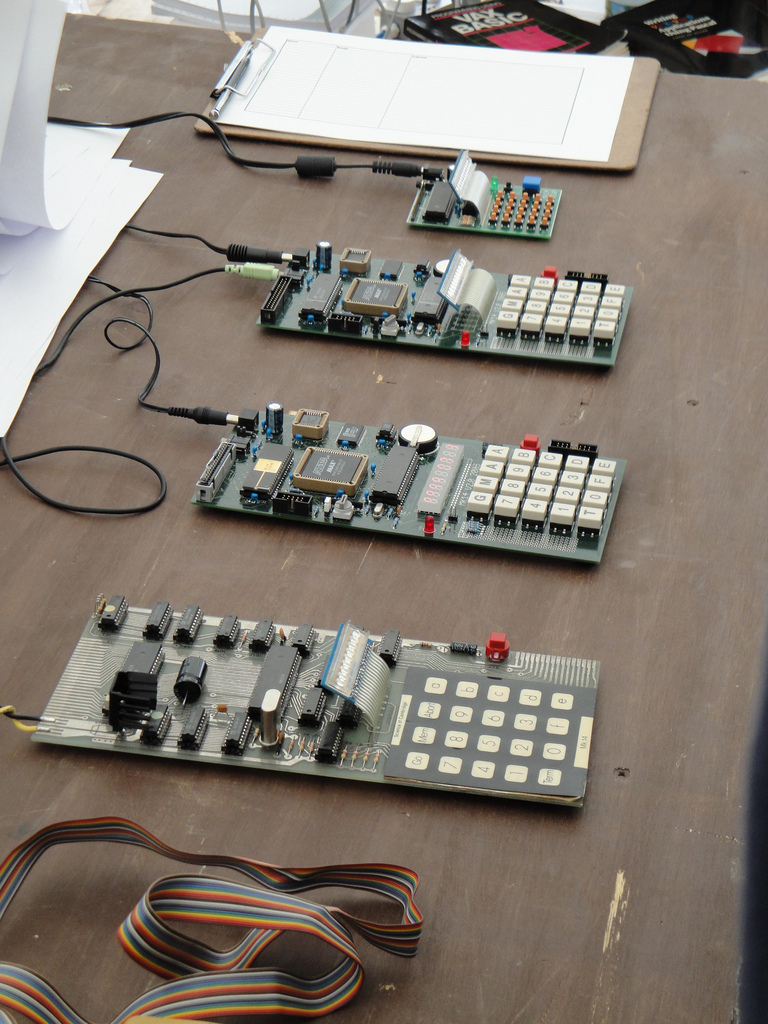
The MK14 (Microcomputer Kit 14) was a computer kit sold by Science of Cambridge of the United Kingdom, first introduced in 1977 for £39.95. The price was very low for a complete computer system at the time, and Science of Cambridge eventually sold over fifteen thousand kits.
The design was unusual in that it used the National Semiconductor SC/MP microprocessor, which was not widely used in this role. The original design was custom, based on a Sinclair calculator as the main input and output device. National Semiconductor offered them the design of National's IntroKit single board computers for free if they agreed to a purchase agreement on the parts, which would be lower than what they could negotiate separately. The original design was dropped in favour of National's offer.
Several upgrades for memory were available, allowing a maximum of 2 KB of RAM, as well as a variety of other add-ons.
From 1974, Ian Williamson was working at the engineering firm Cambridge Consultants Ltd (CCL) where he repeatedly tried to interest the firm in producing microprocessor-based arcade games. With no success there, he began to consider designing a small computer kit for the growing number of engineers interested in microprocessors. He decided it would have to cost around £50-£60. In 1976, Bywood Electronics released the SCRUMPI kit at £56, based on the National Semiconductor SC/MP. But the SCRUMPI lacked a keyboard or display, it instead included circuitry to connect it to a computer terminal, which were very expensive.
Williamson decided to design his own version to address these issues. National had an evaluation system known as the IntroKit that included the SC/MP processor, 256 bytes of RAM, and several support chips. Among these was a system that interfaced the board to the KBDKit, a handheld electronic calculator that was used as a basic display and keyboard. But instead of using National's version, Williamson used a calculator chip already being used at CCL, and went looking for a very low-cost calculator to replace National's. This led to the use of a bright red Sinclair Cambridge Memory calculator from Sinclair Radionics as the interface.
By this time, in the spring of 1977, Williamson was offered a job at British Leyland, which he accepted. He approached the managers at CCL to take on production of his computer design, but they were uninterested. This led naturally to Sinclair, who already made the calculator he was using and had a long history in selling kits.
Sinclair Radionics had been nationalized and Clive Sinclair was losing control of the company. In 1976, he set up Science of Cambridge (originally as Sinclair Instruments) to recreate Radionics' early mail-order kit success. He handed the company to Chris Curry, who ran the company single-handedly. Their first product was the kit-form Sinclair Wrist Calculator which was moderately successful but relatively low quality. When Williamson approached Sinclair and Curry, they both liked the idea and saw the potential of selling this more advanced kit into the hobby market.
When Curry approached National inquiring about costs for a mass purchase of the SC/MP, National countered by offering them a completely developed computer system based entirely on National's parts. The design combined National's SC/MP Introkit and Keyboard Kit and they offered the resulting design for free, along with some basic software, in exchange for a contract for the parts. Sinclair decided this was a far better deal than what he could arrange using Williamson's design, and Williamson was cut out of further development. Williamson would later be paid £2,000, ostensibly for writing a manual.
Hub AI
MK14 AI simulator
(@MK14_simulator)
MK14
The MK14 (Microcomputer Kit 14) was a computer kit sold by Science of Cambridge of the United Kingdom, first introduced in 1977 for £39.95. The price was very low for a complete computer system at the time, and Science of Cambridge eventually sold over fifteen thousand kits.
The design was unusual in that it used the National Semiconductor SC/MP microprocessor, which was not widely used in this role. The original design was custom, based on a Sinclair calculator as the main input and output device. National Semiconductor offered them the design of National's IntroKit single board computers for free if they agreed to a purchase agreement on the parts, which would be lower than what they could negotiate separately. The original design was dropped in favour of National's offer.
Several upgrades for memory were available, allowing a maximum of 2 KB of RAM, as well as a variety of other add-ons.
From 1974, Ian Williamson was working at the engineering firm Cambridge Consultants Ltd (CCL) where he repeatedly tried to interest the firm in producing microprocessor-based arcade games. With no success there, he began to consider designing a small computer kit for the growing number of engineers interested in microprocessors. He decided it would have to cost around £50-£60. In 1976, Bywood Electronics released the SCRUMPI kit at £56, based on the National Semiconductor SC/MP. But the SCRUMPI lacked a keyboard or display, it instead included circuitry to connect it to a computer terminal, which were very expensive.
Williamson decided to design his own version to address these issues. National had an evaluation system known as the IntroKit that included the SC/MP processor, 256 bytes of RAM, and several support chips. Among these was a system that interfaced the board to the KBDKit, a handheld electronic calculator that was used as a basic display and keyboard. But instead of using National's version, Williamson used a calculator chip already being used at CCL, and went looking for a very low-cost calculator to replace National's. This led to the use of a bright red Sinclair Cambridge Memory calculator from Sinclair Radionics as the interface.
By this time, in the spring of 1977, Williamson was offered a job at British Leyland, which he accepted. He approached the managers at CCL to take on production of his computer design, but they were uninterested. This led naturally to Sinclair, who already made the calculator he was using and had a long history in selling kits.
Sinclair Radionics had been nationalized and Clive Sinclair was losing control of the company. In 1976, he set up Science of Cambridge (originally as Sinclair Instruments) to recreate Radionics' early mail-order kit success. He handed the company to Chris Curry, who ran the company single-handedly. Their first product was the kit-form Sinclair Wrist Calculator which was moderately successful but relatively low quality. When Williamson approached Sinclair and Curry, they both liked the idea and saw the potential of selling this more advanced kit into the hobby market.
When Curry approached National inquiring about costs for a mass purchase of the SC/MP, National countered by offering them a completely developed computer system based entirely on National's parts. The design combined National's SC/MP Introkit and Keyboard Kit and they offered the resulting design for free, along with some basic software, in exchange for a contract for the parts. Sinclair decided this was a far better deal than what he could arrange using Williamson's design, and Williamson was cut out of further development. Williamson would later be paid £2,000, ostensibly for writing a manual.