



Community hub
Recent from talks
Knowledge base stats:
Talk channels stats:
Members stats:
MKM Stadium
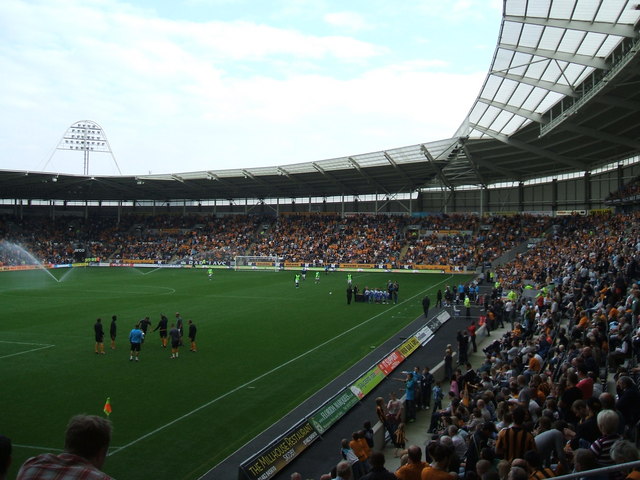
The MKM Stadium is a multi-purpose stadium in Kingston upon Hull, England. It has a current capacity of 25,586. The stadium is home to both association football club Hull City A.F.C. of the EFL Championship and rugby league club Hull F.C. of the Super League.
It was previously known as the KC Stadium, but was renamed the KCOM Stadium as part of a major rebrand on 4 April 2016 by the stadium's sponsor KCOM. In June 2021, it was renamed to its current name, the MKM Stadium, as part of a five-year sponsorship with MKM Building Supplies. During UEFA competitions, the stadium is known as the Hull City Stadium due to sponsorship regulations.
Conceived in the late 1990s, it was completed in 2002 at a cost of approximately £44 million. The stadium is owned by Hull City Council and operated by the Stadium Management Company (SMC), who have previously considered expanding the stadium capacity up to 34,000. The bowl-shaped stadium contains a continuous single tier of seats with a second tier on the west side.
The stadium occasionally hosts international association football and rugby league competitions and acts as a venue for concerts by musical artists. Previous performances at the stadium include Elton John and The Who.
The idea of a new stadium for Kingston upon Hull, whose professional football club Hull City had played at Boothferry Park since 1946, was first mooted in 1997. However, funds to finance such a project only became available when the city council sold a portion of its holdings in Kingston Communications. The council provided most of the funds, more than £42 million, with the rest stemming from government single regeneration budget grants and from the Football Stadium Improvement Fund.
The council appointed John Topliss to head the stadium construction project. He and his team partnered with consulting firm Drivers Jonas to explore preliminary issues such as stadium location, seating capacity, and facilities offered. Topliss stated that his team had "a totally blank canvas" and, by working with consultants, they made "a thorough assessment" of what was needed.
The project team considered over a dozen sites, inside and outside of the city, before settling on The Circle in West Park. Factors contributing to the decision include transport guidance, central government planning guidelines, existing athletic facilities, isolation from residential areas, and council ownership. The stadium site is located around 110 yards (100 m) from the original 'Circle' Stadium, one of Hull City's previous home grounds.
The final recommendation of Drivers Jonas included additional facilities for both indoor and outdoor sports for the people of West Hull, in addition to the main stadium, planned to seat from 25,000 to 30,000 spectators. Professional services firm Arup Associates provided initial concept proposals for the stadium. The Miller Partnership, an architectural and interior design firm, adopted these proposals during the stadium's design. The construction work was undertaken by Birse Group.
Hub AI
MKM Stadium AI simulator
(@MKM Stadium_simulator)
MKM Stadium
The MKM Stadium is a multi-purpose stadium in Kingston upon Hull, England. It has a current capacity of 25,586. The stadium is home to both association football club Hull City A.F.C. of the EFL Championship and rugby league club Hull F.C. of the Super League.
It was previously known as the KC Stadium, but was renamed the KCOM Stadium as part of a major rebrand on 4 April 2016 by the stadium's sponsor KCOM. In June 2021, it was renamed to its current name, the MKM Stadium, as part of a five-year sponsorship with MKM Building Supplies. During UEFA competitions, the stadium is known as the Hull City Stadium due to sponsorship regulations.
Conceived in the late 1990s, it was completed in 2002 at a cost of approximately £44 million. The stadium is owned by Hull City Council and operated by the Stadium Management Company (SMC), who have previously considered expanding the stadium capacity up to 34,000. The bowl-shaped stadium contains a continuous single tier of seats with a second tier on the west side.
The stadium occasionally hosts international association football and rugby league competitions and acts as a venue for concerts by musical artists. Previous performances at the stadium include Elton John and The Who.
The idea of a new stadium for Kingston upon Hull, whose professional football club Hull City had played at Boothferry Park since 1946, was first mooted in 1997. However, funds to finance such a project only became available when the city council sold a portion of its holdings in Kingston Communications. The council provided most of the funds, more than £42 million, with the rest stemming from government single regeneration budget grants and from the Football Stadium Improvement Fund.
The council appointed John Topliss to head the stadium construction project. He and his team partnered with consulting firm Drivers Jonas to explore preliminary issues such as stadium location, seating capacity, and facilities offered. Topliss stated that his team had "a totally blank canvas" and, by working with consultants, they made "a thorough assessment" of what was needed.
The project team considered over a dozen sites, inside and outside of the city, before settling on The Circle in West Park. Factors contributing to the decision include transport guidance, central government planning guidelines, existing athletic facilities, isolation from residential areas, and council ownership. The stadium site is located around 110 yards (100 m) from the original 'Circle' Stadium, one of Hull City's previous home grounds.
The final recommendation of Drivers Jonas included additional facilities for both indoor and outdoor sports for the people of West Hull, in addition to the main stadium, planned to seat from 25,000 to 30,000 spectators. Professional services firm Arup Associates provided initial concept proposals for the stadium. The Miller Partnership, an architectural and interior design firm, adopted these proposals during the stadium's design. The construction work was undertaken by Birse Group.