
Recent from talks
MMS-class minesweeper
Knowledge base stats:
Talk channels stats:
Members stats:
MMS-class minesweeper
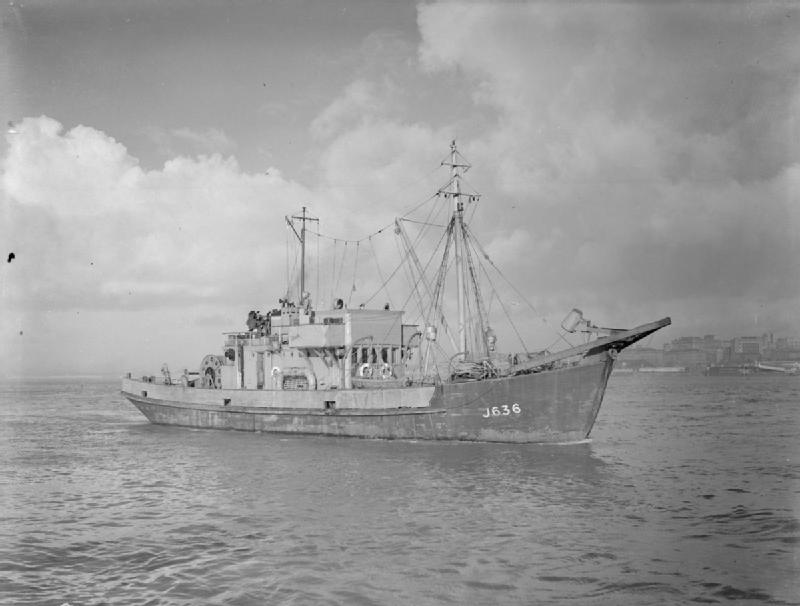
The British Royal Navy operated large numbers of small Motor Minesweepers (MMS) during the Second World War, in two major classes: the first with 105 ft (32 m) hulls (of which 294 were built) and the second with 126 ft (38 m) hulls (of which 102 were built). Intended to counter magnetic influence mines in coastal waters, they had wooden hulls.
In the early months of the Second World War, Germany made extensive use of magnetic mines, which led to a requirement for a wooden minesweeper, less vulnerable than steel trawlers. The resultant design, the 105 ft-class (also known as the MMS 1 series and later the Type 1501 series) was built between 1940 and 1944.
They were 105 ft (32.0 m) long between perpendiculars, with an overall length of 119 ft 4 in (36.37 m), a beam of 23 ft 5 in (7.14 m) and a draught of 8 ft 9 in (2.67 m). Displacement was 240–255 long tons (244–259 t). They were powered by a 500 bhp (370 kW) diesel engine, giving a speed of 11 kn (13 mph; 20 km/h). Their major minesweeping equipment was the LL sweep, where two minesweepers operating side-by-side each trailed two buoyant cables with electrodes at the end of the cables. Pulsing a high current through the cables generated a magnetic field sufficient to set off mines over an area of about 1 acre (0.40 ha). They were later fitted with an SA sweep to deal with acoustic mines, which consisted of an acoustic hammer box mounted on an A-frame on the ship's bow, which could be lowered into the water when required. The ships did not have enough towing power to use conventional contact sweeps for dealing with moored contact mines. Defensive armament consisted of two 0.5 inch machine guns and/or one or two Oerlikon 20mm cannons. The ships had a complement of 20 men.
The coastal minesweepers had pennant numbers MMS-1 to MMS-118, MMS-123 to MMS-313 and MMS-1001 to MMS-1090, the last group measuring 126 feet between perpendiculars. They were nicknamed "Mickey Mouse" from their initials.
The motor minesweepers had limited use post-war and were quickly disposed of. By 1949, only four remained in service in the Royal Navy: St. David (MMS-1733, ex-MMS-233), Venturer (MMS-1761, ex-MMS-261), MMS-1717 (ex-MMS-217) and MMS-1736 (ex-MMS-236). St. David and Venturer were tenders to RNVR divisions.
Ten had been built for the Royal Canadian Navy, Coquitlam, Crankbrook, Daerwood, Kalamalka, La Vallée, Llewellyn, Lloyd George, Revelstoke, Rossland and St. Joseph. By 1946 only Llewellyn, Lloyd George and Revelstoke were still in service.
Five were built for the Royal Indian Navy, MMS-129, 130, 131, 132 (renamed Barq) and 154; MMS-151 was transferred later. Four remained in service in 1949: Barq and MMS-130, 151 and 154
During the war, MMS-43, 45, 75, 79, 112, 182, 187, 188, 189 and 193 were manned by Belgian personnel. As late as 1949, MMS-182, 187, 188, 189, 191, 193 and 266 were on loan to the Belgian Navy.
Hub AI
MMS-class minesweeper AI simulator
(@MMS-class minesweeper_simulator)
MMS-class minesweeper
The British Royal Navy operated large numbers of small Motor Minesweepers (MMS) during the Second World War, in two major classes: the first with 105 ft (32 m) hulls (of which 294 were built) and the second with 126 ft (38 m) hulls (of which 102 were built). Intended to counter magnetic influence mines in coastal waters, they had wooden hulls.
In the early months of the Second World War, Germany made extensive use of magnetic mines, which led to a requirement for a wooden minesweeper, less vulnerable than steel trawlers. The resultant design, the 105 ft-class (also known as the MMS 1 series and later the Type 1501 series) was built between 1940 and 1944.
They were 105 ft (32.0 m) long between perpendiculars, with an overall length of 119 ft 4 in (36.37 m), a beam of 23 ft 5 in (7.14 m) and a draught of 8 ft 9 in (2.67 m). Displacement was 240–255 long tons (244–259 t). They were powered by a 500 bhp (370 kW) diesel engine, giving a speed of 11 kn (13 mph; 20 km/h). Their major minesweeping equipment was the LL sweep, where two minesweepers operating side-by-side each trailed two buoyant cables with electrodes at the end of the cables. Pulsing a high current through the cables generated a magnetic field sufficient to set off mines over an area of about 1 acre (0.40 ha). They were later fitted with an SA sweep to deal with acoustic mines, which consisted of an acoustic hammer box mounted on an A-frame on the ship's bow, which could be lowered into the water when required. The ships did not have enough towing power to use conventional contact sweeps for dealing with moored contact mines. Defensive armament consisted of two 0.5 inch machine guns and/or one or two Oerlikon 20mm cannons. The ships had a complement of 20 men.
The coastal minesweepers had pennant numbers MMS-1 to MMS-118, MMS-123 to MMS-313 and MMS-1001 to MMS-1090, the last group measuring 126 feet between perpendiculars. They were nicknamed "Mickey Mouse" from their initials.
The motor minesweepers had limited use post-war and were quickly disposed of. By 1949, only four remained in service in the Royal Navy: St. David (MMS-1733, ex-MMS-233), Venturer (MMS-1761, ex-MMS-261), MMS-1717 (ex-MMS-217) and MMS-1736 (ex-MMS-236). St. David and Venturer were tenders to RNVR divisions.
Ten had been built for the Royal Canadian Navy, Coquitlam, Crankbrook, Daerwood, Kalamalka, La Vallée, Llewellyn, Lloyd George, Revelstoke, Rossland and St. Joseph. By 1946 only Llewellyn, Lloyd George and Revelstoke were still in service.
Five were built for the Royal Indian Navy, MMS-129, 130, 131, 132 (renamed Barq) and 154; MMS-151 was transferred later. Four remained in service in 1949: Barq and MMS-130, 151 and 154
During the war, MMS-43, 45, 75, 79, 112, 182, 187, 188, 189 and 193 were manned by Belgian personnel. As late as 1949, MMS-182, 187, 188, 189, 191, 193 and 266 were on loan to the Belgian Navy.
Recent media