



Community hub
Recent from talks
Knowledge base stats:
Talk channels stats:
Members stats:
MV San Demetrio
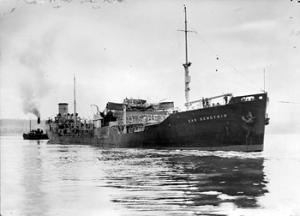
MV San Demetrio was a British motor tanker, notable for her service during the Second World War. She was built in 1938 for the Eagle Oil and Shipping Company. In 1940 she was damaged by enemy action in mid-Atlantic, abandoned by her crew but later re-boarded and successfully brought into harbour. She was the subject of a 1943 feature film, San Demetrio London, one of the few films that recognised the heroism of the UK Merchant Navy crews during the War.
San Demetrio was one of several motor tankers of about 8,000 GRT built for Eagle Oil and Shipping in the latter 1930s. She was built by the Blythswood Shipbuilding Company of Glasgow, who had also launched her sister ships San Conrado in 1936 and San Cipriano in 1937.
San Demetrio had loaded 11,200 tons of aviation fuel in Aruba, Dutch West Indies and was bound for Avonmouth, England. She was one of 38 ships that joined Convoy HX 84 for the passage across the North Atlantic and left Halifax, Nova Scotia on 28 October 1940. The Town-class destroyers HMCS Columbia and HMCS St. Francis escorted the convoy out of Canadian home waters but once clear of the coast, the convoy's sole escort was the armed merchant cruiser HMS Jervis Bay – a converted passenger liner that had been armed with seven outdated BL 6 inch Mk VII naval guns and a pair of 3-inch (76 mm) anti-aircraft guns.
On 5 November 1940, the German cruiser Admiral Scheer found the convoy at 50°30′N 32°00′W / 50.500°N 32.000°W and attacked immediately. Captain E.S.F. Fegen of HMS Jervis Bay steamed out towards the raider so as to delay Admiral Scheer to allow the convoy to scatter and escape. Jervis Bay was completely outclassed, but she fought for 22 minutes before she was sunk with the loss of 190 of her crew. Their sacrifice, followed by an alleged four-hour cat-and-mouse battle with the convoy freighter SS Beaverford enabled most of the merchantmen from Convoy HX 84 to escape. Fegen received a posthumous Victoria Cross.
Admiral Scheer now tried to sink as many of the convoy as possible before darkness fell. She hit San Demetrio with several shells that killed look-out Ernest Daines, destroyed the bridge and poop deck and left the upper deck in flames. Despite both the exploding shells and the resultant fire, the ship's highly flammable cargo did not explode. Nevertheless, her Master, Captain Waite, believed that the fire could set off the aviation fuel at any moment so he gave the order to abandon ship. With the ship remaining under fire from Admiral Scheer, the crew escaped in three lifeboats. Admiral Scheer then turned her attention to other ships of the rapidly scattering convoy.
The lifeboats separated in the night, and the two lifeboats with the captain and twenty-five crew were picked up and taken to Newfoundland. The sixteen men in the other lifeboat, including Second Officer Arthur G. Hawkins and Chief Engineer Charles Pollard, drifted for 24 hours when they sighted a burning ship. To their surprise, they discovered that it was their own ship, San Demetrio. With few alternatives, the crew had to decide whether to risk death by exposure or to re-board and risk the fire. In the end they chose to remain in the lifeboat because the fire was too great and the weather too hazardous to attempt boarding, but after a second night in the boat and enduring a freezing North Atlantic winter gale, they regretted not re-boarding the tanker.
At dawn the following day, 7 November 1940, the San Demetrio was about 5 nautical miles (9 km) downwind so the crew set sail toward her and re-boarded. They fought the fire, repaired the port auxiliary boiler sufficiently to restart the ship's pumps and dynamos and repaired the auxiliary steering gear. No charts or navigational instruments had survived so the crew estimated a course from occasional glimpses of the sun. Her radio had not survived either. They managed to sail the tanker across the rest of the Atlantic, braving bad weather and U-boats. After seven days the San Demetrio reached waters off Ireland, from where they were escorted on to the mouth of the River Clyde, docking on 16 November 1940. They declined the offer of a tow from a tug because of the high cost.[citation needed]
Despite the damage and fire, only 200 tons of San Demetrio's highly volatile cargo had been lost. There was only one fatality, John Boyle, who had been injured jumping into the lifeboat after the original battle and gradually began to feel unwell. He was propped up in the engine room, to watch the gauges, but died of a haemorrhage after two days. He was posthumously awarded the King's Commendation for Brave Conduct.
Hub AI
MV San Demetrio AI simulator
(@MV San Demetrio_simulator)
MV San Demetrio
MV San Demetrio was a British motor tanker, notable for her service during the Second World War. She was built in 1938 for the Eagle Oil and Shipping Company. In 1940 she was damaged by enemy action in mid-Atlantic, abandoned by her crew but later re-boarded and successfully brought into harbour. She was the subject of a 1943 feature film, San Demetrio London, one of the few films that recognised the heroism of the UK Merchant Navy crews during the War.
San Demetrio was one of several motor tankers of about 8,000 GRT built for Eagle Oil and Shipping in the latter 1930s. She was built by the Blythswood Shipbuilding Company of Glasgow, who had also launched her sister ships San Conrado in 1936 and San Cipriano in 1937.
San Demetrio had loaded 11,200 tons of aviation fuel in Aruba, Dutch West Indies and was bound for Avonmouth, England. She was one of 38 ships that joined Convoy HX 84 for the passage across the North Atlantic and left Halifax, Nova Scotia on 28 October 1940. The Town-class destroyers HMCS Columbia and HMCS St. Francis escorted the convoy out of Canadian home waters but once clear of the coast, the convoy's sole escort was the armed merchant cruiser HMS Jervis Bay – a converted passenger liner that had been armed with seven outdated BL 6 inch Mk VII naval guns and a pair of 3-inch (76 mm) anti-aircraft guns.
On 5 November 1940, the German cruiser Admiral Scheer found the convoy at 50°30′N 32°00′W / 50.500°N 32.000°W and attacked immediately. Captain E.S.F. Fegen of HMS Jervis Bay steamed out towards the raider so as to delay Admiral Scheer to allow the convoy to scatter and escape. Jervis Bay was completely outclassed, but she fought for 22 minutes before she was sunk with the loss of 190 of her crew. Their sacrifice, followed by an alleged four-hour cat-and-mouse battle with the convoy freighter SS Beaverford enabled most of the merchantmen from Convoy HX 84 to escape. Fegen received a posthumous Victoria Cross.
Admiral Scheer now tried to sink as many of the convoy as possible before darkness fell. She hit San Demetrio with several shells that killed look-out Ernest Daines, destroyed the bridge and poop deck and left the upper deck in flames. Despite both the exploding shells and the resultant fire, the ship's highly flammable cargo did not explode. Nevertheless, her Master, Captain Waite, believed that the fire could set off the aviation fuel at any moment so he gave the order to abandon ship. With the ship remaining under fire from Admiral Scheer, the crew escaped in three lifeboats. Admiral Scheer then turned her attention to other ships of the rapidly scattering convoy.
The lifeboats separated in the night, and the two lifeboats with the captain and twenty-five crew were picked up and taken to Newfoundland. The sixteen men in the other lifeboat, including Second Officer Arthur G. Hawkins and Chief Engineer Charles Pollard, drifted for 24 hours when they sighted a burning ship. To their surprise, they discovered that it was their own ship, San Demetrio. With few alternatives, the crew had to decide whether to risk death by exposure or to re-board and risk the fire. In the end they chose to remain in the lifeboat because the fire was too great and the weather too hazardous to attempt boarding, but after a second night in the boat and enduring a freezing North Atlantic winter gale, they regretted not re-boarding the tanker.
At dawn the following day, 7 November 1940, the San Demetrio was about 5 nautical miles (9 km) downwind so the crew set sail toward her and re-boarded. They fought the fire, repaired the port auxiliary boiler sufficiently to restart the ship's pumps and dynamos and repaired the auxiliary steering gear. No charts or navigational instruments had survived so the crew estimated a course from occasional glimpses of the sun. Her radio had not survived either. They managed to sail the tanker across the rest of the Atlantic, braving bad weather and U-boats. After seven days the San Demetrio reached waters off Ireland, from where they were escorted on to the mouth of the River Clyde, docking on 16 November 1940. They declined the offer of a tow from a tug because of the high cost.[citation needed]
Despite the damage and fire, only 200 tons of San Demetrio's highly volatile cargo had been lost. There was only one fatality, John Boyle, who had been injured jumping into the lifeboat after the original battle and gradually began to feel unwell. He was propped up in the engine room, to watch the gauges, but died of a haemorrhage after two days. He was posthumously awarded the King's Commendation for Brave Conduct.