Recent from talks
Nothing was collected or created yet.
Macedonian denar
View on Wikipedia
| македонски денар (Macedonian) | |||||
|---|---|---|---|---|---|
| |||||
| ISO 4217 | |||||
| Code | MKD (numeric: 807) | ||||
| Subunit | 0.01 | ||||
| Unit | |||||
| Plural | denari (Macedonian: денари, lit. 'denars') | ||||
| Symbol | den (Macedonian: ден) | ||||
| Denominations | |||||
| Subunit | |||||
| 1⁄100 | deni (Macedonian: дени; no longer used) | ||||
| Banknotes | |||||
| Freq. used | 10 MKD, 50 MKD, 100 MKD, 200 MKD, 500 MKD, 1,000 MKD, 2,000 MKD | ||||
| Coins | |||||
| Freq. used | 1 MKD, 2 MKD, 5 MKD, 10 MKD, 50 MKD | ||||
| Demographics | |||||
| Replaced | Yugoslav dinar | ||||
| User(s) | North Macedonia | ||||
| Issuance | |||||
| Central bank | National Bank of the Republic of North Macedonia | ||||
| Website | www | ||||
| Valuation | |||||
| Inflation | 4.5% (CPI) | ||||
| Source | stat.mk, June 2025 | ||||
The denar (Macedonian: денар; paucal:[clarification needed] denari / денари; abbreviation: den / ден; ISO code: MKD) is the currency of North Macedonia. Though subdivided into one hundred deni (дени), coins with a denomination of less than one denar have not been in use since 2013.
History
[edit]The first denar was established as a temporary currency on 26 April 1992 [1] in the then-Republic of Macedonia, replacing the 1990 version of the Yugoslav dinar at a 1:1 parity. In May 1993, the currency was reformed and a new denar was introduced, with one new denar being equal to 100 old denars.
Etymology
[edit]The name denar comes from the name of the ancient Roman monetary unit, the denarius. The abbreviation is ден, the first three Cyrillic letters of its name.
First denar (1992–1993)
[edit]The first denar was a temporary currency introduced on 26 April 1992 to replace the Yugoslav dinar at 1:1 parity and establish the monetary independence of Macedonia.
History
[edit]Macedonia declared independence from Yugoslavia on 8 September 1991. At the time, the country was using the Yugoslav dinar. But secret preparations were begun to introduce its own currency, and by April 1992, Macedonia was ready to acquire monetary independence from Yugoslavia. On 26 April, the National Bank of Macedonia was established and the denar declared the national currency. Notes in the form of "value coupons" entered circulation the following day, and on 30 April 1992, the Yugoslav dinar ceased to be legal tender.[2] In May 1993, the first denar was replaced at a rate of 100 to 1 by a new, permanent denar consisting of notes and coins.
Coins
[edit]No coins were issued for the first denar.
Banknotes
[edit]Temporary notes ("value coupons") were introduced on 27 April 1992, although preparations for producing them began much earlier. The notes remained in circulation until they were replaced by permanent notes of the second denar in 1993.
Production
[edit]Printing of the notes started on 15 January 1992 at the “11 October” printing firm in Prilep. The difficulties of creating a new currency in secret were reflected in the notes themselves. The paper, purchased from Slovenia, proved to be of poor quality and lacked adequate security. Although denominated in denari, the name of the currency did not appear on the notes because they were printed prior to the adoption of the Law on the Monetary Unit. Likewise, the issuer appeared as the "National Bank of Macedonia", not its successor, the National Bank of the Republic of Macedonia.[3]
Design
[edit]The notes were designed by a young employee of the "11 October" printer, who had only one week and a limited budget to design them. Thus the six lowest denominations were identical, with the exception of their colours. All featured a man and two women picking tobacco leaves on the front, with the back devoted to the Ilinden monument in Kruševo, which, according to the bank, “expresses the eternal fight of citizens of Macedonia for life in peace and freedom.”
| Banknotes of the first denar | ||||||||||
|---|---|---|---|---|---|---|---|---|---|---|
| Image | Value | Dimensions | Watermark | Description | Date of | |||||
| Obverse | Reverse | Obverse | Reverse | printing | issue | withdrawal | lapse | |||
| 10 DEN | 143mm × ? mm | Design | Women gathering tobacco | Monument Makedonium in Kruševo | 1992 | 27 April 1992 | 10 May 1993[4] | ? | ||
| 25 DEN | ||||||||||
| 50 DEN* | 31 August 1993[4] | |||||||||
| 100 DEN | ||||||||||
| 500 DEN | ||||||||||
| 1,000 DEN | 30 November 1993[4] | |||||||||
| 5,000 DEN | Monument Makedonium in Kruševo | Girl in front of a computer | ||||||||
| 10,000 DEN | Panorama of the Church of St. Sofia, Ohrid | Men dancing and the monument Makedonium in Kruševo | ||||||||
These images are to scale at 0.7 pixel per millimetre (18 pixel per inch). For table standards, see the banknote specification table.
| ||||||||||
Exchange rates
[edit]The denar was introduced with a fixed exchange rate of 360 denars to the Deutsche Mark.[2] There was a devaluation in October 1992 and change to the basket peg, new devaluation in December 1992 and abandonment of the peg in mid-1993.[5]
Second denar (1993–present)
[edit]Coins
[edit]First series (1993)
[edit]In May 1993, coins for the second denar were introduced in denominations of 50 deni, and 1, 2, and 5 denars. The coins were designed by Dimče Boškoski and Snežana Atanasovska. In November 2008, 10 and 50 denar coins were introduced, while the 50 deni coin was withdrawn in 2013. Due to its low mintage, it had only been struck in 1993 and was practically never seen in circulation.[6]
Since 1996, a large number of commemorative coins have been issued for collectors; a listing can be found on the national bank website.[7]
Coins are minted at the Suvenir factory in Samokov, a village near Makedonski Brod.
| Coins of the denar (1993–present)[8] | |||||||||||||||
|---|---|---|---|---|---|---|---|---|---|---|---|---|---|---|---|
| Image | Value | Technical parameters | Description | Date of | |||||||||||
| Diameter | Mass | Composition | Edge | Obverse | Reverse | minting | issue | withdrawal | lapse | ||||||
| 50 deni | 21.5 mm | 4.1 g | CuZn15 | Plain | Value, Stylized horizont with a 16-ray sun |
РЕПУБЛИКА МАКЕДОНИЈА, circular; year in the lower central field. Flying seagull | 1993 | 10 May 1993 | 1 January 2013[9] | Indefinitely* | |||||
| 1 DEN | 23.80 mm | 5.1 g | Cu80Ni3Zn17 | РЕПУБЛИКА МАКЕДОНИЈА, circular; year in the lower central field. Šarplaninec shepherd dog | 1993 1997 2001 2006 2008 2014 2016 |
Current | |||||||||
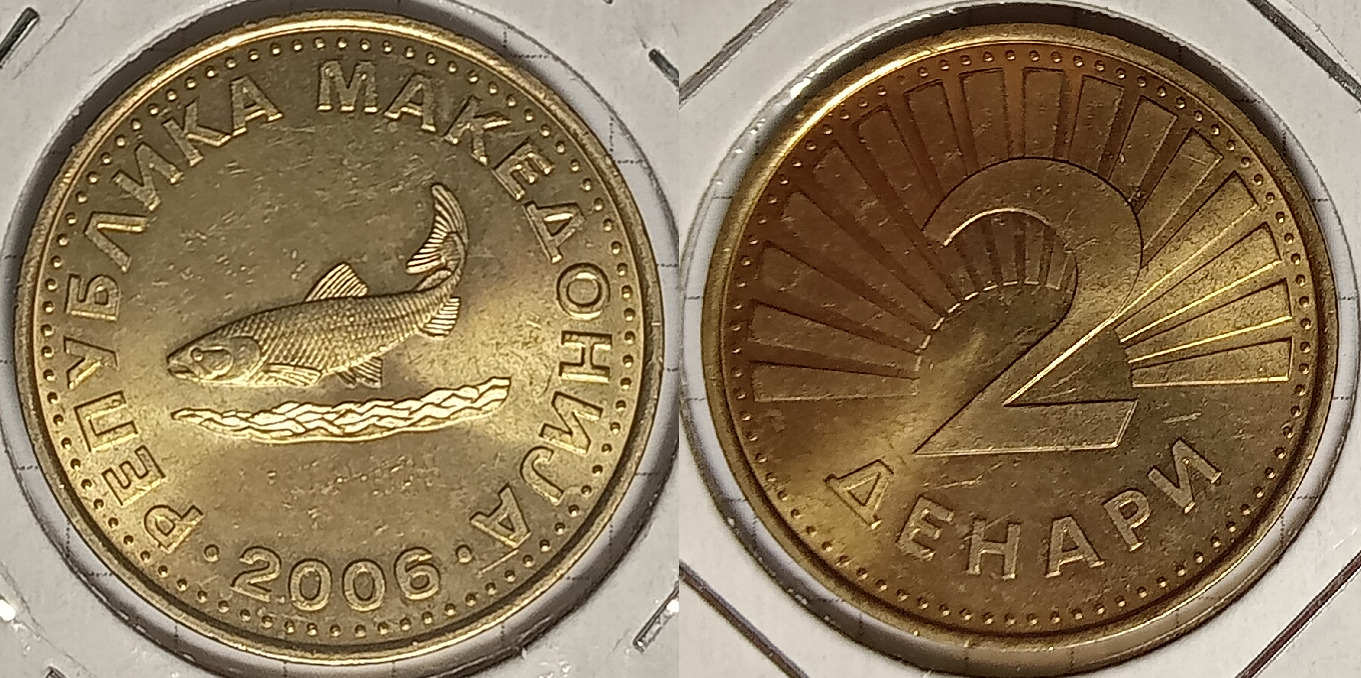
| 2 DEN | 25.50 mm | 6.2 g | РЕПУБЛИКА МАКЕДОНИЈА, circular; year in the lower central field. Ohrid trout (Salmo letnica). | 1993 2001 2006 2008 2014 2018 | |||||||||||
| 5 DEN | 27.5 mm | 7.2 g | РЕПУБЛИКА МАКЕДОНИЈА, circular; year in the lower central field. Balkan lynx (Lynx lynx balcanicus). | 1993 2001 2006 2008 2014 | |||||||||||
| 10 DEN | 24.5 mm | 6.6 g | Cu70Ni12Zn18 | Plain | Value, Stylized horizont with a 16-ray sun |
Peacock, floor mosaic from Stobi from the 6th century AD, detail presented on the banknote of 10 Denari | 2008 2017 | 15 November 2008 | Current | ||||||
| 50 DEN | 26.5 mm | 7.7 g | Cu62Ni18Zn20 | Archangel Gabriel, fresco from the Church of St. George, Kurbinovo - 12th century, detail presented on the banknote of 50 Denari | 2008 | ||||||||||
These images are to scale at 2.5 pixels per millimetre. For table standards, see the coin specification table.
| |||||||||||||||
Second series (2020)
[edit]Due to the country's name change as part of the Prespa Agreement, a new set of coins featuring the new name of North Macedonia is being released into circulation, starting with 1 denar coins in April 2021.
| Coins of the second series (2020–present)[8] | |||||||||||||||
|---|---|---|---|---|---|---|---|---|---|---|---|---|---|---|---|
| Image | Value | Technical parameters | Description | Date of | |||||||||||
| Diameter | Mass | Composition | Edge | Obverse | Reverse | minting | issue | withdrawal | lapse | ||||||
| 1 DEN[10] | 23.80 mm | 5.1 g | Steel core coated with copper and brass | Plain | Value, Stylized horizont with a 16-ray sun |
Република Северна Македонија, circular; year in the lower central field. Šarplaninec shepherd dog | 2020 2024 | 1 April 2021 | Current | ||||||
| 2 DEN | 25.50 mm | 6.2 g | Република Северна Македонија, circular; year in the lower central field. Ohrid trout (Salmo letnica). | 2022 2024 | |||||||||||
| 5 DEN | 27.5 mm | 7.2 g | Република Северна Македонија, circular; year in the lower central field. Balkan lynx (Lynx lynx balcanicus). | ||||||||||||
| These images are to scale at 2.5 pixels per millimetre. For table standards, see the coin specification table. | |||||||||||||||
FAO coinage (1995)
[edit]In 1995, circulation coins of 1, 2, and 5 denar denominations were struck in honor of the United Nations' Food and Agriculture Organization.
Banknotes
[edit]In 1993, the new denar was issued in denominations of 10, 20, 50, 100, and 500 denar notes. The 20 denar note was only issued in this first series. In 1996, 1000 and 5000 denar notes were added. In 2016, notes of 200 and 2,000 denars were issued, while the national bank began withdrawing the 5000 denar banknote from circulation to re-balance the structure of notes in circulation. In 2017, the national bank unveiled its current polymer banknotes, the 10 and 50 denar notes, and put them into circulation on May 15.
| Obverse | Reverse | Value | Colour | Obverse | Reverse | ||
|---|---|---|---|---|---|---|---|
| 1993 series (Issued October 1993) | |||||||
| 10 DEN | blue | Makedonium Monument in Kruševo | Panorama of Kruševo | ||||
| 20 DEN | brown-dark red | Daut-Pasha Bath in Skopje | Clock tower in Skopje | ||||
| 50 DEN | red | Monastery of St. Pantelejmon in Skopje | Old National Bank of Macedonia building in Skopje | ||||
| 100 DEN | brown | Church of St. Sofia in Ohrid | National Museum building in Ohrid | ||||
| 500 DEN | brown-dark green | Monastery of St. Jovan Caneo in Ohrid | Samuil's Fortress in Ohrid | ||||
| 1996 series | |||||||
| 10 DEN | lilac | Egyptian goddess Isis (Izida, 2nd century BC), Ohrid; gold earring (4th century BC), v. Beranci, Bitola | Mosaic in Stobi (4th-5th century) | ||||
| 50 DEN | blue | Fresco in the Church of St. Pantelejmon, Nerezi; Follis coin | Arhangel Gavril in the St. Ǵorǵi Church, Kurbinovo | ||||
| 100 DEN | lilac-brown | Skopje from engraving by Jacobus Harevin | View of Skopje from an Albanian house | ||||
| 500 DEN | red-brown | Gold mask, v. Trebeništa, Ohrid (6th century BC) | Poppy flower | ||||
| 1,000 DEN | brown | Madonna Episkepis, icon from the Church of St. Vrači, Ohrid, 14th century | Gregory's gallery (14th century), Church of St. Sofia, Ohrid | ||||
| 5,000 DEN | red-brown-green | Bronze figure of Maenad (6th century BC), Tetovo | Dog and tree, mosaic, Heraclea Lyncestis (5th-6th century AD), Bitola | ||||
| Upgrade of the 1996 series | |||||||
| 500 DEN | red-brown | Gold mask, v. Trebeništa, Ohrid (6th century BC) | Poppy flower | ||||
| 1,000 DEN | brown | Madonna Episkepis, icon from the St. Vrači Church, Ohrid, 14th century | Gregory's gallery (14th century), Church of St. Sofia, Ohrid | ||||
| 2014 series (Issued December 2016) | |||||||
| 200 DEN | Early medieval bronze fibula (found near Prilep); Relief of the Old Testament Psalm 41 (terracotta icon from Vinica) | Artistic elements on the façade of Colorful Mosque (Šarena Džamija, Alaca Cami), Tetovo; Marble tiles with floral designs of Isaak Beg Mosque (Isak Džamija), Bitola | |||||
| 2000 DEN | Bronze artefact in the form of cup poppy (discovered in Suva Reka, Gevgelija); Macedonian bridal dress from Prilep | Decoration on the inside of a gilded bowl (16th century), "Source of Life", peacocks | |||||
| 2018 "Polymer Series" (Issued March 2018) | |||||||
| 10 DEN | lilac | Egyptian goddess Isis (Izida, 2nd century BC), Ohrid; gold earring (4th century BC), v. Beranci, Bitola. Mosaic in Stobi (4th–5th century) | Mosaic in Stobi (4th–5th century) | ||||
| 50 DEN | blue | Fresco in the Church of St. Pantelejmon, Nerezi; Follis coin | Arhangel Gavril in the St. Ǵorǵi Church, Kurbinovo | ||||
Exchange rates
[edit]Since October 1995, the nominal exchange rate of the Denar was pegged against the Deutsche Mark. Since January 2002, it is pegged against the euro.[11]
The denar is de facto pegged to the euro using a stabilized agreement[12][13][14] at a rate of 1 EUR=61.3644 MKD±1%.[15][16]
| Current MKD exchange rates | |
|---|---|
| From Google Finance: | AUD CAD CHF CNY EUR GBP HKD JPY USD TRY |
| From Yahoo! Finance: | AUD CAD CHF CNY EUR GBP HKD JPY USD TRY |
| From XE.com: | AUD CAD CHF CNY EUR GBP HKD JPY USD TRY |
| From OANDA: | AUD CAD CHF CNY EUR GBP HKD JPY USD TRY |
See also
[edit]References
[edit]- ^ 20 years of the Macedonian denar will be celebrated Archived 2014-10-06 at the Wayback Machine NovaMakedonija
- ^ a b "National Bank of the Republic of Macedonia. Annual Report 1992" (PDF). www.nbrm.mk.
- ^ "Со солзи и во тајност се печатеше првиот македонски денар". www.utrinski.mk. 6 September 2011. Archived from the original on 6 October 2014. Retrieved 3 October 2014.
- ^ a b c d "National Bank of the Republic of North Macedonia. Annual Report 1993" (PDF). www.nbrm.mk.
- ^ North Macedonia
- ^ "National Bank of the Republic of North Macedonia, Annual Report 2011" (PDF). www.nbrm.mk.
- ^ "Македонски - Пригодни ковани пари". www.nbrm.mk.
- ^ a b "Македонски - Ковани пари во оптек". www.nbrm.mk.
- ^ "National Bank of the Republic of North Macedonia, DECISION ON WITHDRAWAL FROM CIRCULATION OF COINS IN DENOMINATION OF 50 DENI" (PDF). www.nbrm.mk. 26 April 2012.
- ^ "DECISION ON PUTTING INTO CIRCULATION OF COINS IN DENOMINATION OF 1 DENAR WITH MODIFIED FEATURES". www.nbrm.mk.
- ^ "Design of monetary policy". www.nbrm.mk.
- ^ "Annual report on exchange arrangements and exchange restrictions, 2023" (PDF). www.elibrary.imf.org. International Monetary Fund, 2023. p. 14. Retrieved 27 August 2025.
- ^ The euro in global foreign exchange reserves and exchange rate anchoring
- ^ "IMF. REPUBLIC OF NORTH MACEDONIA". www.imf.org.
- ^ "Promoting Constructive Capital in Bulgaria and North Macedonia" (PDF).
- ^ "Overview of North Macedonian Agricultural Market".
External links
[edit]- Ministry of Finance website
- Heiko Otto (ed.). "Banknotes of Macedonia" (in English and German). Retrieved 24 March 2017.
Macedonian denar
View on GrokipediaHistory
Etymology and pre-independence context
The term denar originates from the Latin dēnārius, denoting a silver coin introduced by the Roman Republic circa 211 BC during the Second Punic War, valued at ten bronze asses and serving as a principal unit of silver currency across the empire until the 3rd century AD. This nomenclature persisted in post-Roman contexts, evolving into variants like dinar through Byzantine, Arabic, and Slavic linguistic channels, with the Macedonian form reflecting South Slavic phonetics.[5] In the Balkans, the denar/dinar reemerged in medieval monetary systems, as evidenced by its earliest documented use in Serbia in 1214 under the Nemanjić dynasty, where it functioned as a silver coin paralleling regional Byzantine and Western influences.[6] Analogous terms appeared in Bulgarian and other Slavic principalities, underscoring a continuity of Roman-derived monetary nomenclature amid feudal economies reliant on silver imports and local minting.[7] As part of the Socialist Federal Republic of Yugoslavia, the Socialist Republic of Macedonia circulated the Yugoslav dinar from its establishment in 1944 until independence in 1991, with the currency undergoing multiple redenominations amid escalating economic pressures.[8] The dinar suffered from a wage-price-exchange rate spiral through the 1970s and 1980s, fueled by federal subsidies to unprofitable enterprises, external debt servicing, and monetary expansion to finance deficits, yielding an annualized inflation rate of 76% over 1971–1991.[9][10] By the late 1980s, monthly inflation surpassed 50%, driven by structural imbalances including import dependency, productivity stagnation, and inter-republic fiscal disputes that undermined coordinated policy, culminating in five revaluations between 1990 and 1994 to preserve nominal stability.[10][11]Introduction of the first denar (1992–1993)
The denar was introduced as the Republic of Macedonia's national currency on April 26, 1992, coinciding with the establishment of the National Bank of the Republic of Macedonia as the country's independent central bank and sole issuer of the currency.[12][13] This move asserted monetary sovereignty following independence from Yugoslavia, with the Yugoslav dinar remaining in limited circulation briefly for exchange purposes.[13] Provisional banknotes, known as "value coupons," entered circulation on April 27, 1992, replacing the Yugoslav dinar at a 1:1 parity rate to facilitate a smooth transition without immediate valuation disruption.[13][3] The Yugoslav dinar was demonetized and ceased to be legal tender by April 30, 1992, after which the denar became the exclusive medium of exchange.[13] Initial value coupons included denominations such as 10 and 25 denari, featuring depictions of agricultural scenes like tobacco harvesting on the obverse and national monuments, such as the Ilinden "Makedonium" in Kruševo, on the reverse to symbolize economic and historical identity.[14] These provisional issues were printed hastily to meet immediate needs, serving as temporary instruments until more permanent designs could be developed.[15] The introduction prioritized rapid implementation over elaborate security features, reflecting the urgency of decoupling from the disintegrating Yugoslav monetary system, though it laid the groundwork for subsequent issuance of higher denominations up to 10,000 denari in the same provisional series.[16] No coins were issued during the initial 1992 phase, with the focus on banknote circulation to stabilize everyday transactions amid the transition to sovereignty.[3]Hyperinflation crisis and transition to the second denar (1993)
Following independence from Yugoslavia in 1991, the Republic of Macedonia faced acute inflationary pressures inherited from the disintegrating Yugoslav monetary system, exacerbated by fiscal deficits, supply chain disruptions from the federation's breakup, and international sanctions that limited trade and foreign exchange reserves.[17] These factors, combined with rapid monetary expansion to finance government spending amid economic contraction, propelled annual consumer price inflation to 338.7% in 1993.[18] Hyperinflationary dynamics were further intensified by the absence of credible monetary anchors and persistent depreciation of the nascent first denar, introduced in April 1992 at parity with the hyperinflating Yugoslav dinar.[19] The crisis culminated in the decision to redenominate the currency on May 5, 1993, replacing the first denar (MKN) with the second denar (MKD) at a ratio of 1 new denar to 100 old denari, effectively removing two zeros to restore usability and signal a break from prior inflationary expectations.[20] This reform, enacted without altering nominal balances but through new issuance of banknotes and coins, aimed to rebuild public confidence in the National Bank of the Republic of Macedonia's ability to manage the money supply.[21] Initial coins for the second denar, in denominations of 50 deni, 1, 2, and 5 denari, were released concurrently to facilitate everyday transactions.[22] To combat ongoing money supply growth, the central bank implemented restrictive monetary policies, including limits on credit expansion and reserve requirements, which helped temper monthly inflation rates from peaks exceeding 15% targeted earlier in the year.[16] These measures laid the groundwork for subsequent stabilization, though full credibility was not achieved until a currency board-like peg to the Deutsche Mark in 1994; in 1993, the focus remained on containing inherited fiscal imbalances and building minimal reserves through administrative controls on imports and exports.[17] The transition marked a pivotal shift from reactive crisis management to proactive orthodoxy, averting deeper economic dislocation despite persistent external shocks.Stabilization and developments (1993–present)
Following the hyperinflation crisis of 1993, the National Bank of the Republic of North Macedonia (NBRM) implemented conservative monetary policies, including reassertion of central bank control and fiscal adjustments, which reduced annual inflation from over 300% in 1993 to single-digit levels by 1997.[17][23] These measures emphasized price stability through restrained money supply growth and budgetary discipline, marking a shift from earlier heterodox approaches that had failed to curb four-digit inflation.[24] By the late 1990s, inflation stabilized at an average below 5% annually, reflecting effective macroeconomic management amid post-independence challenges.[25] In subsequent decades, monetary policy evolved to support EU integration efforts, with the NBRM aligning frameworks to European standards as part of North Macedonia's candidacy status since 2005 and stalled accession negotiations.[26] Preparations for potential euro adoption involved adopting inflation-targeting elements and enhancing institutional independence, though full convergence criteria remain unmet due to political delays in EU talks.[27] Average consumer price inflation hovered around 3.1% from 2014 to 2024, demonstrating sustained policy effectiveness in maintaining low and stable rates.[28] The denar regime exhibited resilience during external shocks, including the 2008 global financial crisis, where inflation remained contained below 10% through proactive liquidity management, and the COVID-19 pandemic, supported by high foreign reserves and fiscal buffers that limited output contraction to milder levels than regional peers.[29] In 2025, economic growth accelerated to 3.2% in the first half, driven by domestic demand recovery and policy normalization following post-pandemic easing.[30] The NBRM's recent rate adjustments, tracking eurozone trends while prioritizing domestic stability, underscore ongoing adaptability amid global uncertainties.[31]Monetary Policy and Exchange Rate Regime
Peg to the euro and central bank role
The National Bank of the Republic of North Macedonia (NBRNM) maintains the denar in a fixed exchange rate regime pegged to the euro, with a central rate of 1 euro equaling 61.3644 denars and a fluctuation band of ±1%.[32] This arrangement, established de facto since 1999, serves as a nominal anchor to foster monetary stability and low inflation convergence with the euro area.[33] The regime prioritizes exchange rate targeting as an intermediate objective to achieve the NBRNM's primary mandate of price stability, avoiding direct euro adoption absent full eurozone integration.[34] The NBRNM exercises operational independence in conducting monetary policy to defend the peg, primarily through adjustments to key interest rates, such as the base rate, and reserve requirements on commercial banks.[32] These tools influence domestic liquidity and credit conditions, enabling sterilized interventions in the foreign exchange market when necessary to counteract pressures within the band.[35] Unlike pure currency boards, this framework allows discretionary policy responses to domestic shocks while committing to the euro anchor for credibility.[36] In support of the peg, the NBRNM accumulates international reserves, which have grown to cover multiple months of imports, providing a buffer against external vulnerabilities without relying on eurozone membership.[35] This reserve management aligns with the bank's strategy to mitigate balance-of-payments risks and sustain investor confidence in the denar's convertibility.[32]Exchange rate stability and performance metrics
Since the stabilization following the 1993 currency reform, the Macedonian denar has exhibited markedly reduced exchange rate volatility compared to its hyperinflationary origins, transitioning to a regime of low fluctuations anchored by the euro peg established in 2002. The official MKD/EUR central rate, fixed at 61.3644 denars per euro within a ±1% band, has constrained deviations, with the National Bank of North Macedonia intervening as needed to maintain the parity. This has resulted in annual volatility measures for the denar-euro rate typically below 0.5% in standard deviation of daily changes over the 2002–2025 period, as reflected in central bank data and Eurostat monitoring.[37][38] Against the US dollar, the denar's performance has mirrored euro-dollar movements due to the peg, with USD/MKD rates averaging approximately 55–56 over the past decade but ranging from 52 to 60 amid varying EUR/USD dynamics, such as dollar strength in 2022–2023 and euro appreciation in 2025. For instance, the rate stood at 53.15 on October 22, 2025, within a monthly band of under 2% fluctuation. This contrasts with pre-peg eras, where annual depreciations exceeded 100%, and underscores the peg's role in dampening inherent volatility, with IMF data showing no sustained breaks from the band since 2002.[39][40][41] External shocks, including the 2022 energy price spikes from the Russia-Ukraine war, tested the regime but did not disrupt peg integrity, as reserves covered interventions and inflation differentials with the eurozone remained contained. The 2025 IMF Article IV consultation affirmed this resilience, noting the denar's stability amid heightened global uncertainties, with effective volatility against major currencies under 3% annually in recent years per central bank statistics.[42][41][43]Coins
First series (1993)
![2 denari coin (1993)][float-right] The first series of coins for the second denar was issued in May 1993 by the National Bank of the Republic of Macedonia to support the currency redenomination, which replaced the hyperinflated first denar at a rate of 1:1000.[44] These coins comprised denominations of 50 deni (equivalent to 0.5 denar), 1 denar, 2 denari, and 5 denari, minted primarily in brass and nickel-brass alloys to ensure durability amid economic transition.[44] Designs emphasized Macedonian natural heritage, including endemic species, to symbolize national identity during the country's early independence period. The 50 deni coin, struck in brass weighing 4.05 grams and measuring 21.5 mm in diameter, featured a black-headed gull in flight on the obverse, representing coastal or lacustrine wildlife, with the reverse displaying the radiant denomination amid sun rays derived from the national flag.[45] Mintage reached 11,051,000 pieces, though its low value limited practical circulation, leading to demonetization in 2013.[46] Higher denominations utilized nickel-brass (80% copper, 17% zinc, 3% nickel) for enhanced resistance to wear. The 1 denar coin (5.15 grams, 23.7 mm) portrayed the Sarplaninac sheepdog on the obverse with the date below, reverse showing the value superimposed on sixteen sun rays.[47] The 2 denari piece depicted the endemic Ohrid trout on the obverse alongside the republic's name, with the reverse bearing the denomination. The 5 denari coin (7.25 grams, 27.5 mm) illustrated a Balkan lynx on the obverse, reverse with value and sun motif, minted in quantities of 12,330,000.[48]| Denomination | Material | Weight (g) | Diameter (mm) | Obverse Design | Reverse Design | Mintage |
|---|---|---|---|---|---|---|
| 50 deni | Brass | 4.05 | 21.5 | Black-headed gull | Radiant value with sun rays | 11,051,000[46] |
| 1 denar | Nickel-brass | 5.15 | 23.7 | Sarplaninac dog | Value with sixteen sun rays | Not specified[47] |
| 2 denari | Nickel-brass | ~5.1 | ~23.8 | Ohrid trout | Denomination | 8,998,000 |
| 5 denari | Brass | 7.25 | 27.5 | Balkan lynx | Value with sun rays | 12,330,000[48] |
FAO commemorative issues (1995)
In 1995, the National Bank of the Republic of Macedonia issued three circulating commemorative coins denominated 1 denar, 2 denari, and 5 denari to mark the 50th anniversary of the United Nations Food and Agriculture Organization (FAO), founded in 1945 to promote global food security and agricultural development.[50] These coins featured motifs related to natural resources and wildlife, reflecting FAO themes of sustainable agriculture and biodiversity.[51] Produced following the 1993 currency stabilization, they represented Macedonia's initial foray into thematic numismatics amid efforts to integrate with international institutions.[52] The 1 denar coin, struck in brass with a weight of 5.13 g and diameter of 23.7 mm, had a mintage of 2,314,000 pieces.[53] Its obverse bore the Macedonian coat of arms and the inscription "РЕПУБЛИКА МАКЕДОНИЈА" in Cyrillic, while the reverse incorporated FAO-specific elements alongside standard wheat ear designs adapted for the theme.[54] The 2 denari coin, composed of brass or nickel-brass (6.3 g, 25.5 mm diameter), depicted a fish on the reverse to symbolize aquatic food resources, with a mintage of 2,637,500.[50][55] The obverse included the national emblem and value in both Cyrillic and Latin scripts. The 5 denari coin, made of copper-nickel-zinc alloy (7.25 g, 27.5 mm diameter), featured a lynx on one side, evoking wildlife conservation in agricultural contexts, and entered circulation as part of the set.[51][56] All pieces were minted by the Suvenir Factory in Samokov and intended for everyday use while promoting collectibility through their limited thematic release.[57]Second series (2020)
The second series of denar coins entered circulation starting in 2020, updating the inscriptions to reflect the Republic of North Macedonia's revised official name following the constitutional amendments effective 12 February 2019. This adjustment stemmed from the Prespa Agreement, ratified in 2018, which resolved the naming dispute with Greece by incorporating "North" into the country's designation for use in international contexts, including currency. The updated coins maintain the core designs of earlier series, featuring symbolic elements on the obverse such as native flora, fauna, or cultural motifs, and the reverse displaying the Vergina Sun (eight-rayed solar symbol from the national flag), denomination, and the bilingual country name "REPUBLIC OF NORTH MACEDONIA / РЕПУБЛИКА СЕВЕРНА МАКЕДОНИЈА". For example, the 1 denar coin shows a Macedonian shepherd dog on the obverse, with the reverse bearing the sun, value, and updated name inscription below. Similarly, the 2 denar depicts a bunch of grapes on the obverse, preserving agricultural heritage representation.[44] Initial releases focused on lower denominations—1, 2, and 5 denari—produced in brass-plated steel (approximately 4.3–5.1 g, 20–24 mm diameter) for corrosion resistance and economic production. These specifications align with prior issues, prioritizing usability over novel alloys or bimetallic construction, which were not adopted to enhance security against counterfeiting in this series. Higher values (10, 20, 50 denari) retained pre-2020 designs temporarily, allowing phased withdrawal of legacy coins without immediate economic disruption.[44] The series supports the denar's fixed exchange rate peg to the euro at 61.1873 MKD per EUR, maintained since 1998, but does not incorporate specific eurozone coin features, as North Macedonia's EU accession path remains prospective without immediate adoption plans influencing design. Amid rising electronic transaction volumes—reaching over 70% of retail payments by 2020—the physical coins continue facilitating small-scale commerce, particularly in rural areas where cash dependency persists.Banknotes
Denominations and design evolution
The initial banknotes for the second Macedonian denar, introduced in 1993 following the hyperinflation-driven redenomination, comprised denominations of 10, 20, 50, 100, and 500 denari, with the 20 denari note limited to this series.[58] Provisional notes issued in 1992 for the preceding denar variant spanned denominations from 10 to 1,000 denari, serving as temporary currency amid the transition from the Yugoslav dinar.[59] Early designs emphasized portraits of Macedonian revolutionaries, poets, and historical figures on the obverse, paired with reverses depicting national landmarks, architectural motifs, or symbolic elements like the Ohrid region to evoke cultural identity.[60] Subsequent expansions in 1996 added 1,000 and 5,000 denari notes, addressing the need for higher values as the economy stabilized, while designs retained a focus on prominent national icons and heritage symbols.[61] By the early 2000s, updated issues for select denominations, such as the 500 and 1,000 denari in 2003, began incorporating refined visual elements, gradually shifting toward broader cultural heritage themes including ancient artifacts and traditional motifs rather than individual portraits.[62] In 2016, the 200 denari note was issued, featuring obverse depictions of Old Testament warriors from terracotta icons alongside a fibula ornament, followed by the 2,000 denari note with bridal costumes and floral elements; concurrently, the 5,000 denari was withdrawn to rationalize the series.[63][64] Polymer banknotes marked a material evolution for lower denominations, with the 10 denari depicting ancient Ohrid motifs and the 50 denari showcasing peacocks as symbols of immortality and resurrection, entering circulation on May 15, 2018.[65][66] This series reflected a post-2000s thematic progression toward intangible cultural assets, natural sites, and symbolic representations of resilience and tradition. By 2025, seven denominations remain in active circulation—10, 50, 100, 200, 500, 1,000, and 2,000 denari—following phased withdrawals of obsolete higher and unique low-value notes for operational efficiency.[67]Security features and production
The Macedonian denar banknotes employ multiple layers of anti-counterfeiting measures, including watermarks, security threads, and optically variable inks, to enhance authenticity verification. Higher-denomination paper notes, such as the 2000 denari issued in 2016, feature a watermark of the Ilinden monument and a solid red security thread embedded within the substrate. These elements are complemented by microprinting and intaglio printing for tactile differentiation under touch. In response to everyday transaction needs and to improve durability, the National Bank of the Republic of North Macedonia introduced polymer substrate banknotes in denominations of 10 and 50 denari on May 15, 2018, marking the country's first such issuance. These polymer notes incorporate a distinctive dashed-line security thread displaying "НБРМ" (National Bank of the Republic of Macedonia) text, visible when held to light, alongside transparent windows for added visual verification. Innovations in these series include the world's first security thread integrated into a long window design and De La Rue's Kinetic StarChrome optically variable feature, which shifts colors and patterns under angular viewing to deter replication. Banknote production is managed by the National Bank, with initial series from 1992 printed domestically at the Prilep printing house using specialized offset and intaglio techniques. Subsequent issues, particularly polymer variants, leverage international expertise for substrate and feature integration, reflecting constraints in local high-security printing infrastructure. Counterfeiting incidents remain minimal, with officials noting that denar notes' robust features and the currency's stable euro peg reduce incentives for forgery, as confirmed by low detection rates in circulation monitoring.Economic Role and Challenges
Contribution to macroeconomic stability
The fixed exchange rate regime of the Macedonian denar, pegged to the euro at a rate of 61.5 denari per euro since January 2002, has provided a predictable monetary anchor that minimizes currency volatility and exchange rate risks for economic agents.[34][68] This stability has facilitated smoother integration into European trade networks, as the denar's alignment with the euro reduces transaction costs and hedging needs for exporters and importers dealing with EU partners, who account for the majority of North Macedonia's trade.[69] Empirical evidence from the peg's maintenance shows it supporting consistent export growth without overvaluation barriers, as foreign direct investment (FDI)-driven manufacturing sectors, such as automotive assembly, benefit from reliable currency convertibility.[70] In stable economic periods, such as 2010–2019 excluding major disruptions, the denar's peg has correlated with average annual GDP growth of approximately 3%, driven by FDI inflows and export expansion rather than domestic credit booms prone to volatility in unpegged regimes.[71][72] This contrasts with higher volatility observed in neighboring economies with floating currencies, where exchange rate swings have amplified output fluctuations; the denar's discipline enforces fiscal-monetary restraint, channeling resources toward productive investment over speculative finance.[73] National Bank of the Republic of North Macedonia (NBRM) reserves, exceeding €4.7 billion as of mid-2025, have underpinned this peg, enabling interventions that prevent abrupt depreciations and sustain investor confidence.[74] The peg's price stability objective has anchored inflation at moderate levels, averaging around 3% annually in the decade to 2024, below regional peers and supportive of real economic adjustments without eroding purchasing power.[28] This environment has enabled real wage gains, exemplified by the 2025 gross minimum wage increase to 36,037 denari from 33,352 denari in 2024, reflecting productivity-linked labor market tightening amid controlled inflationary pressures.[75] Such outcomes underscore the causal link between exchange rate predictability and sustained macroeconomic discipline, fostering an investment climate where FDI has averaged over 3% of GDP in stable years, bolstering long-term growth potential.[76][35]Impact during crises and reforms
During the 2008 global financial crisis, the Macedonian denar maintained its de facto peg to the euro, avoiding devaluation despite a sharp contraction in exports and external financing that reduced GDP growth to -0.4% in 2009.[77] The National Bank of the Republic of North Macedonia (NBRNM) utilized foreign reserves to defend the exchange rate within its narrow corridor of 61.1–61.9 MKD per euro, preventing speculative pressures that affected currencies with more flexible regimes in the region, such as the Serbian dinar.[78] This resilience stemmed from prior post-independence reforms in the 1990s, which stabilized monetary policy after initial hyperinflation episodes exceeding 300% annually in 1993, establishing the peg as a nominal anchor.[79] In the 2020 COVID-19 pandemic, the denar similarly preserved exchange rate stability, with the NBRNM's monetary measures—including reserve requirements reductions and liquidity injections—neutralizing fiscal expansion impacts without altering the peg.[80] GDP fell by 4.5% that year, yet the currency corridor held firm, contrasting with depreciations in neighboring floating-rate economies amid supply chain disruptions and capital outflows.[81] Banking sector reforms, including the cleanup of non-performing loans from earlier crises (peaking at 25% in the early 2000s) through EU-aligned resolution frameworks, bolstered denar credibility by enhancing financial system buffers, with capital adequacy ratios exceeding 18% by 2020.[82] Post-pandemic reforms, such as the 2023 Bank Resolution Law transposing EU standards, further reinforced the peg's role in shielding against external shocks, including 2022 energy price surges from the Russia-Ukraine conflict that drove regional inflation above 15%.[82] The IMF's 2025 Article IV consultation highlighted momentum from credit expansion—growing 10% year-on-year in 2024—supported by denar stability, which contained imported inflation and facilitated a projected 3.3% GDP growth in 2025 amid volatile commodity prices.[42][31] The NBRNM's effective management of these pressures, via interest rate adjustments and reserve interventions, underscored the peg's causal contribution to macroeconomic resilience without necessitating devaluation.[42]Criticisms and limitations
In the early years following its introduction in 1992, the Macedonian denar faced significant erosion of public trust due to high inflation rates inherited from the dissolution of Yugoslavia, exacerbated by UN sanctions against the Federal Republic of Yugoslavia and domestic fiscal imbalances, with monthly inflation exceeding 100% in early 1994 before stabilization efforts took hold.[83] [17] These pressures stemmed from redenomination of the Yugoslav dinar at par and accumulated debts rather than flaws in the denar's initial design, leading to failed stabilization attempts in 1992 and 1993.[17] The subsequent peg to the Deutsche Mark in 1994 reduced monthly inflation to around 2%, but the episode highlighted vulnerabilities in transitioning from a hyperinflationary predecessor currency amid external shocks.[17] The denar's fixed exchange rate regime, pegged to the euro at approximately 61.5 MKD per EUR since 2002, constrains the National Bank of North Macedonia's ability to conduct independent monetary policy, limiting tools like interest rate adjustments to address asymmetric economic shocks unique to the domestic economy.[68] This rigidity has prompted debates during crises, such as the global financial downturn, over whether to devalue or shift regimes to restore flexibility, as fixed pegs can amplify external pressures without domestic countermeasures.[84] While the peg has anchored inflation expectations, critics argue it reduces adaptability to country-specific challenges like trade imbalances or fiscal strains, potentially prolonging adjustments compared to floating regimes.[85] Persistent informal economic activity, estimated at around 20-30% of GDP, relies heavily on cash transactions in denars, facilitating evasion of taxes and oversight amid perceptions of corruption, as evidenced by North Macedonia's ranking of 76th out of 180 countries in Transparency International's 2023 Corruption Perceptions Index with a score of 42.[86] [87] This cash dominance in the shadow economy, linked to weak enforcement and parafiscal burdens, undermines formal monetary transmission and revenue collection, though the denar's long-term stability has prevented the fiat debasement risks seen in less anchored currencies.[88] [89]References
- https://en.wiktionary.org/wiki/denar
