Hubbry Logo
Magazine (firearms)Magazine (firearms)Main
Open search
Magazine (firearms)
Community hub
Magazine (firearms)
logo
8 pages, 0 posts
0 subscribers
Be the first to start a discussion here.
Magazine (firearms)
Magazine (firearms)
from Wikipedia
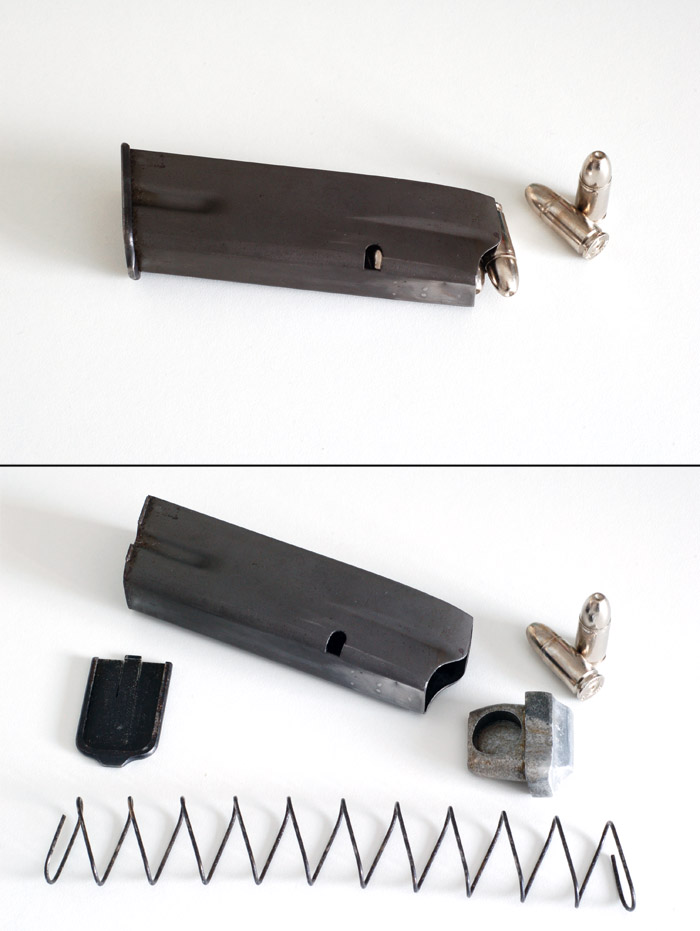
A staggered-column 9×19mm Browning Hi-Power pistol box magazine. The top image shows the magazine loaded and ready for use, while the lower image shows it unloaded and disassembled.
Loading of small arms ammunition into a magazine.

A magazine, often simply called a mag, is an ammunition storage and feeding device for a repeating firearm, either integral within the gun (internal or fixed magazine) or externally attached (detachable magazine). The magazine functions by holding several cartridges within itself and sequentially pushing each one into a position where it may be readily loaded into the barrel chamber by the firearm's moving action. The detachable magazine is sometimes colloquially referred to as a "clip", although this is technically inaccurate since a clip is actually an accessory device used to help load ammunition into the magazine or cylinder of a firearm.[1][2][3]

Magazines come in many different shapes and sizes, from integral tubular magazines on lever-action and pump-action rifles and shotguns, that may hold more than 5 rounds, to detachable box magazines and drum magazines for automatic rifles and light machine guns, that may hold more than 50 rounds. Various jurisdictions ban what they define as "high-capacity magazines".

Nomenclature

[edit]

With the increased use of semi-automatic and automatic firearms, the detachable magazine became increasingly common. Soon after the adoption of the M1911 pistol, the term "magazine" was settled on by the military and firearms experts. Although the term "clip" is often used to refer to detachable (never fixed) magazines, this usage remains a point of strong contention.[4][5][6] The defining difference between a clip and a magazine is the presence of a feed mechanism, typically a spring-loaded follower, which a clip lacks. Whereas a magazine consists of four parts: a spring, a spring follower, a body, and a base. Whereas a clip may be constructed out of a single continuous piece of stamped metal and may contain no moving parts. Examples of clips include moon clips for (e.g., .38 Special and .357 Magnum) revolvers; stripper clips, as those used in association with speedloaders for modern military (e.g., 5.56×45mm NATO and 7.62x51mm NATO) rifles; and en bloc clips for older M1 Garand (e.g., .30-06 Springfield) military rifles.[2][7][8][9]

History

[edit]

The earliest firearms were loaded with loose powder and a lead ball, and to fire more than a single shot without reloading required multiple barrels, such as in pepper-box guns, double-barreled rifles, double-barreled shotguns, or multiple chambers, such as in revolvers. The main problem with these solutions is that they increase the bulk and/or weight of a firearm, over a firearm with a single barrel and/or single chamber. However, many attempts were made to get multiple shots from loading a single barrel through the use of superposed loads.[10] While some early repeaters such as the Kalthoff repeater managed to operate using complex systems with multiple feed sources for ball, powder, and primer, easily mass-produced repeating mechanisms did not appear until self-contained cartridges were developed in the 19th century.

Early tubular magazines

[edit]
Loading sleeve open, three Henry Flat cartridges, compare with .44 WCF round
Diagram of the Spencer rifle showing the tubular magazine in the butt

The first successful mass-produced repeating weapon to use a "tubular magazine" permanently mounted to the weapon was the Austrian Army's Girandoni air rifle, first produced in 1779.

The first mass-produced repeating firearm was the Volcanic Rifle which used a hollow bullet with the base filled with powder and primer fed into the chamber from a tube called a "magazine" with an integral spring to push the cartridges in to the action, thence to be loaded into the chamber and fired. It was named after a building or room used to store ammunition. The anemic power of the Rocket Ball ammunition used in the Volcanic doomed it to limited popularity.[citation needed].

The Henry repeating rifle is a lever-action, breech-loading, tubular magazine-fed repeating rifle, and was an improved version of the earlier Volcanic rifle. Designed by Benjamin Tyler Henry in 1860, it was one of the first firearms to use self-contained metallic cartridges. The Henry was introduced in 1860 and was in production until 1866 in the United States by the New Haven Arms Company. It was adopted in small quantities by the Union Army in the American Civil War and was favored for its greater firepower than the standard issue carbine. Many later found their way Westward and was famed both for its use at the Battle of the Little Bighorn, and being the basis for the iconic Winchester lever-action repeating rifle, which is still in production to the present day.[11] The Henry and Winchester rifles would go on to see service with a number of militaries including Turkey. Switzerland and Italy adopted similar designs.[11]

The second magazine-fed firearm to achieve widespread success was the Spencer repeating rifle, which was designed by Christopher Miner Spencer in 1860, also saw military service during the American Civil War. The Spencer used a tubular magazine located in the butt of the gun instead of under the barrel and it used rimfire metallic cartridges. The Spencer was successful, but the rimfire ammunition did occasionally ignite in the magazine tube and destroy the magazine. It could also injure or kill the user.

The new bolt-action rifles began to gain favor with militaries in the mid-1880s and were often equipped with tubular magazines. The Mauser Model 1871 was originally a single-shot action that added a tubular magazine in its 1884 update. The Norwegian Jarmann M1884 was adopted in 1884 and also used a tubular magazine. The French Lebel Model 1886 rifle also used 8-round tubular magazine.[12]

Tubular magazines remain in common use on many types of shotguns, including some rifles.

Integral box magazines

[edit]
1905 Military Rifles magazines.
1 & 2: Mosin–Nagant M1891
3 & 4: Lebel M1886
5 & 6: Gewehr M1888
7 & 8: Mannlicher M1888
9 & 10: Lee–Metford M1888
11 & 12: Dutch-Mannlicher M1895
13 & 14: Mauser M1893
15: Krag–Jørgensen M1886
16: Schmidt–Rubin M1889

The military cartridge was evolving as the magazine rifle evolved. Cartridges evolved from large-bore cartridges (.40 caliber/10 mm and larger) to smaller bores that fired lighter, higher-velocity bullets and incorporated new smokeless propellants. The Lebel Model 1886 rifle was the first rifle and cartridge to be designed for use with smokeless powder and used an 8 mm wadcutter-shaped bullet that was drawn from a tubular magazine. This would later become a problem when the Lebel's ammunition was updated to use a more aerodynamic pointed bullet. Modifications had to be made to the centerfire case to prevent the spitzer point from igniting the primer of the next cartridge inline in the magazine through recoil or simply rough handling.[13] This remains a concern with lever-action firearms today.

Two early box magazine patents were the ones by Rollin White in 1855 and William Harding in 1859.[14] A detachable box magazine was patented in 1864 by the American Robert Wilson. Unlike later box magazines this magazine fed into a tube magazine and was located in the stock of the gun.[15][16] Another box magazine, closer to the modern type though non-detachable, was patented in Britain (No. 483) by Mowbray Walker, George Henry Money and Francis Little in 1867.[17] James Paris Lee patented a box magazine which held rounds stacked vertically in 1875,[18] 1879 and 1882 and it was first adopted by Austria in the form of an 11mm straight-pull bolt-action rifle, the Mannlicher M1886. It also used a cartridge clip which held 5 rounds ready to load into the magazine.[13][19] One of the first detachable box magazines with a double-stack staggered-feed was the Schmidt-Rubin of 1889. Other examples include the patent of Fritz von Stepski and Erich Sterzinger of Austria-Hungary in May 1888 and the British patents by George Vincent Fosbery in 1883 and 1884.[20][21][22] James Paris Lee is sometimes claimed to have invented the double-stack, staggered-feed detachable box magazine but he did not design one until 1892 for the Mark II Lee-Metford, three years after the Schmidt-Rubin. The first pistol with a double-stack, staggered-feed magazine was the Mauser C96 although it was an integral design fed by stripper clips. The first detachable double-stack, single-feed magazine for pistols was probably the one patented by the American Elbert H. Searle in 1904 and adopted by Arthur Savage though he did not apply it in practice to his designs until much later.[23][24] One of the first double-stack, single-feed box magazines was patented in November 1888 by an English inventor called Joseph James Speed of Waltham Cross.[25] Another was patented in May 1887 by the Austro-Hungarian Karl Krnka.[26]

En bloc clip and 8mm ammo for the Gewehr 88
Swedish Mauser stripper clip loaded with Swedish 6.5×55mm

The bolt-action Krag–Jørgensen rifle, designed in Norway in 1886, used a unique rotary magazine that was built into the receiver. Like Lee's box magazine, the rotary magazine held the rounds side-by-side, rather than end-to-end. Like most rotary magazines, it was loaded through a loading gate one round at a time, this one located on the side of the receiver. While reliable, the Krag–Jørgensen's magazine was expensive to produce and slow to reload. It was adopted by only three countries, Denmark in 1889, the United States in 1892,[27] and Norway in 1894.

Clip-fed revolution

[edit]

A clip (called a charger in the United Kingdom) is a device that is used to store multiple rounds of ammunition together as a unit, ready for insertion into the magazine or cylinder of a firearm. This speeds up the process of reloading the firearm as several rounds can be loaded at once, rather than one round being loaded at a time. Several different types of clips exist, most of which are made of inexpensive metal stampings that are designed to be disposable, though they are often re-used.

The first clips used were of the en bloc variety, developed by Ferdinand Mannlicher and first adopted by the Austro-Hungarian Army, which would be used Austro-Hungarians during the first world war in the form of the Mannlicher M1895, derivatives of which would be adopted by many national militaries. The Germans used this system for their Model 1888 Commission Rifle, featuring a 5-round en bloc clip-fed internal box magazine.[28] One problem with the en bloc system is that the firearm cannot be practically used without a ready supply of (mostly disposable) clips. Paul Mauser would solve this problem by introducing a stripper clip that functioned only to assist the user in loading the magazine quickly: it was not required to load the magazine to full capacity. He would continue to make improved models of rifles that took advantage of this new clip design from 1889 through 1898 in various calibers that proved enormously successful, and were adopted by a wide range of national militaries.[13] In 1890 the French adopted the 8mm Lebel Berthier rifles with 3-round internal magazines, fed from en bloc clips; the empty clips were pushed from the bottom of the action by the insertion of a loaded clip from the top.[29][30]

In the late 19th century, there were many short-lived designs, such as the M1895 Lee Navy and Gewehr 1888, eventually replaced by the M1903 Springfield rifle and Gewehr 98 respectively. The Russian Mosin–Nagant, adopted in 1891, was an exception. It was not revolutionary; it was a bolt-action rifle, used a small-bore smokeless powder cartridge, and a fixed box magazine loaded from the top with stripper clips, all of which were features that were used in earlier military rifles. What made the Nagant stand out was that it combined all the earlier features in a form that was to last virtually unchanged from its issue by Russia in 1894 through World War II and with its sniper rifle variants still in use today.

Magazine cut-off

[edit]

A feature of many late 19th and early 20th century bolt-action rifles was the magazine cut-off, sometimes called a feed interrupter. This was a mechanical device that prevented the rifle from loading a round from the magazine, requiring the shooter to manually load each individual round as he fired, saving the rounds in the magazine for short periods of rapid fire when ordered to use them. Most military authorities that specified them assumed that their riflemen would waste ammunition indiscriminately if allowed to load from the magazine all the time.[31] By the mid-20th century, most manufacturers deleted this feature to save costs and manufacturing time; it is also likely that battlefield experience had proven the futility of this philosophy.

Final fixed-magazine developments

[edit]
Comparison of M1 Garand en bloc clip (left), and SKS stripper clip (right)

One of the last new clip-fed, fixed-magazine rifles widely adopted that was not a modification of an earlier rifle was the M1 Garand. The M1 Garand was the first gas-operated semi-automatic rifle adopted and issued in large numbers as the standard service rifle of any military in the world. The M1 Garand was fed by a special eight-round en bloc clip. The clip itself was inserted into the rifle's magazine during loading, where it was locked in place. The rounds were fed directly from the clip, with a spring-loaded follower in the rifle pushing the rounds up into feeding position. When empty, the bolt would lock open, and a spring would automatically eject the empty clip with a distinctive pinging sound, leaving the rifle ready to be quickly reloaded. The M14 rifle, which was based on incremental changes to the Garand action, switched to a detachable box magazine.[citation needed] However, the M14 with magazine attached could also be loaded via 5-round stripper-clips.[32]

The Soviet SKS carbine, which entered service in 1945, was something of a stopgap between the semi-automatic service rifles being developed in the period leading up to World War II, and the new assault rifle developed by the Germans. The SKS used a fixed magazine, holding ten rounds and fed by a conventional stripper clip. It was a modification of the earlier AVS-36 rifle, shortened and chambered for the new reduced power 7.62×39mm cartridge. It was rendered obsolete for military use almost immediately by the 1947 introduction of the magazine-fed AK-47 assault rifle, though it remained in service for many years in Soviet Bloc nations alongside the AK-47. The detachable magazine quickly came to dominate post-war military rifle designs.[citation needed]

Detachable box magazines

[edit]
(left to right)
M1 Garand 8-round en bloc clip,
M14 20-round magazine,
M16 STANAG 20- and 30-round magazines

Firearms using detachable magazines are made with an opening known as a magazine well into which the detachable magazine is inserted. The magazine well locks the magazine in position for feeding cartridges into the chamber of the firearm, and requires a device known as a magazine release to allow the magazine to be separated from the firearm.[33]

The Lee–Metford rifle, developed in 1888, was one of the first rifles to use a detachable box magazine, and the spare one could be optionally worn on soldier equipment,[34][35][36][37][38] although with the adoption of the Short Magazine Lee–Enfield Mk I this became only detachable for cleaning and not swapped to reload the weapon.[39] However, the first completely modern removable box magazine was patented in 1908 by Arthur Savage for the Savage Model 99 (1899),[40] although it was not implemented on the 99 until 1965.[41] James Paris Lee's patent of November 4, 1879, Number 221,328 would have been before Arthur Savage's magazine. Lee's magazine was also used on the Remington Lee model 1899 factory sporting rifle. Other guns did not adopt all of its features until his patent expired in 1942: It has shoulders to retain cartridges when it is removed from the rifle. It operates reliably with cartridges of different lengths. It is insertable and removable at any time with any number of cartridges. These features allow the operator to reload the gun infrequently, carry magazines rather than loose cartridges, and to easily change the types of cartridges in the field. The magazine is assembled from inexpensive stamped sheet metal. It also includes a crucial safety feature for hunting dangerous game: when empty the follower[42] stops the bolt from engaging the chamber, informing the operator that the gun is empty before any attempt to fire.

The first successful semi-automatic pistol was the Borchardt C-93 (1893) and incorporated detachable box magazines. Nearly all subsequent semiautomatic pistol designs adopted detachable box magazines.[33]

The Swiss Army evaluated the Luger pistol using a detachable box magazine in 7.65×21mm Parabellum and adopted it in 1900 as its standard sidearm. The Luger pistol was accepted by the Imperial German Navy in 1904. This version is known as Pistole 04 (or P.04). In 1908 the German Army adopted the Luger to replace the Reichsrevolver in front-line service. The Pistole 08 (or P.08) was chambered in 9×19mm Parabellum. The P.08 was the usual side arm for German Army personnel in both World Wars.

The M1911 semi-automatic pistol set the standard for most modern handguns and likewise the mechanics of the handgun magazine. In most handguns the magazine follower engages a slide-stop to hold the slide back and keep the firearm out of battery when the magazine is empty and all rounds fired. Upon inserting a loaded magazine, the user depresses the slide stop, throwing the slide forward, stripping a round from the top of the magazine stack and chambering it. In single-action pistols this action keeps the hammer cocked back as the new round is chambered, keeping the gun ready to begin firing again.

During World War One, detachable box magazines found favor, being used in all manner of firearms, such as pistols, light-machine guns, submachine guns, semi-automatic and automatic rifles. However, after the War to End All Wars, military planners failed to recognize the importance of automatic rifles and detachable box magazine concept, and instead maintained their traditional views and preference for clip-fed bolt-action rifles. As a result, many promising new automatic rifle designs that used detachable box magazines were abandoned. An important development that took place during this war was the invention of Schmeisser's Cone in 1916 by Hugo Schmeisser which allowed high-capacity double-stack, single-feed box magazine using guns to function reliably although it wasn't implemented on any of his designs until after World War One. The first reliable high-capacity double-stack, staggered-feed box magazine was developed by an American designer called Oscar V. Payne for the Thompson submachine gun around the same time as Schmeisser's Cone.[43]

As World War II loomed, most of the world's major powers began to develop submachine guns fed by 20- to 40-round detachable box magazines. However, of the major powers, only the United States would adopt a general-issue semi-automatic rifle that used detachable box magazines: the M1 carbine with its 15-round magazines. As the war progressed the Germans developed the Sturmgewehr 44 assault rifle concept with its 30-round detachable magazine. After WWII, automatic weapons using detachable box magazines were developed and used by all of the world's armies. Today, detachable box magazines are the norm and they are so widely used that they are simply referred to as magazines or "mags" for short.

Function and types

[edit]
SKS internal box magazine.
Detachable box magazine for a SIG SG 550 with studs for stacking multiple magazines together.

All cartridge-based single-barrel firearms designed to fire more than a single round of ammunition without manual reloading require some form of magazine designed to store and feed cartridges into the firearm's action. Magazines come in many shapes and sizes, with the most common type in modern firearms being the detachable box type. Most magazines designed for use with a reciprocating bolt firearm (tube fed firearms being the exception) make use of a set of feed lips which stop the vertical motion of the cartridges out of the magazine but allow one cartridge at a time to be pushed forward (stripped) out of the feed lips by the firearm's bolt into the chamber. Some form of spring and follower combination is almost always used to feed cartridges to the lips which can be located either in the magazine (most removable box magazines) or built into the firearm (fixed box magazines). There are also two distinct styles to feed lips. In a single-feed design the top cartridge touches both lips and is commonly used in single-column box magazines, while a staggered feed magazine (sometimes called "double-feed" magazine, not to be confused with the firearm malfunction) consists of a wider set of lips so that the second cartridge in line forces the top cartridge against one of the lips. The staggered-feed design has proven more resistant to jamming in use with double-column magazines than single-feed variants,[44] since the narrowing of a magazine tube to a single-feed induces extra friction which the magazine springs needs to overcome.[45] Some magazine types are strongly associated with certain firearm types, such as the fixed "tubular" magazine found on most modern lever-action rifles and pump-action shotguns. A firearm using detachable magazines may accept a variety of types of magazine, such as the Thompson submachine gun, most variations of which would accept box or drum magazines. Some types of firearm, such as the M249 and other squad automatic weapons, can feed from both magazines and belts.

Tubular

[edit]

Many of the first repeating rifles and shotguns, particularly lever-action rifles and pump-action shotguns, used magazines that stored cartridges nose-to-end inside of a spring-loaded tube that typically runs parallel underneath the barrel, or inside of the buttstock. Tubular magazines are also commonly used in .22 caliber bolt-action rimfire rifles, such as the Marlin Model XT. Tubular magazines and centerfire cartridges with pointed (spitzer) bullets present a safety issue: a pointed bullet may (through the forces of recoil or simply rough handling) strike the next round's primer and ignite that round, or even cause a chain ignition of other rounds, within the magazine. The Winchester Model 1873 used blunt-nosed centerfire cartridges such as the .44-40 Winchester. Certain modern rifle cartridges using soft pointed plastic tips have been designed to avoid this problem while improving the aerodynamic qualities of the bullet to match those available in bolt-action designs, therefore extending the effective range of lever-actions.

Box

[edit]
Left and centre: single-column, single-feed (aka single-stack, single-feed), and double-column, single feed (aka staggered-stack, single-feed) detachable box magazines. Right: double-column, double-feed (aka staggered-stack, staggered-feed) design.

The most popular type of magazine in modern rifles and handguns, box magazines, arrange the cartridges in columns, either in a single-stack or in a double-stack or staggered (zigzag) fashion. In the latter case, the magazine is often referred to as double-column or double-stack that allows for greatly increased capacity compared to single-column or single-stack designs. As the firearm cycles, a spring-loaded follower drives the cartridges toward the end of the magazine, ultimately terminating in either a single position (center-feed) or alternating between left and right positions (staggered-feed). Box magazines may be integral to the firearm or removable:

  • An internal box, integral box, or fixed box magazine (also known as a blind box magazine when lacking a removable floorplate) is built into the firearm and is not easily removable. This type of magazine is found most often on bolt-action rifles. An internal box magazine is usually charged through the action, one round at a time. Military rifles often use stripper clips, a.k.a. chargers, permitting multiple rounds, commonly with 5 or 10 at a time, to be loaded in rapid sequence. Some internal box magazines use en bloc clips that are loaded into the magazine with the ammunition and that are ejected from the firearm when empty.
  • A detachable box magazine is a self-contained mechanism capable of being loaded or unloaded while detached from the host firearm. They are attached via a slot in the firearm receiver, usually below the action, to the side of the action, or on top of the action. When necessary, the magazine can easily be detached from the firearm and replaced by another. This significantly speeds the process of reloading, allowing the operator quick access to ammunition. This type of magazine may be straight or curved, the curve being necessary if the rifle uses rimmed ammunition or ammunition with a tapered case. Detachable box magazines may be metal or plastic. The plastic magazines are sometimes partially transparent so the operator can easily check the remaining ammunition. Box magazines are often affixed to each other with clamps, clips, tape, straps, or built-in studs to facilitate faster reloading: see jungle style.

There are, however, exceptions to these rules. The Lee–Enfield rifle had a detachable box magazine only to facilitate cleaning. The Lee–Enfield magazine did open, permitting rapid unloading of the magazine without having to operate the bolt-action repeatedly to unload the magazine. Other designs, like the Breda Modello 30, had a fixed protruding magazine from the right side that resembled a conventional detachable box, but it was non-detachable and only reloaded by using 20 round stripper clips.

Box magazines may come in straight, angled, or curved forms depending if the cartridges are tapered rimmed/rimless or bottlenecked. Straight or slightly curved magazines work well with straight-sided rimless cartridges, angled magazines work well with straight-sided rimmed or rimless cartridges, and curved magazines work well with rimmed/rimless tapered cartridges.

Pistol magazines are most often found with single-stack or double-stack, single-feed, which may be due to this design being slimmer at the top, which can simplify the design of the pistol frame inregard to its grip thickness.

Horizontal

[edit]
Photo of a loaded FN P90 magazine
Photo of a partially loaded FN P90 magazine
The P90's magazine has a capacity of 50 rounds, and it fits flush with the weapon's frame.[46]

The FN P90, Kel-Tec P50, and AR-57 personal defense weapons use horizontally mounted feeding systems. The magazine sits parallel to the barrel, fitting flush with the top of the receiver, and the ammunition is rotated 90 degrees by a spiral feed ramp before being chambered. The Heckler & Koch G11, an experimental assault rifle that implements caseless ammunition, also functions similarly with the magazine aligned horizontally over the barrel. Rather than being positioned laterally to the barrel like with the aforementioned examples, ammunition is positioned vertically with the bullet facing downward at a 90-degree angle relative to the barrel where it is fed into a rotary chamber before firing. The AR-57, also known as the AR Five-seven, is an upper receiver for the AR-15 rifle lower receiver, firing FN 5.7×28mm rounds from standard FN P90 magazines.

Casket

[edit]
Diagram of the Spectre M4 casket magazine

Another form of box magazine, sometimes referred to as a "quad-column", can hold a large amount of ammunition. It is wider than a standard box magazine, but retains the same length. Casket magazines can be found on the Suomi KP/-31,[47] Hafdasa C-4, Spectre M4, QCW-05 and on 5.45×39mm AK rifle derivatives, and now the Kel-Tec CP33 as well. Magpul has been granted a patent[48] for a STANAG-compatible casket magazine,[49] and such a magazine was also debuted by SureFire in December 2010, and is now sold as the MAG5-60 and MAG5-100 high capacity magazine (HCM) in 60 and 100 round capacities, respectively, in 5.56mm for AR-15 compatible with M4/M16/AR-15 variants and other firearms that accept STANAG 4179 magazines.[50] Izhmash has also developed a casket magazine for the AK-12.[49] Desert Tech have also released the QMAG-53 compatible Quattro-15 lower receiver for the AR-15.[51]

Tandem

[edit]

A tandem magazine is a type of box magazine with another magazine placed in front.[52] When firing, the bolt travels further back past the front section magazine until the rear section is empty, then uses the front section. Firearms using tandem magazines are the Special Purpose Individual Weapon (SPIW),[53] Sunngård pistol, Gerasimenko VAG-73 and the Volkov-Chukhmatov submachine gun. The Mimic Speed9 uses a back-to-back tandem magazine.[54]

Media related to Tandem magazines at Wikimedia Commons

Rotary

[edit]
Ruger 10/22's BX-1CLR rotary magazine

The rotary (or spool) magazine consists of a cylindrical sprocket actuated by a torsion spring, with cartridges fitting between the tooth bar of the sprocket, which is mounted on a spindle parallel to the bore axis and rotates each round sequentially into the feeding position. Rotary magazines may be fixed or detachable, and are usually of low capacity, generally 5 to 10 rounds, depending on the caliber used. John Smith patented a rotary magazine in 1856.[55][56] Another rotary magazine was produced by Sylvester Roper in 1866 and was also used in the weapons by Anton Spitalsky and the Savage Model 1892.[57][58] Otto Schönauer first patented a spool magazine in 1886[59] and his later design, patented in 1900,[60] was used on bolt-action rifles produced at least until 1979,[61] among them Mannlicher–Schönauer adopted by the Greek Army in 1903. The M1941 Johnson rifle and M1947 Johnson auto carbine uses rotary magazines. The design is still used in some modern firearms, most notably the Ruger American series, the semi-automatic Ruger 10/22, the bolt-action Ruger 77/22 and the Steyr SSG 69.

Capsule

[edit]

A capsule magazine functions similar to a box magazine, but the spring and follower is stowed away when the magazine bottom is flipped open. The cartridges are loosely dumped into the magazine and spring-fed to the chamber when the bottom is closed. On the Krag-Jørgensen the magazine is wrapped around the bolt-action to save vertical space and ease loading from the side.

The Krag-Jorgensen bolt-action rifle is the only firearm to use this type of magazine and it was adopted by the militaries of Denmark, Norway, and the United States in the late 19th century.

Chain/Linkless feed

[edit]

Much like a rotary magazine, this uses an internal continuous chain that works like a conveyor belt. The ARCO Abider, Marek MSG 3J, Ruger 10/22,[62][63] Sosso 1941 pistol, Small Arms Ltd. Model 2, Moruzh-2 and the Heckler & Koch LMG 11.[64] uses this magazines.

Drum

[edit]
50- and 100-round drum magazines plus 20- and 30-round box magazines for Thompson SMG

Drum magazines are used primarily for light machine guns. In one type, a moving partition within a cylindrical chamber forces loose rounds into an exit slot, with the cartridges being stored parallel to the axis of rotation. After loading of the magazine, a wound spring or other mechanism forces the partition against the rounds. In all models a single column is pushed by a follower through a curved path. From there the rounds enter the vertical riser either from a single or dual drums. Cylindrical designs such as rotary and drum magazines allow for larger capacity than box magazines, without growing to excessive length. The downside of a drum magazine's extra capacity is its added weight that, combined with the gun, can affect handling and prolonged use. Drum magazines can be more difficult to incorporate into combat gear compared to more regular, rectangular box magazines.

Many drum-fed firearms can also load from conventional box magazines, such as the Soviet PPSh-41 submachine gun, RPK light machine gun, and the American Thompson submachine gun.

The term "drum" is sometimes applied to a belt box for a belt-fed machine gun, though this is just a case that houses a length of ammunition belt, not a drum magazine.

Media related to Drum magazines at Wikimedia Commons

Saddle-drum

[edit]
Beta C-Mag double-drum magazine.

Before WWII the Germans developed 75-round saddle-drum magazines for use in their MG 13 and MG 15 machine guns. The MG 34 machine guns could also use saddle-drum magazine when fitted with a special feed cover. The 75 rounds of ammunition were evenly distributed in each side of the magazine with a central feed "tower" where the ammunition is fed to the bolt. The ammunition was fed by a spring force, with rounds alternating from each side of the double drum so that the gun would not become unbalanced.

Pan

[edit]
Pan magazine as used on a 7.92x57mm Lewis Gun.

Pan magazines differ from other circular magazines in that the cartridges are stored perpendicular to the axis of rotation, rather than being parallel, and are usually mounted on top of the firearm. This type is used on the Lewis Gun, Vickers K, Bren Gun (only used in anti-aircraft mountings),[65] Degtyaryov light machine gun, and American-180 submachine gun. A highly unusual example was found on the Type 89 machine gun fed from two 45-round quadrant-shaped pan magazines (each magazine held nine of the five-round stripper clips).

Helical

[edit]
Calico pioneered the helical magazine design. Pictured is the company's M960 carbine.

Helical magazines extend the drum magazine design so that rounds follow a spiral path around an auger-shaped rotating follower or drive member, allowing for large ammunition capacity in a relatively compact package (compared to a regular box magazine of similar capacity). Early helical magazine designs include that patented by an unidentified inventor through the patent agent William Edward Newton in 1857 and the internal magazine of the Evans Repeating Rifle, patented in the late 1860s.[66][67] This type of magazine is used by the Calico M960, PP-19 Bizon, CS/LS06 and KBP PP90M1. The North Korean military uses a 100- to 150- round helical magazine in the Type 88 assault rifle.[68] Helical magazines offer substantially more ammunition carriage; however, they are inherently complex designs. As such, they can be difficult to load and may decrease the reliability of feeding the weapon.[66]

Hopper

[edit]

The hopper magazine is a very unusual design. Unlike many other types of magazine-fed machine guns, which commonly used either box magazines or belts to feed ammunition into the firearm's action, the hopper magazine functioned differently. It would use stripper clips from an infantryman or machine gunner to supply ammunition for the machine gun to operate. This could be accomplished at any time, by just dropping the entire stripper clip into the hopper magazine.

The Japanese Type 11 light machine gun was the only weapon system that used a hopper magazine. This light machine gun was fed by standard 6.5×50mmSR Arisaka stripper clips that were used by riflemen armed with the Type 38 bolt action rifle. The hopper is located on the left side of the receiver and held 6 of the 5-round clips, for a total of 30 rounds of ammunition. The hopper magazine was designed with a series of mechanical teeth activated by a cam track on the gas piston to pull cartridges off each clip and into the action. After the fifth and final round from each stripper clip was fed and fired, the empty clip would then fall out the bottom of the hopper magazine and the next fully loaded stripper clip would then be dropped into place for feeding. There is a spring-loaded follower that applied pressure on top of the clips to hold them in place so they would not fall out while the weapon was being transported or fired.[69]

STANAG magazine

[edit]
Two STANAG-compliant magazines: A 20-round Colt-manufactured magazine, and a 30-round Heckler & Koch "high reliability" magazine.

A STANAG magazine[70][71] or NATO magazine is a type of detachable magazine proposed by NATO in October 1980.[72] Shortly after NATO's acceptance of the 5.56×45mm NATO rifle cartridge, Draft Standardization Agreement (STANAG) 4179 was proposed in order to allow NATO members to easily share rifle ammunition and magazines down to the individual soldier level. The U.S. M16 rifle magazine was proposed for standardization. Many NATO members subsequently developed or purchased rifles with the ability to accept this type of magazine. However, the standard was never ratified and remains a "Draft STANAG".[73]

The STANAG magazine concept is only an interface, dimensional, and control (magazine latch, bolt stop, etc.) requirement.[74][75] Therefore, it not only allows one type of magazine to interface with various weapon systems,[74][75] but also allows STANAG magazines to be made in various configurations and capacities.[74][75] The standard STANAG magazines are 20, 30, and 40 round box magazines,[75] but there are many other designs available with capacities ranging from one round[76] to 60 and 100 round casket magazines,[77][78] 90 round snail-drum magazines,[79] and 100 round[80] and 150 round double-drum magazines.[81]

High-capacity magazines

[edit]

In the United States, a number of states have passed laws that ban magazines which are defined as "high-capacity" by statute.[82] High-capacity or large-capacity magazines are generally those defined by statute to be capable of holding more than 10 to 15 rounds, although the definitions will vary by state.[82][83][84] Other nations impose restrictions on magazine capacity as well. In Canada, magazines are generally limited to 5 rounds for rifles and shotguns (with some exceptions) and 10 rounds for handguns (with some exceptions), depending on the firearm.[85]

See also

[edit]

References

[edit]

Further reading

[edit]
Revisions and contributorsEdit on WikipediaRead on Wikipedia
from Grokipedia
A magazine in firearms is an ammunition feeding device that stores multiple cartridges and sequentially delivers them to the chamber of a , typically via a spring-driven follower that advances rounds under tension. Unlike clips, which passively hold cartridges for manual insertion into a magazine or chamber, firearm magazines incorporate mechanisms for automatic feeding, enabling sustained fire without individual loading of each round. Magazines may be fixed within the firearm or detachable for quicker reloading, with the latter design proliferating in modern semi-automatic and automatic weapons to enhance operational efficiency. The concept of magazines traces to mid-19th-century repeating arms, such as the Spencer rifle's tubular magazine introduced in 1860, which stored seven in a tube parallel to the barrel. Detachable box magazines emerged prominently in the late 1880s with rifles like the Lee-Metford, allowing removal and replacement of loaded units to minimize downtime in combat or hunting scenarios. This innovation facilitated the evolution of self-loading firearms, including early semi-automatic pistols like the in 1893, and later standardized designs such as the 20-round magazine during . Common magazine types include box magazines, which stack cartridges vertically in single- or double-column configurations for compact storage in pistols and rifles; tubular magazines, employing a helical tube under the barrel suited to lever-action rifles and shotguns; and drum magazines, cylindrical high-capacity variants that arrange rounds in a rotating spool for volumes exceeding 50 cartridges, though prone to reliability issues from mechanical complexity. Variations like pan, rotary, and helical feeds address specialized needs, such as the FN P90's top-mounted horizontal stack for . Materials have advanced from stamped metal to polymers for lighter weight and corrosion resistance, while capacities remain a focal point in regulatory debates, with "high-capacity" limits often set at 10-30 rounds in restrictive jurisdictions despite their prevalence in military and sporting arms.

Definitions and Nomenclature

Terminology and Distinctions

A firearm magazine is an storage and feeding device consisting of a with a spring-loaded follower that positions cartridges for sequential delivery into the firearm's chamber via mechanical action. This mechanism distinguishes magazines from clips, which lack internal springs or followers and serve only to align and hold loose cartridges for manual insertion into a or fixed magazine well, without actively feeding during firing. Magazines are classified as fixed or detachable based on removability: fixed magazines, also termed internal or integral, are permanently incorporated into the firearm's structure, often requiring disassembly or tools for unloading and reloading, as seen in many bolt-action with hinged floorplates. Detachable magazines, conversely, can be swiftly removed and replaced without tools, enabling rapid reloading and pre-loading of spares, a design prevalent in semi-automatic pistols and modern for tactical efficiency. Internal magazines reside within the firearm's frame or , typically fixed and loaded via clips or individual rounds, prioritizing compactness and reliability in or precision but limiting capacity and reload speed. External magazines, usually detachable, protrude outside the and allow higher capacities through stacked arrangements, though they may affect balance and snag risk. Terminology also encompasses cartridge arrangement: single-stack magazines hold rounds in a single column for slimmer profiles suited to pistols, while double-stack variants parallel two columns for increased capacity without excessive width. These distinctions arise from mechanical necessities—spring tension, cartridge dimensions, and —rather than regulatory or stylistic preferences alone.

Relation to Clips and Other Feed Systems

Magazines in firearms serve as self-contained feeding devices that store multiple cartridges and deliver them sequentially to the chamber via a spring-loaded follower, distinguishing them functionally from clips, which act solely as temporary holders to expedite cartridge insertion into a magazine or internal storage without providing ongoing feed mechanics. Clips lack springs and do not interface directly with the firearm's action for feeding; instead, they facilitate bulk loading, after which they are discarded or removed. This relation underscores clips as auxiliary tools complementary to magazines, particularly for rapid replenishment in fixed-magazine designs where detaching is not feasible. Stripper clips, the most common variant, align 5 to 10 cartridges in a metal frame for top-loading into an open-top magazine, with rounds thumb- or tool-pushed off the clip into the magazine's stack, allowing efficient manual filling of both internal fixed magazines (as in bolt-action rifles like the ) and detachable box magazines (such as AR-15 platforms). In practice, stripper clips reduce loading time compared to individual cartridge insertion, historically vital for rifles with non-detachable magazines, though their use has declined with prevalent quick-change detachable magazines that bypass clip dependency for reloads. For instance, surplus ammunition often arrives on stripper clips designed for specific calibers, enabling shooters to top-load magazines without specialized beyond a clip guide. En-bloc clips differ by integrating the entire clip—holding 5 to 20 cartridges rigidly—as a disposable unit inserted wholly into the firearm's internal magazine well, where rounds feed directly from the clip until depletion, at which point the empty clip ejects automatically, as seen in the rifle adopted by the U.S. Army in 1936. Unlike stripper clips, en-bloc types do not load detachable magazines but temporarily form the feed mechanism for fixed internal systems, offering speed advantages over loose rounds but introducing vulnerabilities like clip ejection noise signaling low ammunition. This system relates to magazines by emulating a non-detachable feed , yet its obsolescence in modern designs favors swappable magazines for reliability and capacity without clip-related jams from debris or improper seating. Beyond clips, alternative feed systems such as linked belts predominate in crew-served automatic weapons, where disintegrating or non-disintegrating metal encase cartridges in a flexible for continuous high-volume delivery without fixed capacity limits inherent to magazines. Belts interface with the gun via feed trays or chutes, enabling sustained fire rates exceeding 600 rounds per minute in machine guns like the M249 SAW, contrasting magazine constraints by allowing hundreds of rounds without reload interruption, though requiring more complex handling and ammunition preparation. Other non-clip, non-magazine methods include single-shot loading or hopper feeds in archaic designs, but these lack the efficiency of clip-assisted or magazine-based systems for repeating firearms. The evolution toward detachable magazines has marginalized clips and belts for individual weapons, prioritizing portability and simplicity over specialized loading aids.

Historical Development

Pre-20th Century Innovations

Pre-20th century innovations in magazines centered on internal fixed designs that enabled repeating fire with self-contained metallic cartridges, marking a shift from muzzleloaders. The Company's rifles and pistols, produced from 1848 to 1851, introduced one of the earliest practical tubular magazines under the barrel, holding up to 30 "" projectiles powered by integrated propellant. This design, patented by Horace Smith and , relied on a to cycle rounds from the tube, though limited by the weak ammunition. In 1860, Christopher M. Spencer patented a lever-action featuring a seven-round tubular magazine integrated into the buttstock, chambered for the rimfire cartridge. This innovation allowed soldiers to fire rapidly without exposing themselves during reloading, with Union forces adopting over 200,000 units by the Civil War's end in 1865, contributing to battlefield advantages at engagements like Gettysburg. The magazine's spring-fed mechanism advanced reliable feeding under combat conditions. Concurrently, Benjamin Tyler Henry's 1860 rifle employed a 15-round (plus ) under-barrel tubular magazine for .44 Henry , loaded via a spring plunger through a side port. Approximately 14,000 Henry rifles were produced by , prized for their firepower—up to 28 rounds per minute—despite vulnerabilities to dirt and rimfire reliability issues. This design evolved into the Winchester Model , refining the tubular system for greater durability and capacity in use. Toward century's end, box magazine concepts emerged with James Paris Lee's 1879 patent for a detachable vertical box holding five to ten centerfire rounds, implemented in the Remington-Lee bolt-action rifles of the 1880s. These allowed quicker swaps than tubular reloading, influencing military trials, though tubular designs dominated lever-actions. Alfred J. Hill's 1883 for the held 104 rounds, but its bulk limited small arms application until later.

20th Century Advances in Detachable Designs

The witnessed the maturation of detachable box magazine designs, evolving from early single-column configurations to double-stack arrangements that enhanced capacity and reload speed without compromising firearm ergonomics or reliability. John Browning's Colt Model 1911 pistol, adopted by the U.S. Army in 1911, employed a 7-round single-stack detachable magazine in , which facilitated quicker reloading compared to revolvers and became a benchmark for military sidearms. Similarly, the Winchester Model 1905 introduced a 5-round detachable box magazine, with later Model 1907 variants offering 10- or 15-round options for civilian and police use, demonstrating early adaptability for higher-capacity semi-automatic rifles. World War I accelerated innovations in detachable designs for automatic weapons, particularly submachine guns. The German Bergmann MP 18, introduced in 1918, utilized a 32-round double-stack detachable box magazine chambered in 9mm Parabellum, enabling sustained close-quarters fire and marking one of the first mass-produced selective-fire firearms with such a system. This design influenced subsequent developments, including the American of 1921, which initially featured a 20-round detachable box magazine (later supplemented by 50-round drums), prioritizing modularity for Prohibition-era and applications. These advances emphasized staggered-feed mechanisms to prevent jamming under rapid cycling, a causal improvement driven by the need for reliable feeding in high-rate-of-fire scenarios. Interwar and World War II periods refined double-stack detachable magazines for broader pistol and carbine applications. Dieudonné Saive's design for the FN pistol, finalized in 1935, incorporated a 13-round double-stack magazine in 9mm, doubling capacity over single-stack predecessors like the while maintaining a slim profile through offset cartridge alignment, an evolution from Browning's earlier prototypes. The U.S. , adopted in 1941, further advanced lightweight detachable designs with 15- or 30-round box magazines, optimizing for paratrooper and support roles with improved follower geometry to ensure consistent feeding of .30 Carbine rounds. By mid-century, these refinements—rooted in empirical testing for durability and spring tension—solidified detachable boxes as standard, supplanting fixed magazines in most semi-automatic and firearms due to tactical advantages in reload efficiency and ammunition management.

Post-WWII Military and Civilian Evolution

Following , detachable box magazines became the standard feed system for military rifles worldwide, enabling rapid reloading and compatibility with selective-fire assault rifles chambered in intermediate cartridges. The Soviet , accepted for service in , utilized a stamped 30-round curved magazine designed for the cartridge, prioritizing ruggedness and high capacity for sustained fire; this design influenced numerous and export variants produced in the millions during the . In the West, the Belgian , adopted by multiple nations starting in 1953, employed 20-round detachable magazines for the round, balancing weight and firepower for squads. The shifted from the M14's 20-round box magazine to the in 1964, which initially used straight aluminum 20-round magazines to minimize rifle length and weight while feeding the 5.56×45mm cartridge; early experiences revealed reliability issues with feed lips deforming under abuse. To counter the AK-47's 30-round capacity, prototype curved 30-round M16 magazines were tested in 1967, with production scaling up for widespread fielding by 1969–1970, increasing effective fire volume without significantly altering rifle . formalized this trend with STANAG 4179 in October 1980, standardizing the M16 magazine's dimensions, feed lips, and capacity (20 or 30 rounds) for interoperability among 5.56mm rifles, though adoption varied—many allies modified designs for local production. Material advancements addressed aluminum's vulnerabilities, such as denting and corrosion. In the early 2000s, Magpul Industries introduced the PMAG, a polymer 30-round magazine for M16/M4 variants, which flexes under impact to preserve function unlike rigid aluminum USGI types; its anti-tilt follower and dust cover improved reliability in harsh environments. The US Marine Corps authorized PMAG procurement for combat units in 2016–2017, followed by Air Force approval in 2017, while USSOCOM adopted it earlier for special operations; the US Army lagged, retaining aluminum primaries due to procurement inertia despite superior field performance data. Hybrid designs like the Lancer L5AWM (2011), with steel feed lips embedded in polymer bodies, further mitigated solvent degradation and wear, gaining favor in elite units. Civilian magazine evolution mirrored military trends but accelerated through commercial innovation and surplus availability. Post-1945 demilitarization flooded markets with 15- and 30-round magazines, spurring sales exceeding 200,000 units by the late via manufacturers like Plainfield and . The civilian AR-15, introduced in 1963 by (later Colt), adopted M16-compatible 20-round magazines, with 30-round variants proliferating by the 1970s amid growing popularity—over 20 million AR-15-style rifles sold by 2020. Pistol magazines advanced with double-stack configurations; the Beretta Model 92 (1976), using 15-round steel magazines for 9mm, became a civilian staple post its 1985 military adoption as the M9. Polymer construction gained traction in sectors earlier than full uptake, enhancing weight reduction and resistance; aftermarket PMAGs outsold aluminum equivalents by the due to drop-test exceeding MIL-SPEC aluminum by metrics like retained feed lip after 10-meter impacts. High-capacity variants, such as 40-round quad-stack or drum designs, emerged in the for rifles like the (20-round standard since 1975), driven by competitive shooting and demands, though capacities above 30 rounds often traded reliability for volume in non-optimized feeds. These developments prioritized empirical reliability over capacity alone, as field data showed 20–30 rounds optimal for balancing reload frequency and control in dynamic engagements.

Types and Mechanisms

Tubular Magazines

Tubular magazines are fixed cylindrical feed systems that store cartridges end-to-end, typically positioned parallel to and beneath the barrel in rifles or integrated elsewhere, with a spring-loaded follower advancing rounds toward the chamber sequentially as each is cycled. The design relies on the cartridge rims for proper stacking and feeding, making it suitable primarily for rimmed ammunition, and cartridges are loaded individually from the rear tube opening or via the action. In operation, the firearm's action—such as lever or pump—ejects the spent case and chambers the next round pushed forward by the spring, enabling rapid follow-up shots without detaching the magazine. Early implementations include the Spencer repeating rifle of 1860, which housed a seven-round tubular magazine in the buttstock for rimfire cartridges, and the Henry rifle of the same era, featuring an under-barrel tube holding up to 16 rounds of .44 Henry rimfire. Subsequent lever-action designs, like the Winchester Model 1873, refined the under-barrel configuration for centerfire cartridges, while pump-action shotguns adopted similar tubes for shotshells. Modern examples persist in .22 rimfire semi-automatics, such as the Ruger 10/22, and hunting lever-actions from manufacturers like Marlin and Henry, as well as ubiquitous pump shotguns like the Remington 870, which typically hold 4-8 shells. The mechanism's simplicity—lacking detachable components or complex followers—contributes to high reliability, with fewer failure points than box magazines, particularly in adverse conditions or with rimmed, blunt-nosed projectiles. However, pointed (spitzer) bullets risk denting the primer of the preceding cartridge, potentially igniting a of detonations within the tube, necessitating round- or flat-nosed in applications. Capacity is inherently limited by barrel length, often ranging from 5 to 12 rounds, and reloading demands manual insertion of each cartridge, slowing top-off compared to detachable magazines. Unloading requires cycling rounds out or using a rod, and count is not visually verifiable without disassembly. Despite these limitations, tubular magazines maintain a low-profile integration that avoids snags and enhances balance for shouldered firing, proving advantageous in guns and shotguns where quick handling outweighs high-volume needs. In shotguns, the design accommodates the larger, rimmed shotshells without feeding issues, supporting reliable or semi-auto . Overall, the type endures in niche roles prioritizing durability over speed or versatility, with its fixed nature reducing loss risk in field use.

Box Magazines

A box magazine consists of a rectangular container that holds cartridges in one or more vertical stacks, employing a coil spring and follower to sequentially advance rounds toward the firearm's chamber via gravity-assisted or spring-driven feeding. This design emerged primarily to accommodate spitzer (pointed) bullets safely, avoiding the risk of primer detonation from contact with the preceding round's tip, a hazard inherent in tubular magazines. Early patents for box magazines date to 1867 by Mowbray Walker, George Henry Money, and Francis Little (US Patent 60,483), with James Paris Lee refining the concept in 1875 for vertical stacking (US Patent 181,964). The mechanism typically features feed lips at the upper end to align and control the release of the top cartridge into , while the spring maintains upward pressure on the follower to compensate for recoil-induced setback. Fixed box magazines, integral to the firearm's stock or receiver, were common in early repeating rifles like the Remington-Lee of 1880, which utilized Lee's detachable but often fixed-in-use design holding five rounds. Detachable variants gained prominence with Lee's 1879 patent adaptations, enabling faster reloading by swapping pre-loaded units, as seen in rifles like the semi-automatic. Box magazines vary by stacking configuration: single-stack arrangements position cartridges in a single column for a narrower profile, facilitating concealment in handguns and potentially smoother feeding due to reduced and alignment issues, though at the cost of lower capacity—typically 7-10 rounds in 9mm pistols. Double-stack designs stagger two columns into a wider body, doubling capacity (e.g., 15-17 rounds in similar calibers) while maintaining comparable length, but introducing complexities like offset feeding that demand precise lip geometry to prevent malfunctions. This trade-off favors double-stacks in military applications for sustained fire, exemplified by the STANAG 4179-standardized magazines, which hold 30 rounds in a curved double-stack body weighing approximately 0.25 kg empty. Reliability hinges on material durability, spring tension consistency, and dimensional tolerances; polymer-bodied magazines, post-1980s, offer resistance but can deform under extreme conditions, whereas variants provide robustness at higher weight. High-quality examples, such as those meeting STANAG specifications, ensure interchangeability across platforms like the M16 and , with capacities standardized at 20 or 30 rounds to balance weight, balance, and .

Drum and Pan Magazines

Drum magazines consist of a cylindrical housing where cartridges are arranged in a spiral or circular track parallel to the magazine's axis, advanced by a rotating follower powered by an internal . This design enables high capacities, typically ranging from 50 to 100 rounds, though earlier examples existed with fewer. The mechanism relies on the spring's to rotate the drum, presenting cartridges sequentially to the firearm's feed point. The earliest patented drum magazine appeared in 1883, designed by James G. Accles for the , accommodating 104 rounds to sustain prolonged fire from the multi-barrel system. By the early , drum magazines gained prominence with the [Thompson submachine gun](/page/Thompson_submachine gun), introduced in 1918, which utilized L-type 50-round and rarer C-type 100-round variants chambered in . These magazines, while iconic for their use in and Prohibition-era imagery, proved heavy—often exceeding 10 pounds when loaded—and susceptible to jamming due to the intricate rotating components accumulating debris or suffering spring fatigue. Pan magazines, in contrast, feature a flat, disk-like structure where cartridges are stored radially with their noses pointing inward toward the center, perpendicular to the axis of rotation, often mounted atop the firearm to leverage for feeding. This configuration simplifies alignment in top-fed designs but limits integration to weapons with compatible actions. The Lewis light machine gun, adopted by British forces in 1915, employed pan magazines holding 47 or 97 rounds of , rotated manually or by the gun's mechanism during firing. Modern iterations include the , developed in the late 1980s, which uses a 50-round translucent pan-style magazine positioned horizontally above the barrel, with 5.7x28mm cartridges oriented to the bore and fed via a rotating turret mechanism. This design prioritizes compactness and rapid fire for close-quarters use, though pan magazines share drum-like drawbacks of added bulk and potential feed inconsistencies under adverse conditions. Both types offer capacity advantages over box magazines but at the cost of increased weight, manufacturing complexity, and reduced reliability compared to simpler linear feeds, often relegating them to specialized roles rather than standard issue.

Specialized Variants


Specialized variants of magazines encompass innovative designs that prioritize high capacity, compactness, or unique feeding mechanisms beyond conventional , tubular, or configurations, often tailored to specific weapon architectures like bullpups or shotguns. These include horizontal, helical, quad-stack (casket), and rotary types, each addressing trade-offs in reliability, weight, and through distinct geometries.
The horizontal magazine design, as implemented in the introduced in 1990, orients two staggered rows of 5.7x28mm cartridges perpendicular to the barrel, achieving a 50-round capacity in a compact, top-mounted housing that supports the weapon's layout and low silhouette. This arrangement demands cartridges with minimal taper to prevent misalignment during feeding, a feature enabled by the 5.7x28mm's straight-walled case. Variants appear in other platforms, but the P90's version remains prominent for its integration with polymer construction and selective-fire operation.
Helical magazines coil cartridges in a spiral path within a cylindrical body, maximizing capacity relative to volume; modern examples stem from patents filed in the early by Warren D. Stockton and Michael K. for , yielding 50- to 100-round options in calibers like 9mm and .22 LR. The mechanism advances rounds via a rotating follower or drive, though early prototypes like the 1873 demonstrated helical concepts with 34-round .44 Evans capacities using lever-action feeding. Reliability challenges arise from spring tension over extended coils, limiting widespread adoption despite advantages in sustained fire for carbines and s.
Quad-stack or casket magazines employ four abreast cartridge columns, frequently widening mid-body from a double-stack base to boost capacity without excessive length; the SureFire MAG5-60 for AR-15 platforms holds 60 rounds of 5.56x45mm via this geometry. Historical applications include the submachine gun's 50-round 9mm version and Finnish adaptations reaching 50 rounds, though feeding reliability varies with follower design and ammunition lubrication. These designs trade bulk for volume but risk jams in high-rate fire due to increased friction surfaces. Rotary magazines, such as the shotgun's detachable unit introduced around 2011, feature four parallel tubular sections arranged in a revolving , each accommodating four 12-gauge shells (2¾- or 3-inch) for a total of 16 rounds. The system indexes via delayed blowback action, self-advancing after each shot while maintaining balance in a frame. This configuration enhances tactical reloads by allowing partial tube filling but requires manual rotation for full loading, distinguishing it from continuous-feed alternatives.

Materials and Construction

Historical Materials

Early firearm magazines, primarily tubular designs introduced in the mid-19th century, utilized metals like and for their durability and ability to contain spring-loaded cartridges under operational stresses. The , patented in 1860, featured a seven-round tubular magazine housed in the buttstock, constructed from a tube to withstand the leverage action and repeated loading of .56-56 rimfire cartridges. Similarly, the of 1860 employed a tubular magazine under the barrel, chosen for its resistance against black powder residues and compatibility with the rimfire cartridge, holding up to 16 rounds. These materials allowed for reliable feeding via internal springs, typically also , and metal followers that pushed cartridges toward the chamber. Transitioning to detachable box magazines in the late 19th and early 20th centuries, stamped sheet became the dominant material due to its strength, machinability, and cost-effectiveness in . The Lee-Metford rifle of 1888, one of the earliest military rifles with a detachable box magazine, used steel construction to hold ten rounds of ammunition securely during bolt-action cycling. Early 20th-century designs, such as those in Mannlicher and rifles from the 1890s onward, similarly relied on folded or stamped steel bodies, often with steel baseplates and followers, enabling interchangeability and robustness against field abuse. was occasionally used for accents or in corrosive environments, but steel predominated for its higher tensile strength, preventing deformation under the pressure of stacked spitzer-pointed cartridges that tubular designs could not safely accommodate. Drum magazines, emerging around the 1880s for machine guns like the Accles for the , were fabricated from or metals to manage the centrifugal forces and high capacities—up to 104 rounds—while maintaining rotational feeding integrity. These early metallic constructions prioritized empirical reliability over weight reduction, as evidenced by their adoption in military contexts where failure could compromise combat effectiveness, contrasting with later polymer shifts driven by economics rather than inherent material superiority in historical applications.

Modern Composites and Polymers

Polymer materials gained traction for firearm magazines in the mid-20th century, with Thermold Magazines pioneering injection-molded plastic construction in the United States starting in the 1960s, primarily for AR-15 and similar platforms. Widespread acceptance, however, occurred later; the Soviet Union developed polymer magazines for the AK-74 rifle in the late 1970s to reduce weight without sacrificing essential function. The modern era saw a surge in polymer adoption with Magpul Industries' PMAG, introduced in 2007 as the first broadly reliable all-polymer magazine for AR-15-pattern rifles, utilizing high-strength reinforced polymer for the body and featuring an anti-tilt follower. Key advantages of polymers include significant weight savings—often 30-50% lighter than equivalents—improving handling and reducing fatigue in extended use, alongside inherent resistance and simplified via injection molding, which lowers costs compared to . Drop tests demonstrate polymers' superior impact resistance over aluminum or , as they flex rather than dent, preserving feed lips critical for reliable delivery. However, polymers can warp or expand under prolonged high heat exposure, potentially affecting tolerances, and may embrittle in sub-zero temperatures, necessitating material formulations like or glass-filled polymers for enhanced thermal stability. Advanced composites, particularly carbon fiber-reinforced polymers, represent a further , offering even greater strength-to-weight ratios for specialized applications. HEXMAG introduced carbon fiber AR-15 magazines in 2021, achieving approximately 20% weight reduction over standard polymer while boosting rigidity and heat dissipation to mitigate deformation risks. These materials excel in corrosion resistance and durability under extreme conditions, though higher manufacturing complexity limits their use to premium or lightweight competition setups rather than standard issue. Overall, the shift to polymers and composites reflects trade-offs prioritizing portability and reliability in diverse environments, validated by field performance in military and civilian contexts.

Manufacturing Processes

Metal box magazines are primarily fabricated from sheet metal using progressive die stamping. Coils of or are uncoiled and fed into a stamping press, where sequential operations cut the initial outline, punch pilot holes for alignment, form bends along the sides, press reinforcing ribs for structural integrity, punch slots for the follower button, and fold the body into its final U-shaped cross-section. The semi-formed body is separated from the strip, trimmed of excess tabs, and welded along the longitudinal seam, with robotic welding applied in high-volume production to ensure consistent penetration and strength, as seen in AR-15 style magazines requiring eight welds per body. Aluminum stamping is used for lighter variants, such as certain 20- and 30-round M16 magazines, followed by to enhance durability. Followers and baseplates undergo separate stamping processes: followers from or via for complex anti-tilt designs, while baseplates are stamped, bent, and dimpled for locking. Springs, typically chrome-silicone wire for resistance, are coiled automatically and attached to the follower. Post-stamping, components are vapor-degreased, inspected for fit, and finished with coatings like , Teflon, or moly for and wear resistance. In traditional designs like magazines, hand-placed welds join stamped bodies with minimal secondary machining, prioritizing simplicity and cost efficiency. Polymer magazines and hybrid designs (polymer body with metal feed lips) utilize injection molding. Thermoplastic materials, such as glass-filled , are melted and injected under high pressure into preheated molds, filling cavities to form the body, follower, or integrated features; the part cools, solidifies, and is ejected. This process allows precise replication of feed lips and ribs, with cycle times enabling high output, though molds must account for material shrinkage to maintain tolerances critical for reliable feeding. Assembly is common across materials: the spring-follower assembly is compressed and inserted into the body, followed by securing the baseplate via locking tabs, rivets, or dimples to retain the components under spring pressure. Final includes drop tests, feeding simulations, and verification of free movement to prevent binding, with production scales reaching 125,000 units weekly for standardized designs. Drum magazines involve additional winding mechanisms machined or stamped separately, but box types dominate due to simpler fabrication.

Capacity and Design Trade-offs

Standard Capacity Configurations

Standard capacity configurations for magazines denote the factory-specified round counts designed for optimal , , and reliability in specific firearm platforms, typically reflecting the balance between volume, weight distribution, and feeding without extended or reduced variants. These capacities have evolved based on military, , and civilian requirements, with empirical testing prioritizing consistent extraction and chambering under varied conditions. For semi-automatic pistols, configurations differ by stacking method and . Single-stack magazines, common in compact or officer-sized models like the in , hold 7 to 8 rounds to maintain a slim grip profile for concealability and control. Double-stack designs, prevalent in service pistols such as the 17 chambered in , standardly accommodate 15 to 17 rounds, enabling sustained fire while preserving manageable recoil and holster compatibility. Rifle magazines exhibit higher capacities suited to intermediate cartridges and scenarios. Box magazines for platforms like the AR-15 in typically hold 30 rounds, a configuration standardized for its compatibility with full rifle length, minimal interference with barrel heat dissipation, and proven reliability in high-round-count engagements. Twenty-round variants offer a lighter alternative for improved balance in shorter barrels or precision roles, as seen in M14-era designs. Shotgun magazines, often tubular and to or semi-automatic actions like the Remington 870 in 12 gauge, configure for 4 to 7 rounds plus one in the chamber, constrained by barrel length regulations and the physical stacking of shells to prevent deformation. Detachable box-fed shotguns, such as certain tactical variants, mirror rifle standards with 5 to 10 rounds to facilitate quicker reloading. These configurations represent the norm across billions of magazines in circulation, where capacities exceeding 10 rounds predominate for detachable types, underscoring their empirical validation over restricted alternatives in unrestricted markets.

High-Capacity Designs and Engineering Challenges

High-capacity box magazine designs, typically exceeding standard capacities such as 30 rounds for cartridges or 17 rounds for common calibers, often employ extended lengths, double- or quad-stack arrangements, or enhanced follower geometries to accommodate more while maintaining compatibility with existing actions. For instance, the Magpul PMAG 40 for AR-15 platforms uses a elongated body with internal ribbing to prevent deformation under load, achieving reliable feeding in testing across various conditions. These designs prioritize sustained fire capability but introduce engineering trade-offs rooted in physics and , including the need for springs that deliver sufficient force throughout the unloading cycle without excessive initial compression that could bind components. A primary challenge is spring dynamics: higher capacities require longer or multi-coil springs to stack cartridges linearly, but compression springs inherently lose as they expand, potentially dropping below the minimum threshold needed to strip and chamber the final rounds reliably—often around 10 pounds of for handgun magazines, scaling higher for . Poorly designed springs can bow under load, causing follower tilt and cartridge misalignment, while constant- alternatives, like negator springs, offer uniform pressure but add complexity and cost, limiting their adoption beyond specialized applications. Feed lip exacerbates this, as extended magazines demand precise angles to guide diverse cartridge orientations without denting or failing under recoil-induced vibration; minor variances, such as 0.001-inch deviations, can precipitate failures in high-round-count scenarios. Bulk and mass further complicate usability: a 40-round AR-15 magazine weighs approximately 1.5 pounds loaded with 5.56mm ammunition, shifting the firearm's center of gravity rearward and increasing muzzle rise during rapid fire, which demands compensatory shooter technique or stock modifications. Aftermarket extensions, common for pistols, often compromise reliability more than OEM designs due to suboptimal integration, leading to higher malfunction rates from improper seating or accelerated wear on locking tabs. Sustained use amplifies thermal stresses, particularly in polymer bodies, where prolonged firing can soften materials, distorting internals and reducing lifespan compared to steel counterparts rated for 5,000-10,000 cycles in standard capacities. Despite these hurdles, advancements like polymer-steel hybrids and anti-tilt followers have enabled capacities up to 40 rounds with failure rates under 1% in controlled drop and environmental tests for reputable models.

Reliability Implications of Capacity

Higher-capacity magazines in firearms often compromise reliability compared to lower-capacity designs, primarily due to increased mechanical complexity, greater spring compression variability, and heightened susceptibility to misalignment during feeding. In box magazines, elevating capacity beyond standard configurations—such as from 15-17 rounds in double-stack magazines to 20+ or in rifles from 20-30 rounds to 40+—intensifies friction as cartridges transition from dual columns to single-file feeding, potentially causing failures to feed or extract, especially under adverse conditions like dirt accumulation or rapid firing. This effect scales with capacity, as longer follower travel demands stronger springs that exert diminishing force toward the magazine's base, leading to insufficient cartridge presentation for chambering in the final rounds. Drum and pan magazines, which enable capacities of 50-100 rounds via rotational or panoramic layouts, exhibit even more pronounced reliability deficits, with jamming rates elevated by inconsistent spring tension across the spiral path and vulnerability to improper loading sequences that halt rotor movement. Historical examples, such as the Thompson submachine gun's 50- or 100-round s, frequently malfunctioned from binding or round stacking errors, requiring meticulous maintenance to achieve functionality, while modern aftermarket drums for platforms like the AR-15 or pistols report frequent failures to feed when loaded fully, often necessitating polishing of internal ramps or selective ammunition to mitigate issues. Overloading standard box magazines beyond rated capacity, such as forcing an extra round into a 17-round pistol magazine, further exacerbates misfeeds by deforming the follower or lips, as the excessive stack height disrupts the designed cartridge-to-feed ramp geometry. Empirical testing underscores these causal links: feeding reliability hinges on the as the primary interface for delivery, where higher capacities correlate with elevated malfunction probabilities in semi-automatic systems, absent compensatory like reinforced polymers or anti-tilt followers. Standard military configurations, such as 30-round STANAG magazines for , balance capacity with proven low failure rates in endurance tests, whereas extended or variants demand rigorous to avoid field failures, as deviations in tolerances amplify under the stresses of sustained operation. Manufacturers mitigate these implications through , such as variable-force springs or wider bodies to reduce column constriction, but inherent trade-offs persist, prioritizing volume over the robustness of compact, low-capacity feeds.

Standardization and Compatibility

Military Standards like STANAG

Military standards for firearm magazines, particularly those established by through Standardization Agreements (STANAGs), prioritize among allied forces to facilitate shared during operations. STANAG 4179, proposed in 1980 following the adoption of the cartridge under STANAG 4172, outlines dimensional specifications for detachable box magazines compatible with rifles chambered in this caliber. These specifications focus on external interfaces, including magazine well dimensions, locking mechanisms, and overall geometry derived from the U.S. M16 rifle's 30-round aluminum magazine, ensuring that magazines from different manufacturers can function interchangeably across compliant platforms. Although STANAG 4179 remains a draft document not universally ratified by all NATO members, it has achieved de facto standardization, with widespread adoption by major allies including the , , , and . Weapons such as the U.S. , British L85A3 (), Canadian C7 rifle, and Belgian FN SCAR-L incorporate magazine wells designed to accept STANAG-compliant 30-round s, enabling seamless ammunition resupply in multinational coalitions. This compatibility reduces logistical burdens, as evidenced by NATO exercises where forces exchange magazines without adaptation, minimizing downtime in combat scenarios. The standard's emphasis on reliability under adverse conditions—such as mud, sand, and extreme temperatures—stems from rigorous testing protocols aligned with NATO's broader goals, though variations in follower design and spring tension among manufacturers can affect feeding performance in specific . Non-adopters, like France's rifle with its proprietary magazines until its replacement by the HK416 in , highlight limitations where national designs prioritize unique features over alliance-wide uniformity. Despite these exceptions, STANAG 4179's influence extends to civilian markets, where "STANAG-compatible" designations ensure broad usability in AR-15 pattern firearms.

Civilian and Aftermarket Interchangeability

Civilian and aftermarket magazines for AR-15 platforms are predominantly designed to meet STANAG 4179 specifications, facilitating seamless interchangeability with military-issued magazines in compatible firearms. Polymer aftermarket options, such as Magpul's PMAG series, replicate the dimensions and follower geometry of aluminum USGI magazines, allowing reliable function across civilian AR-15 lowers and military M4 carbines without modification. Manufacturers like Okay Industries produce USGI-type 30-round magazines specifically for civilian markets, maintaining exact tolerances for drop-in compatibility with standard mil-spec magazine wells. Despite this standardization, subtle manufacturing variances in aftermarket products can introduce fit inconsistencies, potentially causing binding or failure to feed in with precision-machined components, though high-quality brands minimize such risks through adherence to proven specs. Aluminum aftermarket magazines often stack more uniformly for storage and transport compared to polymers, aiding logistical compatibility in civilian training scenarios. In semi-automatic pistols, interchangeability varies by platform but enables shared use among models within a family. full-size 17-round magazines function in compact G19 frames, albeit with partial capacity, supporting modular civilian setups for range or defensive applications. Aftermarket -compatible magazines from producers like ETS Group provide cost-effective alternatives with extended capacities, though users report occasional reliability variances under rapid fire versus OEM units, underscoring the need for empirical testing. For modular systems like the , civilian variants accept the same 21-round magazines as military M17 pistols, with textured polymer bodies ensuring grip compatibility across issued and commercial configurations. Sig P226 full-size magazines fit P228 and certain P229 frames with minor play, extending aftermarket utility while preserving feeding mechanics. Overall, aftermarket innovations prioritize with OEM designs, though empirical user data highlights that premium materials and tight quality control enhance long-term interchangeability over budget options.

Performance Characteristics

Feeding Mechanisms and Malfunction Causes

![Diagram of single-stack, double-stack, and double-feed magazine configurations][float-right] In box magazines, the primary feeding mechanism relies on a compressed that exerts upward force on a follower platform, sequentially presenting cartridges toward the magazine's feed lips for extraction by the firearm's bolt or slide. The follower, typically a or metal plate, distributes the spring's pressure evenly across the cartridge bases, ensuring controlled advancement as each round is stripped away. Feed lips, the inward-protruding edges at the magazine's top, constrain the cartridge's rim or extractor groove, orienting it at a precise angle—often 5 to 10 degrees nose-up for pistols—to align with the chamber's feed ramp during the firearm's cycle of operation. This configuration enables reliable stripping of the round via the bolt face or carrier, propelling it forward into battery. Variations in magazine design, such as single-stack versus double-stack arrangements, influence feeding dynamics; single-stack magazines present cartridges in a single column for smoother, more linear feeding in compact pistols, while double-stack designs stagger rounds to increase capacity but require precisely tuned to prevent misalignment or "double-feed" presentations where two cartridges attempt simultaneous extraction. Drum or helical magazines employ rotary followers or gears to align rounds radially, but these introduce additional friction points that can impede smooth feeding under rapid fire. The spring's compression rate and material—typically music wire or flat-wire for —must balance sufficient force to overcome cartridge stack without exceeding the lips' retention strength, as excessive can deform components over time. Malfunctions in feeding primarily stem from magazine-specific failures, including weakened or broken springs that fail to elevate the follower adequately, resulting in "failure to feed" (FTF) where the bolt contacts an insufficiently positioned round. Deformed , often from drops or improper insertion, alter the cartridge angle, causing nose-dives into the feed ramp or hesitation during stripping, with empirical tests showing bent lips increasing FTF rates by up to 20% in controlled reliability evaluations. from , residue, or excess accumulates on the follower or , disrupting smooth cartridge release and contributing to stovepipes or failures to go into battery, as unclean magazines exhibit malfunction frequencies 5-10 times higher than maintained ones in dusty environments. Double feeds, where the follower pushes two rounds forward concurrently, arise from overly wide or asymmetrically worn combined with fatigued springs, preventing proper spacing and leading to extractor override; this is exacerbated in high-capacity magazines under prolonged compression, where spring set reduces output force by 15-30% after 1,000 cycles. Mismatched , such as overly tapered cases or non-OEM rounds, interacts poorly with , inducing erratic feeding paths verifiable through high-speed in ballistic labs. Follower defects, like warping or inadequate anti-tilt features, cause cartridge stacking errors, particularly in followers prone to swelling from chemical exposure, underscoring the causal role of material fatigue in malfunction over tolerances alone. Preventive measures, including regular spring replacement every 2,000-5,000 rounds and gauging with precision tools, mitigate these issues, as documented in sustainment protocols.

Durability Testing and Lifespan

Durability testing for magazines typically involves a combination of mechanical stress, environmental exposure, and functional reliability assessments to simulate operational abuse. Common protocols include drop tests from heights of 36 inches for handguns, measuring retention of rounds upon impact, and repeated seating and ejection cycles to evaluate feed lip integrity and spring tension. Impact resistance is gauged by applying force until structural failure, such as cracking in bodies or denting in , often quantified in foot-pounds. Live-fire sequences, sometimes exceeding thousands of rounds, combined with hand-cycling dummy , reveal feeding malfunctions early, while accelerated aging tests expose magazines to extremes, , and to assess long-term viability. In military evaluations, such as the U.S. Army's 2015 Test Center report on magazines, designs like the Magpul PMAG Gen M3 demonstrated superior performance over enhanced government-issue metal magazines across metrics including drop survival, mud immersion, and sustained firing reliability. These tests prioritize adherence to standards like those for STANAG-compatible magazines, which emphasize disposability under combat conditions, with variants often retaining functionality after impacts that deform metal counterparts. Magazine lifespan is primarily limited by spring fatigue from repeated compression and decompression cycles rather than constant loading, with empirical data indicating modern designs can endure 15,000 to 70,000 cycles in controlled settings before noticeable weakening. Handgun magazines have been documented to function reliably after decades of storage, even when kept fully loaded, as compression alone does not cause permanent set in properly manufactured springs. Material choice influences : magazines offer greater resistance to deformation from blunt impacts but are prone to in humid environments, potentially reducing effective lifespan without coatings, whereas magazines provide immunity and lighter weight but risk cracking under repeated hard drops, though reinforced feed lips mitigate this in quality units. practices, such as periodic unloading and for , extend , but magazines remain , often replaced after 5,000-10,000 rounds in high-use scenarios to preempt failures.

Ergonomics and User Factors

The configuration of a firearm magazine significantly influences the ergonomics of the host weapon, particularly in terms of grip circumference and overall handling. Single-stack magazines, where cartridges are aligned in a single column, result in a slimmer grip profile, typically measuring around 1 inch in width for .45 ACP pistols, which accommodates smaller hands and facilitates concealed carry by reducing printing under clothing. In contrast, double-stack designs stack cartridges in two parallel columns, increasing grip width to approximately 1.2-1.5 inches for 9mm pistols, providing a fuller hand wrap that enhances recoil control through greater surface area for the shooter's fingers, though this added bulk can exacerbate fatigue during prolonged use or hinder draw speed for users with average or smaller hand sizes. Magazine capacity directly impacts the weight distribution and balance of the , altering user control dynamics. Higher-capacity magazines, such as 17-round double-stack 9mm units weighing up to 4 ounces when loaded compared to 7-round single-stack magazines at about 3 ounces, initially stabilize the weapon by lowering the center of when full, aiding muzzle control during sustained . However, as rounds are expended, the decreasing weight shifts balance forward, potentially increasing and straining the shooter's wrist, a factor compounded in rifles where extended magazines like 30-round STANAG types extend the weapon's length by 2-3 inches, affecting pointability and transition speeds between targets. Anthropometric studies indicate that optimal magazine-induced grip thickness aligns with the 5th-95th percentile hand breadth of users, with deviations leading to reduced accuracy; for instance, grips exceeding 1.4 inches in width correlate with diminished control for 40% of shooters in European populations due to inadequate finger overlap. User proficiency and physical attributes modulate these ergonomic trade-offs, with trained operators mitigating issues through technique while novices experience amplified effects. Individuals with larger hands (palm width >4 inches) report 15-20% improved shot grouping with double-stack configurations due to enhanced purchase, whereas smaller-handed users (palm width <3.5 inches) favor single-stack for reduced torque during recoil absorption. Reloading ergonomics hinge on magazine shape and release placement; curved pistol magazines reduce insertion angle errors by 10-15% compared to straight designs, facilitating faster seat-and-rack sequences averaging 1.5 seconds for proficient users, though protruding baseplates on extended magazines can snag on clothing, increasing fumble rates by up to 25% in dynamic scenarios. Overall, ergonomic optimization requires balancing capacity-driven bulk against user-specific anthropometrics, as evidenced by military human factors evaluations emphasizing modular grips to accommodate diverse operator profiles.

International Variations

In the European Union, Directive (EU) 2021/555 mandates that member states prohibit civilian possession of magazines exceeding 10 rounds for rifles and 20 rounds for pistols, subject to exceptions for licensed sporting or professional use, with pre-2021 higher-capacity magazines often grandfathered if compliant with national registries. National implementations differ; Germany, for example, restricts new semi-automatic rifle magazines to 10 rounds and pistol magazines to 20 rounds under the Waffengesetz, while allowing retention of legacy higher-capacity units for verified owners. In contrast, Czechia permits up to 30-round magazines for certain sporting rifles under its more permissive framework, reflecting exemptions for competitive shooting. Australia's , implemented in 1996 following the Port Arthur incident where 35 were killed, limits semi-automatic centerfire rifle magazines to 10 rounds, rimfire rifles to 15 rounds, and handguns to 10 rounds, with bans on automatic and most semi-automatic long guns effectively curtailing higher capacities. These rules apply nationwide, enforced via state licensing, and prohibit importation or manufacture of non-compliant magazines post-1996, though tubular magazines in lever-actions remain unregulated by capacity. Canada's , via amendments effective May 1, 2020, bans magazines capable of holding over 5 rounds for semi-automatic rifles and shotguns or 10 rounds for handguns, targeting "large capacity" devices to impede rapid fire in prohibited semi-automatics. Grandfathered magazines acquired before the date may be possessed but not sold or imported, with exemptions for certain legacy firearms like the AR-15 variants seized in a 2020 buyback. The United Kingdom's Firearms Acts of 1987 and 1997, prompted by the (1987, 17 killed) and (1996, 17 killed) shootings, banned most semi-automatic centerfire rifles and all handguns, restricting .22 rimfire semi-automatic rifles to 10-round magazines and prohibiting detachable magazines in many shotguns. Higher capacities are illegal for civilian use, with straight-pull bolt-actions as a for some but still capped indirectly by design approvals. More permissive jurisdictions like impose no federal magazine capacity limits, allowing ownership of standard 20- or 30-round detachable magazines for licensed semi-automatic rifles, provided ammunition storage complies with cantonal rules limiting total rounds to 300-500 per . , conversely, effectively bans most semi-automatic firearms under its 1958 Firearms and Swords Control Law, rendering magazine capacities moot for civilians beyond single-shot or low-capacity bolt-actions. These disparities highlight how national histories of violence, cultural attitudes toward , and supranational harmonization efforts shape regulatory divergence.

U.S. State and Federal Restrictions

At the federal level, law imposes no capacity limits on detachable magazines for rifles, pistols, or shotguns available to civilians. The under the Violent Crime Control and Law Enforcement Act of 1994 restricted the manufacture and transfer of magazines holding more than 10 rounds of ammunition, but this provision expired on September 13, 2004, without renewal. Subsequent federal regulations, such as those under the of 1934 or the , do not regulate magazine capacity independently of the host firearm, though fully automatic weapons registered under the may use higher-capacity magazines without additional restrictions on the devices themselves. In June 2025, the U.S. declined to review challenges to state-level magazine bans, preserving the absence of a nationwide federal prohibition while allowing state variations to persist. State restrictions on magazine capacity vary widely, with ten jurisdictions—, , , , , , , , New York, and the District of Columbia—enacting bans on "large-capacity" or "high-capacity" magazines as of 2025, typically defined as those holding more than 10 rounds. These laws generally prohibit the manufacture, sale, import, or transfer of such magazines manufactured after specified dates, though many grandfather magazines lawfully possessed prior to enactment, creating compliance pathways for existing owners but limiting new acquisitions. For instance, California's Roberti-Roos Assault Weapons Control Act of 1989, amended in 2000, caps magazines at 10 rounds with no exceptions for post-ban production, though ongoing litigation under Duncan v. Bonta contests its constitutionality post-New York State Rifle & Pistol Association v. Bruen (2022). permits up to 15 rounds for long guns and 10 for handguns under a 2013 law expanded in 2023, reflecting a higher threshold than most peers.
State/JurisdictionCapacity LimitKey Provisions and Exceptions
California10 roundsBans possession, sale, or manufacture post-2000; grandfathering for pre-ban items challenged in courts.
Colorado15 rounds (long guns); 10 (handguns)Post-2013 ban on sales; pre-existing magazines exempt.
Connecticut10 rounds1994 ban updated post-2013; fixed magazines exempt if integral.
Delaware17 rounds (handguns); 10 (others)2022 law bans sales; possession of pre-ban allowed.
Hawaii10 rounds2024 expansion bans possession after January 1, 2026, with limited grandfathering.
Maryland10 rounds2013 ban; pre-October 2013 magazines legal if owned.
Massachusetts10 rounds1998 ban; no grandfathering for assault weapons magazines.
New Jersey17 rounds (handguns); 10 (rifles/shotguns)1990 law amended; pre-ban possession permitted.
New York10 roundsNY SAFE Act of 2013; loading over 10 rounds prohibited even for grandfathered items.
District of Columbia10 rounds1994 ban upheld; no sales or transfers.
Following the 's Bruen decision in 2025, which emphasized historical analogues for Second Amendment restrictions, several state bans faced challenges asserting that magazines are "arms" or "bearable" components not subject to capacity limits without historical precedent. Courts have upheld most bans to date, as in Washington's May 2025 state supreme court ruling affirming a 10-round sales ban, though petitions for U.S. Supreme Court review continue in cases like Washington and . No state has fully repealed capacity restrictions post-Bruen, but empirical data from jurisdictions without bans show no correlating rise in firearm misuse attributable to higher capacities, per analyses of .

Empirical Assessments of Capacity Bans

Empirical assessments of magazine capacity bans, particularly those limiting magazines to 10 rounds or fewer, have yielded mixed results, with rigorous reviews often concluding limited or inconclusive evidence of substantial impacts on . The 1994 federal Control and Law Enforcement Act included a ban on large-capacity magazines (LCMs) exceeding 10 rounds for many firearms, which expired in 2004. A U.S. Department of Justice evaluation of the ban's initial years (1994-1996) found no discernible reduction in gun-related violence attributable to the restrictions, as assault weapons and LCMs were used in a small fraction of crimes (about 2% of gun crimes involved assault weapons, and LCMs did not significantly alter offending patterns). An updated assessment (2004) similarly reported that the ban had minimal effects on gun violence trends, noting that criminals rarely used banned features and could easily substitute with pre-ban stocks or multiple smaller magazines. State-level LCM bans, implemented in places like (since 2000) and New York (post-2013), have been analyzed for effects on mass shootings, defined variably but often as incidents with four or more fatalities. A 2019 study in the claimed states without LCM bans experienced 35% more high-fatality mass shootings and 48% higher per capita deaths from such events between 1990 and 2017, attributing this to bans reducing shooter firepower. However, a comprehensive review (updated 2023) rated evidence for high-capacity magazine bans decreasing mass shootings as "limited," citing methodological challenges like small event counts, variables (e.g., other laws, socioeconomic factors), and potential substitution effects where attackers reload or use multiple devices. found "inconclusive" effects on overall firearm homicides, with only weak supportive evidence from select studies linking bans to modest homicide reductions, often in models sensitive to specification choices. Broader evaluations highlight the rarity of mass shootings (comprising less than 1% of gun homicides annually) and question causal links to capacity limits, as perpetrators in unrestricted states like have conducted high-casualty attacks using standard-capacity magazines through rapid reloading. Critics of pro-ban findings, including those from advocacy-influenced sources like or Everytown, note overreliance on correlational data without robust controls for enforcement, compliance (e.g., grandfathered magazines persisting), or attacker adaptability, potentially inflating perceived effects. In contrast, analyses of everyday show LCMs in about 20-30% of gun homicides but no clear drop post-ban in jurisdictions with restrictions, suggesting bans do little to curb determined offenders who ignore laws. Defensive gun uses, estimated at 500,000 to 3 million annually by some surveys, may benefit from higher capacities in prolonged encounters, though direct empirical quantification remains sparse due to underreporting. Overall, while some observational studies suggest marginal benefits for fatalities, the weight of systematic reviews leans toward negligible population-level impacts, underscoring challenges in isolating policy effects amid multifaceted violence drivers.

Controversies and Debates

Utility in Self-Defense versus Crime

In defensive gun uses (DGUs), empirical indicate that the average number of shots fired is approximately three, with most incidents resolving after few rounds due to the deterrent effect of displaying or firing a . This suggests that standard-capacity magazines, typically holding 10-17 rounds for common handguns, suffice for the majority of scenarios, where threats often involve single assailants at close range and end rapidly upon the defender's action. However, higher-capacity magazines enhance utility by accommodating misses—common under stress, with hit rates in real-world shootings often below 20%—multiple attackers, or prolonged engagements, reducing the risk of vulnerability during reloads that can take 1-3 seconds. Conversely, in criminal applications, high-capacity magazines (exceeding 10 rounds) are disproportionately associated with mass shootings and high-fatality events, enabling perpetrators to sustain fire and inflict greater casualties before reloading or intervention. Analysis of mass shootings from 1990-2017 found that large-capacity magazines were used in incidents averaging 14 victims shot versus 5 without, correlating with elevated death tolls. Such magazines appear in 22-36% of traced guns, particularly in gang-related or attacks, though they represent a minority of overall homicides, which predominantly involve handguns with standard capacities in interpersonal disputes. Peer-reviewed examinations confirm their overrepresentation in mass shootings relative to everyday murders, where lower capacities predominate. The comparative utility hinges on scenario asymmetry: favors preparedness for outliers (e.g., home invasions by groups), where empirical DGU estimates—ranging from 500,000 to 3 million annually—underscore rare but critical needs for extended capacity without reload exposure, whereas criminal misuse amplifies harm in intentional, multi-victim attacks. Bans on high-capacity magazines may marginally reduce fatalities but do not address predominant crime patterns, and their defensive restrictions overlook causal factors like reload timing in dynamic threats. No comprehensive longitudinal studies equate magazine capacity directly to net societal outcomes, but first-principles reveals that capacity limits impose asymmetric burdens—constraining lawful users in high-threat variances while criminals often evade restrictions via illicit means.

Effectiveness of Capacity Limits

The of 1994, which included a prohibition on magazines holding more than 10 rounds, showed no discernible effect on gun-related violence during its initial implementation period from 1994 to 1996, according to a evaluation. Researcher Christopher found that banned assault weapons and large-capacity magazines (LCMs) comprised only 1-6% of crime guns traced by authorities, limiting potential impacts, while pre-ban stockpiling and manufacturing loopholes—such as pinning magazines to comply minimally—undermined supply restrictions. Subsequent assessments by confirmed that exemptions and low criminal reliance on banned features muted any broader effects on rates or mass shootings. State-level large-capacity magazine bans, enacted in places like California (2000) and New York (2013), have yielded mixed empirical results, with stronger claims of effectiveness concentrated on rare high-fatality mass shootings rather than overall crime. A 2019 study by Louis Klarevas et al. analyzed data from 1990-2017 and estimated that states with LCM bans experienced 48% fewer mass shooting incidents (defined as four or more killed, excluding perpetrators) and lower per-incident fatalities compared to non-ban states. However, RAND Corporation reviews classify the evidence as limited, citing small event counts (fewer than 100 qualifying incidents nationwide over decades) that inflate statistical significance through regression models prone to overfitting and confounders like varying state demographics or enforcement. Critiques, including from the Cato Institute, highlight that such analyses often fail to account for reverse causation—strict-gun-law states adopting bans amid preexisting violence trends—or substitution, where attackers use multiple standard-capacity magazines, as seen in over 80% of mass shootings regardless of legal limits. Compliance with capacity limits remains low, particularly among criminals, further eroding effectiveness. In Maryland's 2013 ban requiring registration of pre-owned LCMs, fewer than 2% of estimated circulating magazines were reported, with underground markets sustaining supply via interstate from permissive states. Federal data indicate that 22-36% of traced guns feature detachable magazines exceeding 10 rounds, but perpetrators routinely bypass restrictions by modifying compliant devices or carrying spares, negating reload-time advantages theorized to aid victim escape. Broader rates, per FBI , declined 21% nationally after the 2004 federal ban expiration, uncorrelated with capacity access. From a causal standpoint, capacity limits address a marginal factor in dynamics, as most firearm homicides involve handguns with standard capacities under 10 rounds and occur in close-range, impulsive scenarios unaffected by magazine size. Peer-reviewed syntheses, including RAND's comprehensive gun database updated through 2023, conclude inconclusive effects on total firearm homicides or injuries, with any mass-shooting benefits unproven at scale due to rarity and non-compliance. Proponents' reliance on advocacy-linked research, such as from Everytown or centers with documented advocacy, contrasts with neutral evaluations like those from the Department of Justice, underscoring interpretive biases in narrower datasets.

Political and Cultural Dimensions

Firearm magazines, particularly those with capacities exceeding 10 rounds, have become focal points in political discourse on Second Amendment rights versus public safety measures. Gun rights organizations, such as the (NRA), maintain that capacity restrictions constitute unconstitutional infringements, emphasizing that standard-capacity magazines are integral to common defensive and sporting firearms, with no demonstrating reduced criminal violence from bans. In contrast, advocates, including groups like , argue that prohibiting high-capacity magazines limits the lethality of s by forcing reloads, citing analyses associating such bans with up to 49% fewer fatal mass shooting incidents per capita, though these claims have been critiqued for overlooking compensatory criminal tactics like multiple magazines or extended reloading times. Partisan divides amplify these tensions, with 85% of Democrats supporting bans per 2023 Pew Research data, compared to minimal Republican backing, reflecting broader ideological rifts where capacity limits serve as proxies for debates over assault weapon prohibitions. Legislative efforts persist, exemplified by the Keep Americans Safe Act reintroduced in February 2025 by Representatives Diana DeGette and others, aiming to reinstate federal bans on manufacture, sale, and possession of magazines holding over 10 rounds, echoing the expired 1994 Assault Weapons Ban. Judicial challenges underscore the contention: the Washington Supreme Court upheld a state ban in January 2025 by deeming large-capacity magazines non-"arms" under constitutional protections, prompting NRA-backed appeals to the U.S. Supreme Court, while the Court declined to review D.C.'s ban in June 2025. Culturally, magazines embody practical evolution in American firearm traditions, from Civil War-era tubular designs to modern detachable standards enabling efficient , , and competitive , aligning with a heritage of individual dating to the nation's founding. This utility fosters pride among owners, who view high-capacity variants as essential for realistic training and rural preparedness, amid a increasingly diversified by younger, urban, and minority entrants since 2020. Yet, post-mass shooting media portrayals often frame them as enablers of unchecked , contributing to urban-rural perceptual gaps and politicization, where advocacy-driven narratives in outlets and academia—frequently aligned with control perspectives—prioritize rarity-driven fears over routine defensive contexts. Such dynamics have entrenched magazines as symbols in cultural battles, with rights proponents decrying bans as erosions of heritage and control voices leveraging them for symbolic reforms amid stagnant overall homicide trends.

Recent Innovations

Capacity-Enhancing Technologies

Capacity-enhancing technologies in magazines primarily involve designs that exceed the limitations of conventional single- or double-stack box magazines, such as , helical, and multi-row stacked configurations, which enable storage of 50 or more rounds in compact forms. These innovations prioritize increased density through geometric arrangements like spirals or multiple parallel stacks, often at the expense of added weight and mechanical complexity. Drum magazines, cylindrical in shape, store cartridges in a spiral around a central axis, allowing capacities up to 100 rounds or more, as seen in the 1920s Thompson submachine gun's 50- and 100-round drums. The design originated earlier with James G. Accles' 1883 for a 104-round drum, but small-arms applications faced reliability challenges due to spring tension inconsistencies and feeding jams from the rotational feed mechanism. Modern iterations, like the introduced in 1997 following a 1987 , offer dual 100-round drums for rifles such as the M16, using a crank-wound spring for more consistent pressure, though they remain heavier and bulkier than box magazines. Helical magazines employ a spiral feed path within a rectangular or cylindrical housing, invented in 1985 by Michael Miller and Warren Stockton for , enabling top-mounted 50- to 100-round capacities in calibers like 9mm and .22 LR without excessive protrusion. In firearms such as the M960, rounds are wound helically around a core, with a follower advancing them toward horizontal feed lips, reducing overall length compared to extended box designs while maintaining a low profile. This configuration, while innovative for sustained fire in submachine guns and carbines, can suffer from feeding irregularities if not precisely manufactured, limiting widespread adoption beyond niche applications. Quad- and multi-stack designs further enhance capacity by arranging multiple rows of cartridges horizontally or in offset stacks, as exemplified by the FN P90's 50-round magazine for 5.7x28mm ammunition, which orients rounds bullpup-style for ejection from the top. This approach achieves pistol-sized dimensions with rifle-like capacity, relying on a housing and constant-force spring to feed from four staggered rows into a single channel. Recent aftermarket developments, such as SureFire's quad-stack magazines for AR-15 platforms holding 60 to 120 rounds, build on similar principles using construction and progressive stacking to minimize jams, though they introduce balance issues during prolonged use. These technologies collectively demonstrate trade-offs between capacity gains and practical reliability, with empirical testing showing higher malfunction rates in high-stress scenarios compared to standard 20- to 30-round boxes. Double variants, like those depicted in designs, combine two interlocking drums for capacities exceeding 100 rounds, primarily for historical machine guns but adapted in modern replicas, emphasizing rotational synchronization for feed consistency. Overall, while these enhancements support extended engagement without reloading, their complexity often results in greater susceptibility to dirt ingress and spring fatigue, as documented in post-1980s evaluations of combat and civilian use.

Compliance and Adaptive Designs

Manufacturers have engineered firearm magazines with integrated capacity limiters to adhere to state laws capping detachable magazines at 10 rounds, such as those in , New York, , and . These limiters typically consist of internal plastic or metal blocks, dimples, or epoxy-filled modifications that permanently reduce the usable capacity of otherwise higher-capacity magazines, ensuring compliance without altering the external dimensions. Adaptive designs extend beyond simple blockers by incorporating fixed-magazine mechanisms that classify the device as non-detachable under legal definitions, often paired with alternative loading ports to enable faster reloading while evading weapon prohibitions tied to quick-detach features. The CompMag GEN.3 series, for example, employs a side-loading fixed magazine for AR-15 and platforms that automatically locks upon insertion, allowing users to top off from the side without removal, thereby meeting California's fixed-magazine requirements for semi-automatic . Similarly, systems like the AR Maglock utilize a tool-required release mechanism to render standard magazines legally fixed, preserving compatibility with existing high-capacity bodies while complying with restrictions in states defining assault weapons by detachable high-capacity magazines. XTech Tactical's Freedom Series introduces 10-round limited magazines explicitly for regulatory adherence, featuring reinforced construction to maintain reliability in defensive or sporting applications despite the reduced capacity. These compliance-oriented innovations, proliferating since the reinforcement of 10-round limits in the early , balance legal constraints with operational utility by prioritizing permanent modifications over reversible ones, as jurisdictions often mandate irreversibility to prevent circumvention. Empirical data from manufacturer testing indicates such designs retain feed reliability comparable to unmodified magazines, though they may introduce minor delays in full-capacity restoration if laws change.

Emerging Materials and Smart Features

Advanced composites represent a key emerging material in firearm magazine , offering superior strength-to-weight ratios, impact resistance, and thermal stability over conventional polymers or metals. For instance, Hexmag's PolyHex2 series employs a composite blend that maintains reliable feeding under extreme conditions, including temperatures from -60°F to 180°F, while reducing overall magazine weight by up to 25% compared to aluminum equivalents. These materials mitigate common polymer failures like cracking under stress or warping in , as evidenced by military-grade testing protocols that prioritize drop resistance and cyclic loading endurance. Hybrid constructions further advance durability by integrating steel or reinforced feed lips into polymer bodies, balancing lightness with resistance to deformation during high-round-count use. Such designs, seen in products from manufacturers like Lancer Systems, have demonstrated over 10,000 reliable cycles in abrasion and environmental exposure tests, extending service life in tactical environments. Patents like US7533483B1 outline composite housings that enhance follower-spring interactions, reducing and improving ammunition presentation consistency. While carbon fiber composites appear in stocks and barrels for weight savings, their application to magazines remains limited due to cost and machining challenges, though prototypes suggest potential for ultra-light, high-capacity variants. Smart features in magazines primarily involve embedded RFID technology for automated tracking and serialization, particularly in and contexts. Systems like those from WeaponTrackerIoT affix RFID tags to magazines, enabling real-time via readers that detect presence, location, and status without manual intervention, cutting armory accountability time by hours per session. These tags comply with STANAG standards for , logging data on usage cycles and maintenance needs to prevent loss or unauthorized distribution. Emerging electronic integrations include prototypes for round-counting sensors within magazines, which interface with electronics to display remaining via LED indicators or apps, addressing operator in dynamic scenarios. However, such features remain conceptual or training-oriented, as seen in dry-fire tools like BLUEOPS xMAG, due to reliability concerns in live-fire environments like battery failure or EMP vulnerability. RFID-enabled concepts link magazines to user-specific fobs, preventing operation by unauthorized personnel, though adoption lags owing to added complexity and potential single points of failure. Mechanical "smart" followers, such as those in R6 SMARTMAG, provide last-round bolt hold-open without , offering a simpler reliability edge over fully digital systems.

References

Add your contribution
Related Hubs
User Avatar
No comments yet.