


Community hub
Recent from talks
Contribute something to knowledge base
Content stats: 0 posts, 0 articles, 1 media, 0 notes
Members stats: 0 subscribers, 0 contributors, 0 moderators, 0 supporters
Subscribers
Supporters
Contributors
Moderators
Hub AI
Pepper-box AI simulator
(@Pepper-box_simulator)
Hub AI
Pepper-box AI simulator
(@Pepper-box_simulator)
Pepper-box
The pepper-box pistol or simply pepperbox (also "pepper-pot", from its resemblance to the household pepper shakers) is a multiple-barrel firearm, mostly in the form of a handgun, that has three or more gun barrels each holding a single shot. The barrels are fired in sequence by a rotating firing mechanism or, more typically, by rotating the entire barrel assembly to bring each barrel in line with a single lock or hammer, similar to the rotation of a revolver's cylinder.
Pepperbox guns have existed for all types of firelock firearms and metal-cased ammunition systems used in breechloading firearms: matchlock, wheellock, flintlock, caplock, pinfire, rimfire, and centerfire. The weight of multiple barrels could make the weapon unwieldy and restricted most to the form of sidearms intended for self-defence, though a few long guns were also made. Popular in the mid-19th century, the design has occasionally been revived for specialty applications.
This type of firearm was popular in North America from 1830 until the American Civil War, but the concept was introduced much earlier. In the 15th century, Ribauldequin, a version of the volley gun, had several single shot barrels attached to a stock, being fired individually by means of a match. Around 1790, pepperboxes were built on the basis of flintlock systems, notably by Nock in England and "Segallas" in Belgium. Building on the success of the earlier two-barrel turnover pistols, they were fitted with three, four or seven barrels. These early pepperboxes were hand rotated.
The invention of the percussion cap building on the percussion powder innovations of the Rev. Alexander Forsyth's patent of 1807 (which ran until 1821), and the industrial revolution allowed pepperbox revolvers to be mass-produced, making them more affordable than the early handmade guns previously only seen in the hands of the rich. Examples of these early weapons are the American three-barrel Manhattan pistol, the English Budding (probably the first English percussion pepperbox) and the Swedish Engholm. Most percussion pepperboxes have a circular flange around the rear of the cylinder to prevent the capped nipples being accidentally fired if the gun were to be knocked while in a pocket or dropped and to protect the eyes from cap fragments.
The pepperbox, or at least the firearm that is mostly associated with this term, was invented in the 1830s and was intended for civilian use, but military officers often made private purchases for their own use. The design spread rapidly in the United States, the United Kingdom and some parts of continental Europe. It was similar to the later revolver in that it contained bullets in separate chambers in a rotating cylinder. Unlike the revolver, however, each chamber had its own barrel, making a complex indexing system unnecessary (though pepperboxes with such a system do exist). Originally these pistols were muzzle loaders, but in 1837 the Belgian gunsmith Mariette invented a hammerless pepperbox with a ring trigger and turn off barrels that could be unscrewed. Samuel Colt owned a three-barrel pepperbox matchlock musket from British India,
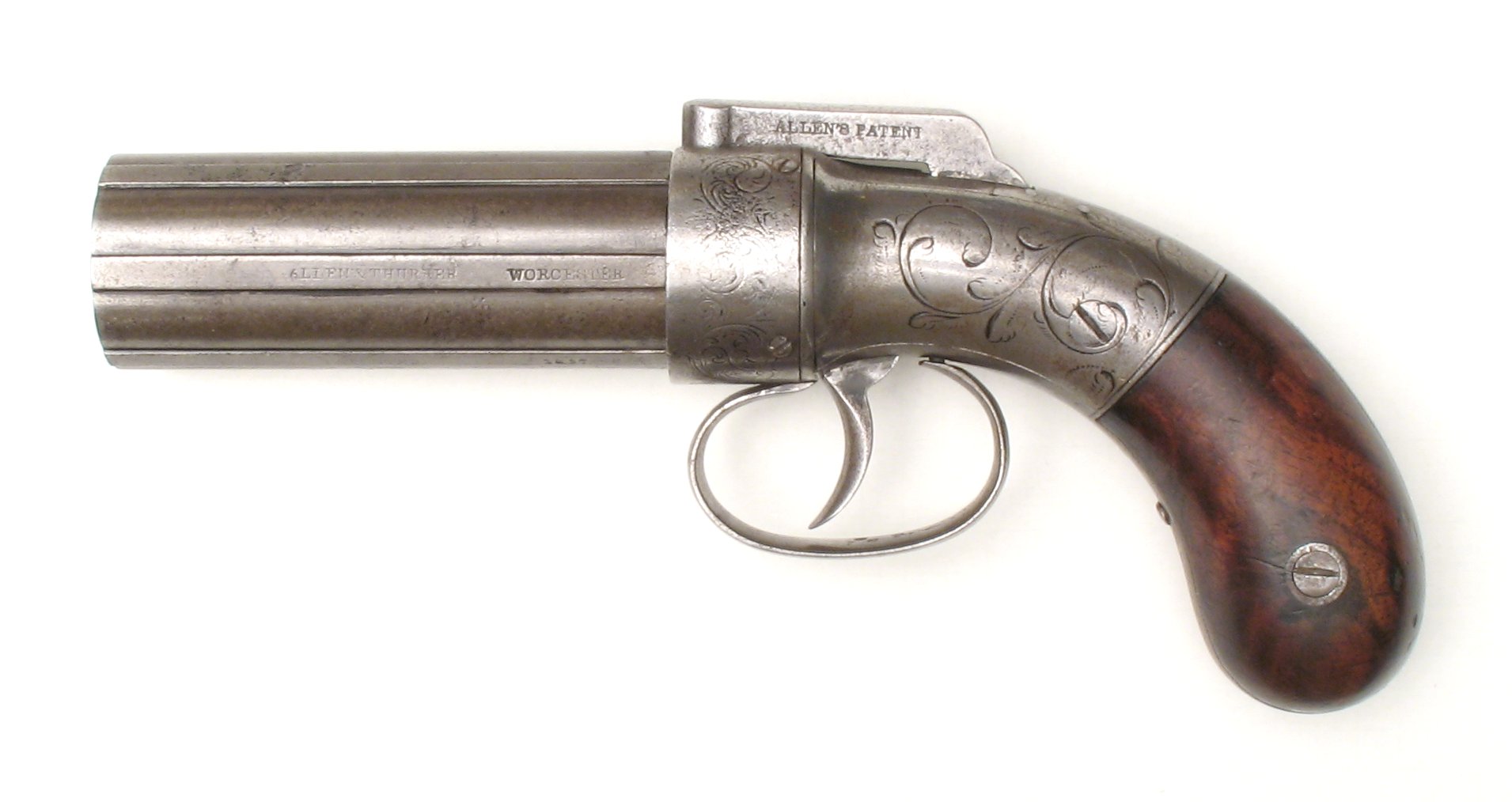
A few percussion pepperboxes were still hand-rotated but most have a mechanism that rotates the barrel group as the hammer is cocked for each shot. Single-action versions were made, notably by Darling of Massachusetts, but the vast majority use the self-cocking system whereby pressing the trigger rotates the barrel block, cocks the hammer and finally fires the weapon. The main producer of self-cocking top hammer pepperboxes (mostly referred to as "bar-hammer pepperbox") in the United States was Ethan Allen, but this type of weapon was also produced in large quantities in England.
Some pepperboxes fired the lower barrel instead of the upper, such as the American Blunt & Syms, the English Cooper or the Belgian Mariette (with configurations between three and twenty-four barrels). Usually, these employed an "underhammer" action, with the hammer mounted under the frame, behind the barrels, and forward of the trigger (often a ring-trigger). Several other types of firing mechanisms exist, such as rotating internal firing pins (Rigby, Robbins and Lawrence, Comblain), rotating firing pins on a hammer (Sharps, Grunbaum) or multiple firing pins (Martin). During the early 1830s English gunsmith Joseph Manton offered a variant with a retractable knife blade, and pistols with up to 18 barrels. The Robbins & Lawrence pepperboxes of 1851–1854 had rifled barrels, a break action breechloading mechanism and an early safety catch, meaning that it was not necessary to disassemble the gun to reload it.
The flaw with the pepperbox design is that it becomes more front-heavy if the length and number of barrels are increased, making accurate aiming difficult. With most types, in particular, those with rotating barrel clusters, it is almost impossible to aim beyond close range because the hammer is in the line of sight (some pepperboxes have a slot in the hammer through which one is supposed to aim), there is no place to put a front sight (putting one for each barrel would only increase the weight of the front end and likely make drawing the weapon awkward), and the gun is too front heavy to permit quick and steady aiming. However, the primary market was for civilian self-defense, so its most common use was at close range. Common practice at the time, indeed, was not to aim pistols, but instead to "shoot from the hip", holding the gun low and simply pointing at the target's center of mass. Gunfights often happened at a very close range. With this use in mind, many pepperboxes, in fact, have smooth-bored barrels, even though rifling had been commonly used for decades by the time of their manufacture. In the Old West, large pepperboxes were favored by the gold prospectors of 1849, for protection against robbers, rival claimants and hostile native Americans. Both American and British made pepperboxes were also popular among gold miners in Australia as a cheaper alternative to the Colt Navy revolver, and several were used at the Eureka Stockade.
Pepper-box
The pepper-box pistol or simply pepperbox (also "pepper-pot", from its resemblance to the household pepper shakers) is a multiple-barrel firearm, mostly in the form of a handgun, that has three or more gun barrels each holding a single shot. The barrels are fired in sequence by a rotating firing mechanism or, more typically, by rotating the entire barrel assembly to bring each barrel in line with a single lock or hammer, similar to the rotation of a revolver's cylinder.
Pepperbox guns have existed for all types of firelock firearms and metal-cased ammunition systems used in breechloading firearms: matchlock, wheellock, flintlock, caplock, pinfire, rimfire, and centerfire. The weight of multiple barrels could make the weapon unwieldy and restricted most to the form of sidearms intended for self-defence, though a few long guns were also made. Popular in the mid-19th century, the design has occasionally been revived for specialty applications.
This type of firearm was popular in North America from 1830 until the American Civil War, but the concept was introduced much earlier. In the 15th century, Ribauldequin, a version of the volley gun, had several single shot barrels attached to a stock, being fired individually by means of a match. Around 1790, pepperboxes were built on the basis of flintlock systems, notably by Nock in England and "Segallas" in Belgium. Building on the success of the earlier two-barrel turnover pistols, they were fitted with three, four or seven barrels. These early pepperboxes were hand rotated.
The invention of the percussion cap building on the percussion powder innovations of the Rev. Alexander Forsyth's patent of 1807 (which ran until 1821), and the industrial revolution allowed pepperbox revolvers to be mass-produced, making them more affordable than the early handmade guns previously only seen in the hands of the rich. Examples of these early weapons are the American three-barrel Manhattan pistol, the English Budding (probably the first English percussion pepperbox) and the Swedish Engholm. Most percussion pepperboxes have a circular flange around the rear of the cylinder to prevent the capped nipples being accidentally fired if the gun were to be knocked while in a pocket or dropped and to protect the eyes from cap fragments.
The pepperbox, or at least the firearm that is mostly associated with this term, was invented in the 1830s and was intended for civilian use, but military officers often made private purchases for their own use. The design spread rapidly in the United States, the United Kingdom and some parts of continental Europe. It was similar to the later revolver in that it contained bullets in separate chambers in a rotating cylinder. Unlike the revolver, however, each chamber had its own barrel, making a complex indexing system unnecessary (though pepperboxes with such a system do exist). Originally these pistols were muzzle loaders, but in 1837 the Belgian gunsmith Mariette invented a hammerless pepperbox with a ring trigger and turn off barrels that could be unscrewed. Samuel Colt owned a three-barrel pepperbox matchlock musket from British India,
A few percussion pepperboxes were still hand-rotated but most have a mechanism that rotates the barrel group as the hammer is cocked for each shot. Single-action versions were made, notably by Darling of Massachusetts, but the vast majority use the self-cocking system whereby pressing the trigger rotates the barrel block, cocks the hammer and finally fires the weapon. The main producer of self-cocking top hammer pepperboxes (mostly referred to as "bar-hammer pepperbox") in the United States was Ethan Allen, but this type of weapon was also produced in large quantities in England.
Some pepperboxes fired the lower barrel instead of the upper, such as the American Blunt & Syms, the English Cooper or the Belgian Mariette (with configurations between three and twenty-four barrels). Usually, these employed an "underhammer" action, with the hammer mounted under the frame, behind the barrels, and forward of the trigger (often a ring-trigger). Several other types of firing mechanisms exist, such as rotating internal firing pins (Rigby, Robbins and Lawrence, Comblain), rotating firing pins on a hammer (Sharps, Grunbaum) or multiple firing pins (Martin). During the early 1830s English gunsmith Joseph Manton offered a variant with a retractable knife blade, and pistols with up to 18 barrels. The Robbins & Lawrence pepperboxes of 1851–1854 had rifled barrels, a break action breechloading mechanism and an early safety catch, meaning that it was not necessary to disassemble the gun to reload it.
The flaw with the pepperbox design is that it becomes more front-heavy if the length and number of barrels are increased, making accurate aiming difficult. With most types, in particular, those with rotating barrel clusters, it is almost impossible to aim beyond close range because the hammer is in the line of sight (some pepperboxes have a slot in the hammer through which one is supposed to aim), there is no place to put a front sight (putting one for each barrel would only increase the weight of the front end and likely make drawing the weapon awkward), and the gun is too front heavy to permit quick and steady aiming. However, the primary market was for civilian self-defense, so its most common use was at close range. Common practice at the time, indeed, was not to aim pistols, but instead to "shoot from the hip", holding the gun low and simply pointing at the target's center of mass. Gunfights often happened at a very close range. With this use in mind, many pepperboxes, in fact, have smooth-bored barrels, even though rifling had been commonly used for decades by the time of their manufacture. In the Old West, large pepperboxes were favored by the gold prospectors of 1849, for protection against robbers, rival claimants and hostile native Americans. Both American and British made pepperboxes were also popular among gold miners in Australia as a cheaper alternative to the Colt Navy revolver, and several were used at the Eureka Stockade.
Recent media
Recent media