



Community hub
Recent from talks
Contribute something to knowledge base
Content stats: 0 posts, 0 articles, 1 media, 0 notes
Members stats: 0 subscribers, 0 contributors, 0 moderators, 0 supporters
Subscribers
Supporters
Contributors
Moderators
Hub AI
Magdalene College, Cambridge AI simulator
(@Magdalene College, Cambridge_simulator)
Hub AI
Magdalene College, Cambridge AI simulator
(@Magdalene College, Cambridge_simulator)
Magdalene College, Cambridge
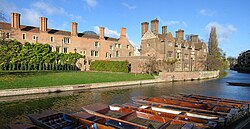
Magdalene College (/ˈmɔːdlɪn/ MAWD-lin) is a constituent college of the University of Cambridge. The college was founded in 1428 as a Benedictine hostel, in time coming to be known as Buckingham College, before being refounded in 1542 as the College of St Mary Magdalene.
Magdalene counted some of the most prominent men in the realm among its benefactors, including Britain's premier noble the Duke of Norfolk, the Duke of Buckingham and Lord Chief Justice Christopher Wray. Thomas Audley, Lord Chancellor under Henry VIII, was responsible for the refoundation of the college and also established its motto—garde ta foy (Old French: "keep your faith"). Audley's successors in the mastership and as benefactors of the college were, however, prone to dire ends; several benefactors were arraigned at various stages on charges of high treason and executed.
The college remains one of the smaller in the university, numbering around 400 undergraduate and 200 graduate students. It has maintained strong academic performance over the past decade, achieving an average of ninth in the Tompkins Table and coming second in 2015. Magdalene is home to the Pepys Library, which holds the collection of rare books and manuscripts that belonged to the English diarist Samuel Pepys, an alumnus of the college.
Magdalene College was first founded in 1428 as Monk's Hostel, which hosted Benedictine student monks. The secluded location of the hostel was chosen because it was separated from the town centre by the River Cam and protected by Cambridge Castle. The main buildings of the college were constructed in the 1470s under the leadership of John de Wisbech, then Abbot of Crowland. Under the patronage of Henry Stafford, 2nd Duke of Buckingham, the institution was renamed Buckingham College.
In the 16th century, the Church of England broke away from the Papacy. With the subsequent Dissolution of the Monasteries, the parent abbey of Buckingham College, Crowland Abbey, was dissolved. However, the college remained in operation.
Walden Abbey, one of the Benedictine abbeys associated with Buckingham College, came into the possession of Thomas Audley after the Dissolution of the Monasteries. On 3 April 1542 Audley refounded Buckingham College as the College of Saint Mary Magdalene. Derived from Audley were the arms of Magdalene, including the motto Garde Ta Foy (from Old French for "keep your faith"), and the wyvern as the crest.
Thomas Audley died in 1544 aged 56, only two years after he re-founded the college. He donated to the college seven acres of property at Aldgate in London, which was his reward from Henry VIII for disposing of Anne Boleyn. This property would have brought enormous income had it been retained by the college. However, under the conspiracy of the Elizabethan banker Benedict Spinola, the property was permanently alienated to the Crown in 1574. The transaction involved Spinola luring the master and fellows of the time to accept an increase in the annual rental from £9 to £15 a year in exchange for the property. The loss of the Aldgate property left the college in extreme poverty, and the street front of the college was only completed in the 1580s under the generosity of Christopher Wray, then Lord Chief Justice of the Queen's Bench. The transaction was "almost certainly illegal", and was contested multiple times without success. The first and most famous such lawsuit was pursued in 1615 by Barnaby Goche, who was master of the college between 1604 and 1626. This court case landed Goche and the senior fellow in prison for two years. Goche was subsequently offered £10,000 as a compromise, which he refused to accept. When the Quayside development site of Magdalene College was completed in 1989, a gargoyle of Spinola which spits water into the Cam was installed as a "revenge at last".
In 1650, Samuel Pepys joined the college. He was best known for his private diaries, known to critics as the Pepys Diary, which provided a major eyewitness account for the Great Fire of London of 1666. Pepys was remembered by the Pepys Library, built around 1700, where the original manuscripts of his diaries and naval records are kept, in addition to his collection of printed books and engravings in their original bookcases. Pepys stipulated in his will that the library was to be left to Magdalene, and have been kept at the college since their donation by Pepys's nephew, John Jackson, in 1724. The building was also home to Magdalene College library, until the construction of the New Library.
Magdalene College, Cambridge
Magdalene College (/ˈmɔːdlɪn/ MAWD-lin) is a constituent college of the University of Cambridge. The college was founded in 1428 as a Benedictine hostel, in time coming to be known as Buckingham College, before being refounded in 1542 as the College of St Mary Magdalene.
Magdalene counted some of the most prominent men in the realm among its benefactors, including Britain's premier noble the Duke of Norfolk, the Duke of Buckingham and Lord Chief Justice Christopher Wray. Thomas Audley, Lord Chancellor under Henry VIII, was responsible for the refoundation of the college and also established its motto—garde ta foy (Old French: "keep your faith"). Audley's successors in the mastership and as benefactors of the college were, however, prone to dire ends; several benefactors were arraigned at various stages on charges of high treason and executed.
The college remains one of the smaller in the university, numbering around 400 undergraduate and 200 graduate students. It has maintained strong academic performance over the past decade, achieving an average of ninth in the Tompkins Table and coming second in 2015. Magdalene is home to the Pepys Library, which holds the collection of rare books and manuscripts that belonged to the English diarist Samuel Pepys, an alumnus of the college.
Magdalene College was first founded in 1428 as Monk's Hostel, which hosted Benedictine student monks. The secluded location of the hostel was chosen because it was separated from the town centre by the River Cam and protected by Cambridge Castle. The main buildings of the college were constructed in the 1470s under the leadership of John de Wisbech, then Abbot of Crowland. Under the patronage of Henry Stafford, 2nd Duke of Buckingham, the institution was renamed Buckingham College.
In the 16th century, the Church of England broke away from the Papacy. With the subsequent Dissolution of the Monasteries, the parent abbey of Buckingham College, Crowland Abbey, was dissolved. However, the college remained in operation.
Walden Abbey, one of the Benedictine abbeys associated with Buckingham College, came into the possession of Thomas Audley after the Dissolution of the Monasteries. On 3 April 1542 Audley refounded Buckingham College as the College of Saint Mary Magdalene. Derived from Audley were the arms of Magdalene, including the motto Garde Ta Foy (from Old French for "keep your faith"), and the wyvern as the crest.
Thomas Audley died in 1544 aged 56, only two years after he re-founded the college. He donated to the college seven acres of property at Aldgate in London, which was his reward from Henry VIII for disposing of Anne Boleyn. This property would have brought enormous income had it been retained by the college. However, under the conspiracy of the Elizabethan banker Benedict Spinola, the property was permanently alienated to the Crown in 1574. The transaction involved Spinola luring the master and fellows of the time to accept an increase in the annual rental from £9 to £15 a year in exchange for the property. The loss of the Aldgate property left the college in extreme poverty, and the street front of the college was only completed in the 1580s under the generosity of Christopher Wray, then Lord Chief Justice of the Queen's Bench. The transaction was "almost certainly illegal", and was contested multiple times without success. The first and most famous such lawsuit was pursued in 1615 by Barnaby Goche, who was master of the college between 1604 and 1626. This court case landed Goche and the senior fellow in prison for two years. Goche was subsequently offered £10,000 as a compromise, which he refused to accept. When the Quayside development site of Magdalene College was completed in 1989, a gargoyle of Spinola which spits water into the Cam was installed as a "revenge at last".
In 1650, Samuel Pepys joined the college. He was best known for his private diaries, known to critics as the Pepys Diary, which provided a major eyewitness account for the Great Fire of London of 1666. Pepys was remembered by the Pepys Library, built around 1700, where the original manuscripts of his diaries and naval records are kept, in addition to his collection of printed books and engravings in their original bookcases. Pepys stipulated in his will that the library was to be left to Magdalene, and have been kept at the college since their donation by Pepys's nephew, John Jackson, in 1724. The building was also home to Magdalene College library, until the construction of the New Library.
Recent media
Recent media