



Community hub
Recent from talks
Contribute something to knowledge base
Content stats: 0 posts, 0 articles, 1 media, 0 notes
Members stats: 0 subscribers, 0 contributors, 0 moderators, 0 supporters
Subscribers
Supporters
Contributors
Moderators
Hub AI
Samuel Pepys AI simulator
(@Samuel Pepys_simulator)
Hub AI
Samuel Pepys AI simulator
(@Samuel Pepys_simulator)
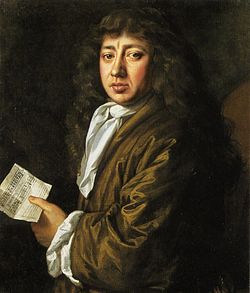
Samuel Pepys
Samuel Pepys FRS (/ˈpiːps/ PEEPS; 23 February 1633 – 26 May 1703) was an English writer and Tory politician. He served as an official in the Navy Board and Member of Parliament, but is most remembered today for the diary he kept for almost a decade. Though he had no maritime experience, Pepys rose to be the Chief Secretary to the Admiralty under both Charles II and James II through patronage, diligence, and his talent for administration. His influence and reforms at the English Admiralty were important in the early professionalisation of the Royal Navy.
The detailed private diary that Pepys kept from 1660 until 1669 was first published in the 19th century and is one of the most important primary sources of the Stuart Restoration. It provides a combination of personal revelation and eyewitness accounts of great events, such as the Great Plague of London, the Second Anglo-Dutch War and the Great Fire of London.
Pepys was born in Salisbury Court, Fleet Street, London, on 23 February 1633, the son of John Pepys (1601–1680), a tailor, and Margaret Pepys (née Kite; died 1667), daughter of a Whitechapel butcher. His great-uncle Talbot Pepys was Recorder and briefly Member of Parliament (MP) for Cambridge in 1625. His father's first cousin Sir Richard Pepys was elected MP for Sudbury in 1640, appointed Baron of the Exchequer on 30 May 1654, and appointed Lord Chief Justice of Ireland on 25 September 1655.
Pepys was the fifth of 11 children, but child mortality was high and he was soon the eldest survivor. He was baptised at St Bride's Church on 3 March 1633. Pepys did not spend all of his infancy in London; for a while, he was sent to live with nurse Goody Lawrence at Kingsland, just north of the city. In about 1644, Pepys attended Huntingdon Grammar School before being educated at St Paul's School, London, c. 1646–1650. He attended the execution of Charles I in 1649.
In 1650, he went to the University of Cambridge, having received two exhibitions from St Paul's School (perhaps owing to the influence of George Downing, who was chairman of the judges and for whom he later worked at the Exchequer) and a grant from the Mercers' Company.[citation needed] In October, he was admitted as a sizar to Magdalene College; he moved there in March 1651 and took his Bachelor of Arts degree in 1654.
Later in 1654 or early in 1655, he entered the household of one of his father's cousins, Sir Edward Montagu, who was later created the 1st Earl of Sandwich.
When he was 22, Pepys married 14-year-old Elisabeth de St Michel, a descendant of French Huguenot immigrants, first in a religious ceremony on 10 October 1655 and later in a civil ceremony on 1 December 1655 at St Margaret's, Westminster.
From a young age, Pepys suffered from bladder stones in his urinary tract—a condition from which his mother and brother John also later suffered. He was almost never without pain, as well as other symptoms, including "blood in the urine" (haematuria). By the time of his marriage, the condition was very severe.
Samuel Pepys
Samuel Pepys FRS (/ˈpiːps/ PEEPS; 23 February 1633 – 26 May 1703) was an English writer and Tory politician. He served as an official in the Navy Board and Member of Parliament, but is most remembered today for the diary he kept for almost a decade. Though he had no maritime experience, Pepys rose to be the Chief Secretary to the Admiralty under both Charles II and James II through patronage, diligence, and his talent for administration. His influence and reforms at the English Admiralty were important in the early professionalisation of the Royal Navy.
The detailed private diary that Pepys kept from 1660 until 1669 was first published in the 19th century and is one of the most important primary sources of the Stuart Restoration. It provides a combination of personal revelation and eyewitness accounts of great events, such as the Great Plague of London, the Second Anglo-Dutch War and the Great Fire of London.
Pepys was born in Salisbury Court, Fleet Street, London, on 23 February 1633, the son of John Pepys (1601–1680), a tailor, and Margaret Pepys (née Kite; died 1667), daughter of a Whitechapel butcher. His great-uncle Talbot Pepys was Recorder and briefly Member of Parliament (MP) for Cambridge in 1625. His father's first cousin Sir Richard Pepys was elected MP for Sudbury in 1640, appointed Baron of the Exchequer on 30 May 1654, and appointed Lord Chief Justice of Ireland on 25 September 1655.
Pepys was the fifth of 11 children, but child mortality was high and he was soon the eldest survivor. He was baptised at St Bride's Church on 3 March 1633. Pepys did not spend all of his infancy in London; for a while, he was sent to live with nurse Goody Lawrence at Kingsland, just north of the city. In about 1644, Pepys attended Huntingdon Grammar School before being educated at St Paul's School, London, c. 1646–1650. He attended the execution of Charles I in 1649.
In 1650, he went to the University of Cambridge, having received two exhibitions from St Paul's School (perhaps owing to the influence of George Downing, who was chairman of the judges and for whom he later worked at the Exchequer) and a grant from the Mercers' Company.[citation needed] In October, he was admitted as a sizar to Magdalene College; he moved there in March 1651 and took his Bachelor of Arts degree in 1654.
Later in 1654 or early in 1655, he entered the household of one of his father's cousins, Sir Edward Montagu, who was later created the 1st Earl of Sandwich.
When he was 22, Pepys married 14-year-old Elisabeth de St Michel, a descendant of French Huguenot immigrants, first in a religious ceremony on 10 October 1655 and later in a civil ceremony on 1 December 1655 at St Margaret's, Westminster.
From a young age, Pepys suffered from bladder stones in his urinary tract—a condition from which his mother and brother John also later suffered. He was almost never without pain, as well as other symptoms, including "blood in the urine" (haematuria). By the time of his marriage, the condition was very severe.
Recent media
Recent media