
Recent from talks
Mainz carnival
Knowledge base stats:
Talk channels stats:
Members stats:
Mainz carnival
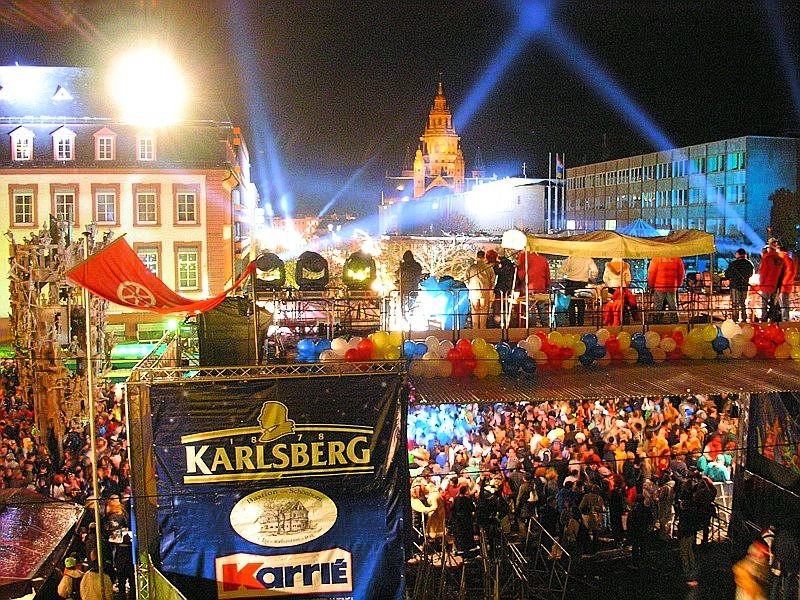
The Mainz Carnival (Mainzer Fastnacht, "Määnzer Fassenacht" or "Meenzer Fassenacht") is a months-long citywide carnival celebration in Mainz, Germany that traditionally begins on 11 November but culminates in the days before Ash Wednesday in the spring.
It is one of the largest carnival events in Germany and, along with the Cologne and Düsseldorfer carnivals, Mainz is one of the three cities prominent in the rhenish carnival tradition. Aside from the celebrations, parades, and jollity which are typical of carnival traditions in many countries, the Mainz carnival has an unusual emphasis on political and literary humor and commentary.
The tradition of carnival can be traced back to the Christian moveable feasts, where Ash Wednesday is the first day of Lent and occurs forty-six days (forty days not counting Sundays) before Easter. The first written records of the tradition date from the 13th and 14th century. By that time, regulations against excessive gluttony and debauchery during the days before carnival had been established. The word "Fastnacht" or carnival occurs for the first time during the 13th century. Details about the old Mainz carnival are not thoroughly covered in primary sources. A scripture of the Mainz humanist writer Dietrich Gresemund dated to the end of the 15th century describes carnival as an unorganized Volksfest comprising masquerade, meals, drinking and dancing during day and night. He describes the celebrants engaging in crude jokes or, under the protection of their masks, excessive quarrelling.
Simultaneously, huge carnival celebrations at the electoral court happened, where the roles at the court were rearranged at random. In 1664 the prince elector drew the role of the electoral cabinetmaker, in 1668 he was cup-bearer and had to serve all guests. This habit was called "Mainzer Königreich" (Mainz kingdom). This roleplaying tradition continued until the last elector, Friedrich Karl Joseph von Erthal, terminated it in 1775.
During carnival time, the general public was allowed to attend the masked balls...
With the end of the Ancien Régime, the "people's carnival" continued, but, according to old records, degenerated into vulgarity. The upper-class at that time celebrated costume parties, carrying on a tradition which had existed previously.
The origins of the contemporary carnival in Mainz lie in the strengthening of the middle class after the end of the Ancien Régime at the beginning of the 19th century and stronger economic relations with Cologne. In the latter city, reforms were made in the carnival in 1823, which introduced carnevalistic events in great halls, as well as a big parade on Rosenmontag. In addition, the middle-class in Mainz strived for alternate forms of social gatherings and readily accepted the Cologne Reform, with the slight variation of placing a greater emphasis on opposition and competition. After the old carnival was restored in Cologne, the Mainz carnivalists organized a parade named "Krähwinkler Landsturm" in 1837, where the oldest carnival organization in Mainz, later called the Mainzer Ranzengarde, appeared the first time. Like other carnival organizations in the Rhineland at the time, fees for joining were high enough that participation was largely restricted to the upper middle class. It was not until the mid-19th century that a proliferation of clubs and resulting drop in membership fees allowed lower middle class participation. The clubs would meet weekly beginning in January to plan events for final week of carnival. Unlike other rhenish carnival cities, in Mainz, the clubs tended to be slightly more heterogeneous, as members of the clubs were allowed to bring friends, and often did, from outside the burgeoning middle class.
The initiative for creating the first organization may be traced back to the merchant Nicolaus Krieger. His primary objective was that the rather disgustingly vulgar people's carnival was transformed by organized activities to an orderly event, generating revenue for the innkeepers and attracting tourists.
Hub AI
Mainz carnival AI simulator
(@Mainz carnival_simulator)
Mainz carnival
The Mainz Carnival (Mainzer Fastnacht, "Määnzer Fassenacht" or "Meenzer Fassenacht") is a months-long citywide carnival celebration in Mainz, Germany that traditionally begins on 11 November but culminates in the days before Ash Wednesday in the spring.
It is one of the largest carnival events in Germany and, along with the Cologne and Düsseldorfer carnivals, Mainz is one of the three cities prominent in the rhenish carnival tradition. Aside from the celebrations, parades, and jollity which are typical of carnival traditions in many countries, the Mainz carnival has an unusual emphasis on political and literary humor and commentary.
The tradition of carnival can be traced back to the Christian moveable feasts, where Ash Wednesday is the first day of Lent and occurs forty-six days (forty days not counting Sundays) before Easter. The first written records of the tradition date from the 13th and 14th century. By that time, regulations against excessive gluttony and debauchery during the days before carnival had been established. The word "Fastnacht" or carnival occurs for the first time during the 13th century. Details about the old Mainz carnival are not thoroughly covered in primary sources. A scripture of the Mainz humanist writer Dietrich Gresemund dated to the end of the 15th century describes carnival as an unorganized Volksfest comprising masquerade, meals, drinking and dancing during day and night. He describes the celebrants engaging in crude jokes or, under the protection of their masks, excessive quarrelling.
Simultaneously, huge carnival celebrations at the electoral court happened, where the roles at the court were rearranged at random. In 1664 the prince elector drew the role of the electoral cabinetmaker, in 1668 he was cup-bearer and had to serve all guests. This habit was called "Mainzer Königreich" (Mainz kingdom). This roleplaying tradition continued until the last elector, Friedrich Karl Joseph von Erthal, terminated it in 1775.
During carnival time, the general public was allowed to attend the masked balls...
With the end of the Ancien Régime, the "people's carnival" continued, but, according to old records, degenerated into vulgarity. The upper-class at that time celebrated costume parties, carrying on a tradition which had existed previously.
The origins of the contemporary carnival in Mainz lie in the strengthening of the middle class after the end of the Ancien Régime at the beginning of the 19th century and stronger economic relations with Cologne. In the latter city, reforms were made in the carnival in 1823, which introduced carnevalistic events in great halls, as well as a big parade on Rosenmontag. In addition, the middle-class in Mainz strived for alternate forms of social gatherings and readily accepted the Cologne Reform, with the slight variation of placing a greater emphasis on opposition and competition. After the old carnival was restored in Cologne, the Mainz carnivalists organized a parade named "Krähwinkler Landsturm" in 1837, where the oldest carnival organization in Mainz, later called the Mainzer Ranzengarde, appeared the first time. Like other carnival organizations in the Rhineland at the time, fees for joining were high enough that participation was largely restricted to the upper middle class. It was not until the mid-19th century that a proliferation of clubs and resulting drop in membership fees allowed lower middle class participation. The clubs would meet weekly beginning in January to plan events for final week of carnival. Unlike other rhenish carnival cities, in Mainz, the clubs tended to be slightly more heterogeneous, as members of the clubs were allowed to bring friends, and often did, from outside the burgeoning middle class.
The initiative for creating the first organization may be traced back to the merchant Nicolaus Krieger. His primary objective was that the rather disgustingly vulgar people's carnival was transformed by organized activities to an orderly event, generating revenue for the innkeepers and attracting tourists.
Recent media