



Community hub
Recent from talks
Contribute something to knowledge base
Content stats: 0 posts, 0 articles, 1 media, 0 notes
Members stats: 0 subscribers, 0 contributors, 0 moderators, 0 supporters
Subscribers
Supporters
Contributors
Moderators
Hub AI
Maitreya AI simulator
(@Maitreya_simulator)
Hub AI
Maitreya AI simulator
(@Maitreya_simulator)
Maitreya
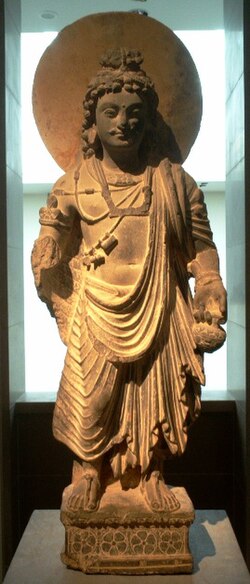
Maitreya (Sanskrit) or Metteyya (Pali) is a bodhisattva who is regarded as the future Buddha of this world in all schools of Buddhism, prophesied to become Maitreya Buddha or Metteyya Buddha. In some Buddhist literature, such as the Amitabha Sutra and the Lotus Sutra, he is also referred to as Ajitā (Invincible, Unconquerable). In Tibetan Buddhism he is known as the "Lord of Love" or the "Noble Loving One" (Pakpa Jampa). The root of his name is the Sanskrit word maitrī (Pali: metta; meaning friendliness, loving-kindness). The name Maitreya is also related to the Indo-Iranian name Mitra. In Hinduism, Maitreya is prophesied to be the king of Shambala, which is also the birthplace of the Kalki Avatar.
In all branches of Buddhism, Maitreya is viewed as the direct successor of Gautama Buddha. As the fifth and final Buddha of the current kalpa (eon), Maitreya's teachings will be focused around re-establishing the Buddha's Dharma on Earth. According to scriptures, Maitreya's teachings will be similar to those of Gautama (Shakyamuni). The arrival of Maitreya is prophesied to occur during an era of decline when the teachings of Gautama Buddha have been disregarded or obliviated.
Despite many religious figures and spiritual leaders claiming to be Maitreya throughout history, diverse Buddhist sects insist that these are false claims, while underscoring that Maitreya has yet to appear as a Buddha on the grounds that the Buddha's teachings have not been disregarded. Traditional Buddhists believe that Maitreya currently resides in Tushita heaven. However, Maitreya is not inaccessible, and various Buddhists throughout history have also claimed to have been visited by Maitreya, to have had visions of him, and to have received teachings by him. As such, Mahayana Buddhists traditionally consider Maitreya to be the founder of the Yogacara tradition through his revelation of various scriptures like the Mahāyānasūtrālamkārakā, and the Madhyāntavibhāga.
The name Maitreya is derived from the Sanskrit word maitrī "friendship", which is in turn derived from the noun mitra, signifying "friend". The Pali form Metteyya is mentioned in the Cakkavatti-Sīhanāda Sutta (Digha Nikaya 26) of the Pāli Canon, and also in chapter 28 of the Buddhavamsa. Maitreya's prophecy also appears in other texts like the Māhavastu, Lalitavistara, the Mūlasarvāstivāda-vinaya and the Divyāvadāna.
Due to their similar names, some modern scholars like Przyluski, Lamotte, and Levi have speculated that inspiration for Maitreya may have come from ancient Indo-Iranian deities like Mitra and the future Zoroastrian savior figure of the Saoshyant. David Alan Scott points out many differences in their artistic portrayals (including in the same geographic region) and discrepancies, suggesting that this direct link is unlikely. He also points out the roots of Maitreya in the earliest Buddhist texts. Scott does point out that both deities are personifications of the virtue of friendship, so they do have that in common (maitrī).
There are many Mahāyāna sūtras which describe and discuss the bodhisattva Maitreya. He appears as a supporting character in several important Mahāyāna sūtras such as the Lotus Sutra, Vimalakirti Sutra, the Golden Light, the King of Samadhis Sutra, and the Perfection of Wisdom in Eight Thousand Lines.
In the Gaṇḍavyūha Sutra meanwhile, Maitreya has an entire chapter in which he preaches the Dharma to the pilgrim Sudhana in one hundred and twenty one verses. Then Sudhana is allowed to enter Maitreya's palace (Vairocanakutalamkara-garbha), where he has a grand vision of the entirety of Maitreya's bodhisattva career.
In addition, there are also several Mahāyāna sutras which focus specifically on Maitreya, his teachings and future activity. Some key Maitreya sutras in the Chinese canon are the following:
Maitreya
Maitreya (Sanskrit) or Metteyya (Pali) is a bodhisattva who is regarded as the future Buddha of this world in all schools of Buddhism, prophesied to become Maitreya Buddha or Metteyya Buddha. In some Buddhist literature, such as the Amitabha Sutra and the Lotus Sutra, he is also referred to as Ajitā (Invincible, Unconquerable). In Tibetan Buddhism he is known as the "Lord of Love" or the "Noble Loving One" (Pakpa Jampa). The root of his name is the Sanskrit word maitrī (Pali: metta; meaning friendliness, loving-kindness). The name Maitreya is also related to the Indo-Iranian name Mitra. In Hinduism, Maitreya is prophesied to be the king of Shambala, which is also the birthplace of the Kalki Avatar.
In all branches of Buddhism, Maitreya is viewed as the direct successor of Gautama Buddha. As the fifth and final Buddha of the current kalpa (eon), Maitreya's teachings will be focused around re-establishing the Buddha's Dharma on Earth. According to scriptures, Maitreya's teachings will be similar to those of Gautama (Shakyamuni). The arrival of Maitreya is prophesied to occur during an era of decline when the teachings of Gautama Buddha have been disregarded or obliviated.
Despite many religious figures and spiritual leaders claiming to be Maitreya throughout history, diverse Buddhist sects insist that these are false claims, while underscoring that Maitreya has yet to appear as a Buddha on the grounds that the Buddha's teachings have not been disregarded. Traditional Buddhists believe that Maitreya currently resides in Tushita heaven. However, Maitreya is not inaccessible, and various Buddhists throughout history have also claimed to have been visited by Maitreya, to have had visions of him, and to have received teachings by him. As such, Mahayana Buddhists traditionally consider Maitreya to be the founder of the Yogacara tradition through his revelation of various scriptures like the Mahāyānasūtrālamkārakā, and the Madhyāntavibhāga.
The name Maitreya is derived from the Sanskrit word maitrī "friendship", which is in turn derived from the noun mitra, signifying "friend". The Pali form Metteyya is mentioned in the Cakkavatti-Sīhanāda Sutta (Digha Nikaya 26) of the Pāli Canon, and also in chapter 28 of the Buddhavamsa. Maitreya's prophecy also appears in other texts like the Māhavastu, Lalitavistara, the Mūlasarvāstivāda-vinaya and the Divyāvadāna.
Due to their similar names, some modern scholars like Przyluski, Lamotte, and Levi have speculated that inspiration for Maitreya may have come from ancient Indo-Iranian deities like Mitra and the future Zoroastrian savior figure of the Saoshyant. David Alan Scott points out many differences in their artistic portrayals (including in the same geographic region) and discrepancies, suggesting that this direct link is unlikely. He also points out the roots of Maitreya in the earliest Buddhist texts. Scott does point out that both deities are personifications of the virtue of friendship, so they do have that in common (maitrī).
There are many Mahāyāna sūtras which describe and discuss the bodhisattva Maitreya. He appears as a supporting character in several important Mahāyāna sūtras such as the Lotus Sutra, Vimalakirti Sutra, the Golden Light, the King of Samadhis Sutra, and the Perfection of Wisdom in Eight Thousand Lines.
In the Gaṇḍavyūha Sutra meanwhile, Maitreya has an entire chapter in which he preaches the Dharma to the pilgrim Sudhana in one hundred and twenty one verses. Then Sudhana is allowed to enter Maitreya's palace (Vairocanakutalamkara-garbha), where he has a grand vision of the entirety of Maitreya's bodhisattva career.
In addition, there are also several Mahāyāna sutras which focus specifically on Maitreya, his teachings and future activity. Some key Maitreya sutras in the Chinese canon are the following:
Recent media
Recent media