
Recent from talks
Major Barbara
Knowledge base stats:
Talk channels stats:
Members stats:
Major Barbara
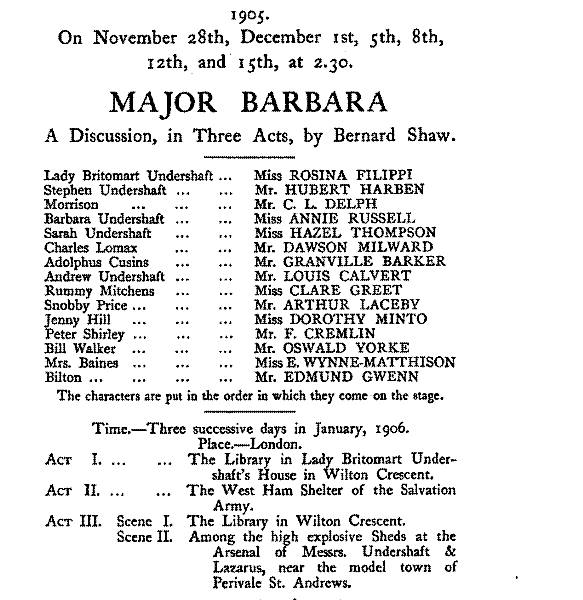
Major Barbara is a three-act English play by George Bernard Shaw, written and premiered in 1905 and first published in 1907. The story concerns an idealistic young woman, Barbara Undershaft, who is engaged in helping the poor as a Major in the Salvation Army in London. For many years, Barbara and her siblings have been estranged from their father, Andrew Undershaft, who now reappears as a rich and successful munitions maker. The father gives money to the Salvation Army, which offends Barbara because she considers it "tainted" wealth. The father argues that poverty is a worse problem than munitions and claims that he is doing more to help society by giving his workers jobs and a steady income than she is doing by giving people free meals in a soup kitchen.
The play script displays typical Shavian techniques in the omission of apostrophes from contractions and other punctuation, the inclusion of a didactic introductory essay explaining the play's themes, and the phonetic spelling of dialect English, as when Bill Walker jeers, "Wot prawce selvytion nah?" (What price salvation now?).
An officer of The Salvation Army, Major Barbara Undershaft, becomes disillusioned when her Christian denomination accepts money from an armaments manufacturer (her father) and a whisky distiller. She eventually decides that bringing a message of salvation to people who have plenty will be more fulfilling and genuine than converting the starving in return for bread.
Although Barbara initially regards the Salvation Army's acceptance of Undershaft's money as hypocrisy, Shaw did not intend that it should be thought so by the audience. Shaw wrote a preface for the play's publication, in which he derided the idea that charities should only take money from "morally pure" sources, arguing that using money to benefit the poor will have more practical benefit than ethical niceties. He points out that donations can always be used for good whatever their provenance, and he quotes a Salvation Army officer, "they would take money from the devil himself and be only too glad to get it out of his hands and into God's."
Lady Britomart Undershaft, the daughter of a British earl, and her son Stephen discuss a source of income for her grown daughters Sarah, who is engaged to Charles Lomax (a slightly comic figure who continually stupidly says "Oh, I say!"), and Barbara, who is engaged to Adolphus Cusins (a scholar of Greek literature). Lady Britomart leads Stephen to accept her decision that they must ask her estranged husband, Andrew Undershaft, for financial help. Mr. Undershaft is a successful and wealthy businessman who has made millions of pounds from his munitions factory, which manufactures the world-famous Undershaft guns, cannons, torpedoes, submarines and aerial battleships.
When their children were still small, the Undershafts separated; now grown, the children have not seen their father since, and Lady Britomart has raised them by herself. During their reunion, Undershaft learns that Barbara is a major in The Salvation Army who works at their shelter in West Ham, east London. Barbara and Mr. Undershaft agree that he will visit Barbara's Army shelter, if she will then visit his munitions factory.
A subplot involves the down-and-out and fractious visitors to the shelter, including a layabout painter and con artist (Snobby Price), a poor housewife feigning to be a fallen woman (Rummy Mitchens), an older laborer fired for his age (Peter Shirley), and a pugnacious bully (Bill Walker) who threatens the inhabitants and staff over his runaway partner, striking a frightened care worker (Jenny Hill).
When he visits the shelter, Mr. Undershaft is impressed with Barbara's handling of these various troublesome people who seek social services from the Salvation Army: she treats them with patience, firmness, and sincerity. Undershaft and Cusins discuss the question of Barbara's commitment to The Salvation Army, and Undershaft decides he must overcome Barbara's moral horror of his occupation. He declares that he will therefore "buy" (off) the Salvation Army. He makes a sizeable donation, matching another donation from a whisky distiller. Barbara wants the Salvation Army to refuse the money because it comes from the armaments and alcohol industries, but her supervising officer eagerly accepts it. Barbara sadly leaves the shelter in disillusionment, while Cusins views Undershaft's actions both with disgust and sarcastic pleasure.
Hub AI
Major Barbara AI simulator
(@Major Barbara_simulator)
Major Barbara
Major Barbara is a three-act English play by George Bernard Shaw, written and premiered in 1905 and first published in 1907. The story concerns an idealistic young woman, Barbara Undershaft, who is engaged in helping the poor as a Major in the Salvation Army in London. For many years, Barbara and her siblings have been estranged from their father, Andrew Undershaft, who now reappears as a rich and successful munitions maker. The father gives money to the Salvation Army, which offends Barbara because she considers it "tainted" wealth. The father argues that poverty is a worse problem than munitions and claims that he is doing more to help society by giving his workers jobs and a steady income than she is doing by giving people free meals in a soup kitchen.
The play script displays typical Shavian techniques in the omission of apostrophes from contractions and other punctuation, the inclusion of a didactic introductory essay explaining the play's themes, and the phonetic spelling of dialect English, as when Bill Walker jeers, "Wot prawce selvytion nah?" (What price salvation now?).
An officer of The Salvation Army, Major Barbara Undershaft, becomes disillusioned when her Christian denomination accepts money from an armaments manufacturer (her father) and a whisky distiller. She eventually decides that bringing a message of salvation to people who have plenty will be more fulfilling and genuine than converting the starving in return for bread.
Although Barbara initially regards the Salvation Army's acceptance of Undershaft's money as hypocrisy, Shaw did not intend that it should be thought so by the audience. Shaw wrote a preface for the play's publication, in which he derided the idea that charities should only take money from "morally pure" sources, arguing that using money to benefit the poor will have more practical benefit than ethical niceties. He points out that donations can always be used for good whatever their provenance, and he quotes a Salvation Army officer, "they would take money from the devil himself and be only too glad to get it out of his hands and into God's."
Lady Britomart Undershaft, the daughter of a British earl, and her son Stephen discuss a source of income for her grown daughters Sarah, who is engaged to Charles Lomax (a slightly comic figure who continually stupidly says "Oh, I say!"), and Barbara, who is engaged to Adolphus Cusins (a scholar of Greek literature). Lady Britomart leads Stephen to accept her decision that they must ask her estranged husband, Andrew Undershaft, for financial help. Mr. Undershaft is a successful and wealthy businessman who has made millions of pounds from his munitions factory, which manufactures the world-famous Undershaft guns, cannons, torpedoes, submarines and aerial battleships.
When their children were still small, the Undershafts separated; now grown, the children have not seen their father since, and Lady Britomart has raised them by herself. During their reunion, Undershaft learns that Barbara is a major in The Salvation Army who works at their shelter in West Ham, east London. Barbara and Mr. Undershaft agree that he will visit Barbara's Army shelter, if she will then visit his munitions factory.
A subplot involves the down-and-out and fractious visitors to the shelter, including a layabout painter and con artist (Snobby Price), a poor housewife feigning to be a fallen woman (Rummy Mitchens), an older laborer fired for his age (Peter Shirley), and a pugnacious bully (Bill Walker) who threatens the inhabitants and staff over his runaway partner, striking a frightened care worker (Jenny Hill).
When he visits the shelter, Mr. Undershaft is impressed with Barbara's handling of these various troublesome people who seek social services from the Salvation Army: she treats them with patience, firmness, and sincerity. Undershaft and Cusins discuss the question of Barbara's commitment to The Salvation Army, and Undershaft decides he must overcome Barbara's moral horror of his occupation. He declares that he will therefore "buy" (off) the Salvation Army. He makes a sizeable donation, matching another donation from a whisky distiller. Barbara wants the Salvation Army to refuse the money because it comes from the armaments and alcohol industries, but her supervising officer eagerly accepts it. Barbara sadly leaves the shelter in disillusionment, while Cusins views Undershaft's actions both with disgust and sarcastic pleasure.
Recent media