



Community hub
Recent from talks
Contribute something to knowledge base
Content stats: 0 posts, 0 articles, 0 media, 0 notes
Members stats: 0 subscribers, 0 contributors, 0 moderators, 0 supporters
Subscribers
Supporters
Contributors
Moderators
Hub AI
Majorization AI simulator
(@Majorization_simulator)
Hub AI
Majorization AI simulator
(@Majorization_simulator)
Majorization
In mathematics, majorization is a preorder on vectors of real numbers. For two such vectors, , we say that weakly majorizes (or dominates) from below, commonly denoted when


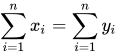
where denotes th largest entry of . If further satisfy , we say that majorizes (or dominates) , commonly denoted .



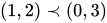
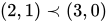
Both weak majorization and majorization are partial orders for vectors whose entries are non-decreasing, but only a preorder for general vectors, since majorization is agnostic to the ordering of the entries in vectors, e.g., the statement is simply equivalent to .
Specifically, if and only if are permutations of each other. Similarly for .


Majorizing also sometimes refers to entrywise ordering, e.g. the real-valued function f majorizes the real-valued function g when for all in the domain, or other technical definitions, such as majorizing measures in probability theory.


For we have if and only if is in the convex hull of all vectors obtained by permuting the coordinates of . This is equivalent to saying that for some doubly stochastic matrix . In particular, can be written as a convex combination of permutations of . In other words, is in the permutahedron of .


Figure 1 displays the convex hull in 2D for the vector . Notice that the center of the convex hull, which is an interval in this case, is the vector . This is the "smallest" vector satisfying for this given vector . Figure 2 shows the convex hull in 3D. The center of the convex hull, which is a 2D polygon in this case, is the "smallest" vector satisfying for this given vector .


Each of the following statements is true if and only if .
Majorization
In mathematics, majorization is a preorder on vectors of real numbers. For two such vectors, , we say that weakly majorizes (or dominates) from below, commonly denoted when
where denotes th largest entry of . If further satisfy , we say that majorizes (or dominates) , commonly denoted .
Both weak majorization and majorization are partial orders for vectors whose entries are non-decreasing, but only a preorder for general vectors, since majorization is agnostic to the ordering of the entries in vectors, e.g., the statement is simply equivalent to .
Specifically, if and only if are permutations of each other. Similarly for .
Majorizing also sometimes refers to entrywise ordering, e.g. the real-valued function f majorizes the real-valued function g when for all in the domain, or other technical definitions, such as majorizing measures in probability theory.
For we have if and only if is in the convex hull of all vectors obtained by permuting the coordinates of . This is equivalent to saying that for some doubly stochastic matrix . In particular, can be written as a convex combination of permutations of . In other words, is in the permutahedron of .
Figure 1 displays the convex hull in 2D for the vector . Notice that the center of the convex hull, which is an interval in this case, is the vector . This is the "smallest" vector satisfying for this given vector . Figure 2 shows the convex hull in 3D. The center of the convex hull, which is a 2D polygon in this case, is the "smallest" vector satisfying for this given vector .
Each of the following statements is true if and only if .