
Recent from talks
Malabar rebellion
Knowledge base stats:
Talk channels stats:
Members stats:
Malabar rebellion
The Malabar rebellion of 1921 (also called Moplah rebellion, and Mappila rebellion, Malayalam: malabār kalāpam) started as a resistance against the British colonial rule in certain places in the southern part of old Malabar district of present-day Kerala. The popular uprising was also against the prevailing feudal system controlled by Hindus.
For the mappila side, the rebellion was primarily a peasant revolt against the colonial government. During the uprising, the rebels attacked various symbols and institutions of the colonial state, such as telegraph lines, train stations, courts and post offices.
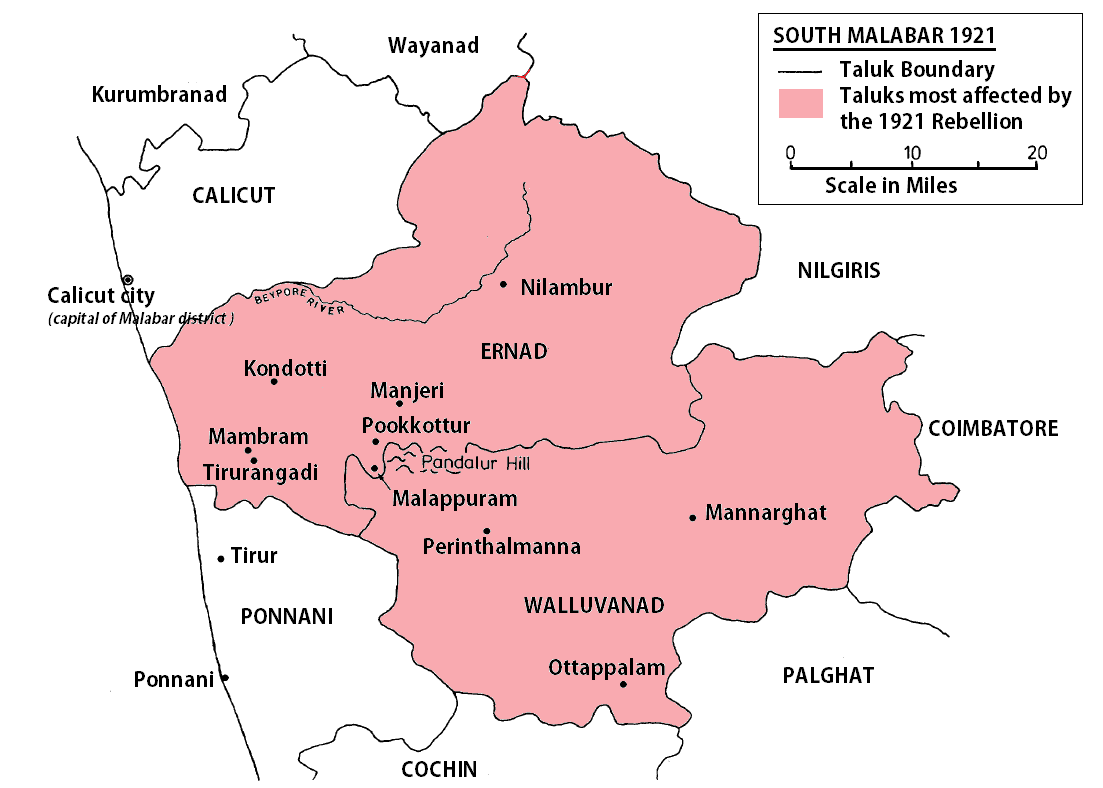
There were also a series of clashes between the Mappila Muslims and the Hindu landlords, the latter supported by the British colonial government, throughout the 19th and early 20th centuries. The heavy-handed suppression of the Khilafat Movement by the colonial government was met by resistance in the Eranad and Valluvanad taluks of Malabar. The Mappilas attacked and took control of police stations, colonial government offices, courts and government treasuries.
For six months from August 1921, the rebellion extended over 2,000 square miles (5,200 km2) – some 40% of the South Malabar region of the Madras Presidency. The British colonial government sent troops to quell the rebellion and martial law imposed. An estimated 10,000 people died, although official figures put the numbers at 2337 rebels killed, 1652 injured and 45,404 imprisoned. Unofficial estimates put the number imprisoned at almost 50,000 of whom 20,000 were deported, mainly to the penal colony in the Andaman Islands, while around 10,000 went missing. According to Arya Samaj about 600 Hindus were killed and 2,500 were forcibly converted to Islam during the rebellion. It is also said during the rebellion, thousands of Hindus were murdered and forcibly converted to Islam.
Contemporary colonial administrators and modern historians differ markedly in their assessment of the incident, debating whether the revolts were triggered by religious fanaticism or agrarian grievances. At the time, the Indian National Congress repudiated the movement and it remained isolated from the wider nationalist movement. However, some contemporary Indian evaluations now view the rebellion as a national upheaval against colonial rule and the most important event concerning the political movement in Malabar during the period.
In its magnitude and extent, it was an unprecedented popular upheaval, the likes of which has not been seen in Kerala before or since. While the Mappilas were in the vanguard of the movement and bore the brunt of the struggle, several non-Mappila leaders actively sympathized with the rebels' cause, giving the uprising the character of a national upheaval. In 1971, the Government of Kerala officially recognized the active participants in the events as "freedom fighters".
Malabar's agricultural system was historically based on a hierarchy of privileges, rights and obligations for all principal social groups in what British administrator William Logan sometimes referred to as the "Father of Tenancy Legislation" in Malabar, describing it as a system of 'corporate unity' or joint proprietorship of each of the principal land right holders:
The Jenmi, consisting mainly of the Namboothiri Brahmins and Nair chieftains, were the highest level of the hierarchy, and a class of people given hereditary land grants (''janmam'') by the Naduvazhis or rulers. The rights conveyed by this janmam were not a freehold in the European sense, but an office of dignity. Owing to their ritual status as priests (Nambudiris), the jenmis could neither cultivate nor supervise the land but would instead provide a grant of kanam (a form of land tenure) to a kanakkaran (holder of tenure) in return for a fixed share of the crops produced. Typically, a Jenmi would have a large number of kanakkarar under him.[citation needed]
Hub AI
Malabar rebellion AI simulator
(@Malabar rebellion_simulator)
Malabar rebellion
The Malabar rebellion of 1921 (also called Moplah rebellion, and Mappila rebellion, Malayalam: malabār kalāpam) started as a resistance against the British colonial rule in certain places in the southern part of old Malabar district of present-day Kerala. The popular uprising was also against the prevailing feudal system controlled by Hindus.
For the mappila side, the rebellion was primarily a peasant revolt against the colonial government. During the uprising, the rebels attacked various symbols and institutions of the colonial state, such as telegraph lines, train stations, courts and post offices.
There were also a series of clashes between the Mappila Muslims and the Hindu landlords, the latter supported by the British colonial government, throughout the 19th and early 20th centuries. The heavy-handed suppression of the Khilafat Movement by the colonial government was met by resistance in the Eranad and Valluvanad taluks of Malabar. The Mappilas attacked and took control of police stations, colonial government offices, courts and government treasuries.
For six months from August 1921, the rebellion extended over 2,000 square miles (5,200 km2) – some 40% of the South Malabar region of the Madras Presidency. The British colonial government sent troops to quell the rebellion and martial law imposed. An estimated 10,000 people died, although official figures put the numbers at 2337 rebels killed, 1652 injured and 45,404 imprisoned. Unofficial estimates put the number imprisoned at almost 50,000 of whom 20,000 were deported, mainly to the penal colony in the Andaman Islands, while around 10,000 went missing. According to Arya Samaj about 600 Hindus were killed and 2,500 were forcibly converted to Islam during the rebellion. It is also said during the rebellion, thousands of Hindus were murdered and forcibly converted to Islam.
Contemporary colonial administrators and modern historians differ markedly in their assessment of the incident, debating whether the revolts were triggered by religious fanaticism or agrarian grievances. At the time, the Indian National Congress repudiated the movement and it remained isolated from the wider nationalist movement. However, some contemporary Indian evaluations now view the rebellion as a national upheaval against colonial rule and the most important event concerning the political movement in Malabar during the period.
In its magnitude and extent, it was an unprecedented popular upheaval, the likes of which has not been seen in Kerala before or since. While the Mappilas were in the vanguard of the movement and bore the brunt of the struggle, several non-Mappila leaders actively sympathized with the rebels' cause, giving the uprising the character of a national upheaval. In 1971, the Government of Kerala officially recognized the active participants in the events as "freedom fighters".
Malabar's agricultural system was historically based on a hierarchy of privileges, rights and obligations for all principal social groups in what British administrator William Logan sometimes referred to as the "Father of Tenancy Legislation" in Malabar, describing it as a system of 'corporate unity' or joint proprietorship of each of the principal land right holders:
The Jenmi, consisting mainly of the Namboothiri Brahmins and Nair chieftains, were the highest level of the hierarchy, and a class of people given hereditary land grants (''janmam'') by the Naduvazhis or rulers. The rights conveyed by this janmam were not a freehold in the European sense, but an office of dignity. Owing to their ritual status as priests (Nambudiris), the jenmis could neither cultivate nor supervise the land but would instead provide a grant of kanam (a form of land tenure) to a kanakkaran (holder of tenure) in return for a fixed share of the crops produced. Typically, a Jenmi would have a large number of kanakkarar under him.[citation needed]
Recent media