



Community hub
Recent from talks
Knowledge base stats:
Talk channels stats:
Members stats:
Malkata
Malkata (or Malqata; Arabic: الملقطة, lit. 'the place where (ancient) things are picked up'), is the site of an Ancient Egyptian palace complex built during the New Kingdom, by the 18th Dynasty pharaoh Amenhotep III. It is located on the West Bank of the Nile at Thebes, Upper Egypt, in the desert to the south of Medinet Habu. The site also included a temple dedicated to Amenhotep III's Great Royal Wife, Tiy, which honors Sobek, the crocodile deity.
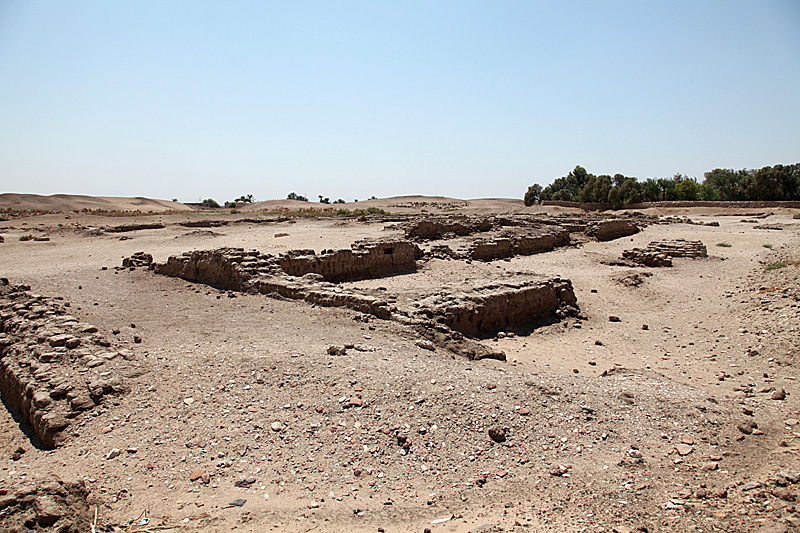
There are various structures in the desert, consisting of several residential palaces, a temple of Amun, a festival hall, elite villas, houses for the relatives of the royal family, apartments for attendants, and a desert altar termed the Kom al-Samak, all of which were constructed of mud bricks.
As stated by Jennifer Houser Wagner, this site contained a large manmade lake expanding 2.5 km. This Lake was believed to be part of Amenhotep III sed festival ritual where in the pharoah becomes one with the God Re. Theses festivals took place during the years 30, 34, and 37. These festivals took place for months and expanded across Egypt.
The royal palace was built in the 14th century BC and its ancient name was Per-Hai, "House of Rejoicing". Originally, the palace was known as the Palace of the Dazzling Aten. Built mostly out of mud-brick, it was Amenhotep's residence throughout most of the later part of his reign. Construction began around year 11 of his reign and continued until the king moved there permanently around his year 29. Once completed, it was the largest royal residence in Egypt.
To the east of the palace a large ceremonial lake was dug. The palace area was connected to the Nile through a system of canals, which end in a large harbour or quay, now called Birket Habu (Hapu's Lake). While excavating the Birket Habu Egyptologists David O'Connor and Barry Kemp discovered fragments of painted wall plaster from a palace they termed Site K. This palace had apparently been demolished when the lake was built in the last decade of Amenhotep III's reign. These fragments of painted decoration are significant as their artistic style closely resembled that of the Minoan civilization, similar to those found at the earlier Thutmosid palace of Tell el-Dab’a in the Delta. Birket Habu was used as an important feature of Amenhotep III's heb-sed festival in year 30 of his reign; it was also used as a super highway as it was connected to the Nile. The man made harbor acted as a location for goods and transportation being brought to Malkata.
The palace contained many audience halls, central halls, courtyards, villas, smaller palace complexes for the royal family, and apartments for officials. The harbor and canal connected the palace with the Nile, allowing easy travel across the river to the city of Thebes, which was situated on the eastern bank. There is little evidence of this lake today but the foundations of the palace itself remain.
The royal apartment featured a bedroom, a dressing room, a private audience chamber, and a harem, which, after the reign of Amenhotep III, was used simply for storage. The palace had a central courtyard, and across from the pharaoh's rooms were apartments for his daughters and son. His Great Royal Wife, Tiye, had her own smaller palace complex diagonally across from the pharaoh's. The palace grounds contained gardens and a large pleasure lake.
Remains exist of a temple of Amun to the north of the palace, within the complex. A "desert altar" on the outskirts of the ruins has also been excavated. Remains of a temple to the goddess Isis lie south of the main palace complex.
Hub AI
Malkata AI simulator
(@Malkata_simulator)
Malkata
Malkata (or Malqata; Arabic: الملقطة, lit. 'the place where (ancient) things are picked up'), is the site of an Ancient Egyptian palace complex built during the New Kingdom, by the 18th Dynasty pharaoh Amenhotep III. It is located on the West Bank of the Nile at Thebes, Upper Egypt, in the desert to the south of Medinet Habu. The site also included a temple dedicated to Amenhotep III's Great Royal Wife, Tiy, which honors Sobek, the crocodile deity.
There are various structures in the desert, consisting of several residential palaces, a temple of Amun, a festival hall, elite villas, houses for the relatives of the royal family, apartments for attendants, and a desert altar termed the Kom al-Samak, all of which were constructed of mud bricks.
As stated by Jennifer Houser Wagner, this site contained a large manmade lake expanding 2.5 km. This Lake was believed to be part of Amenhotep III sed festival ritual where in the pharoah becomes one with the God Re. Theses festivals took place during the years 30, 34, and 37. These festivals took place for months and expanded across Egypt.
The royal palace was built in the 14th century BC and its ancient name was Per-Hai, "House of Rejoicing". Originally, the palace was known as the Palace of the Dazzling Aten. Built mostly out of mud-brick, it was Amenhotep's residence throughout most of the later part of his reign. Construction began around year 11 of his reign and continued until the king moved there permanently around his year 29. Once completed, it was the largest royal residence in Egypt.
To the east of the palace a large ceremonial lake was dug. The palace area was connected to the Nile through a system of canals, which end in a large harbour or quay, now called Birket Habu (Hapu's Lake). While excavating the Birket Habu Egyptologists David O'Connor and Barry Kemp discovered fragments of painted wall plaster from a palace they termed Site K. This palace had apparently been demolished when the lake was built in the last decade of Amenhotep III's reign. These fragments of painted decoration are significant as their artistic style closely resembled that of the Minoan civilization, similar to those found at the earlier Thutmosid palace of Tell el-Dab’a in the Delta. Birket Habu was used as an important feature of Amenhotep III's heb-sed festival in year 30 of his reign; it was also used as a super highway as it was connected to the Nile. The man made harbor acted as a location for goods and transportation being brought to Malkata.
The palace contained many audience halls, central halls, courtyards, villas, smaller palace complexes for the royal family, and apartments for officials. The harbor and canal connected the palace with the Nile, allowing easy travel across the river to the city of Thebes, which was situated on the eastern bank. There is little evidence of this lake today but the foundations of the palace itself remain.
The royal apartment featured a bedroom, a dressing room, a private audience chamber, and a harem, which, after the reign of Amenhotep III, was used simply for storage. The palace had a central courtyard, and across from the pharaoh's rooms were apartments for his daughters and son. His Great Royal Wife, Tiye, had her own smaller palace complex diagonally across from the pharaoh's. The palace grounds contained gardens and a large pleasure lake.
Remains exist of a temple of Amun to the north of the palace, within the complex. A "desert altar" on the outskirts of the ruins has also been excavated. Remains of a temple to the goddess Isis lie south of the main palace complex.