



Community hub
Recent from talks
Knowledge base stats:
Talk channels stats:
Members stats:
Malmesbury
Malmesbury (/ˈmɑː(l)mzbəri/) is a town and civil parish in north Wiltshire, England, which lies approximately 14 miles (23 km) west of Swindon, 25 miles (40 km) northeast of Bristol, 9 miles (14 km) north of Chippenham and 5 miles south of Tetbury. The older part of the town is on a hilltop which is almost surrounded by the upper waters of the Bristol Avon and one of its tributaries.
Once the site of an Iron Age fort, in the early medieval period Malmesbury became the site of Malmesbury Abbey, a monastery famed for its learning. It was later home to one of Alfred the Great's fortified burhs for defence against the Vikings. Æthelstan, the first king of all England, was buried in the abbey when he died in 939. As a market town, it became prominent in the Middle Ages as a centre for learning, focused on and around the abbey.
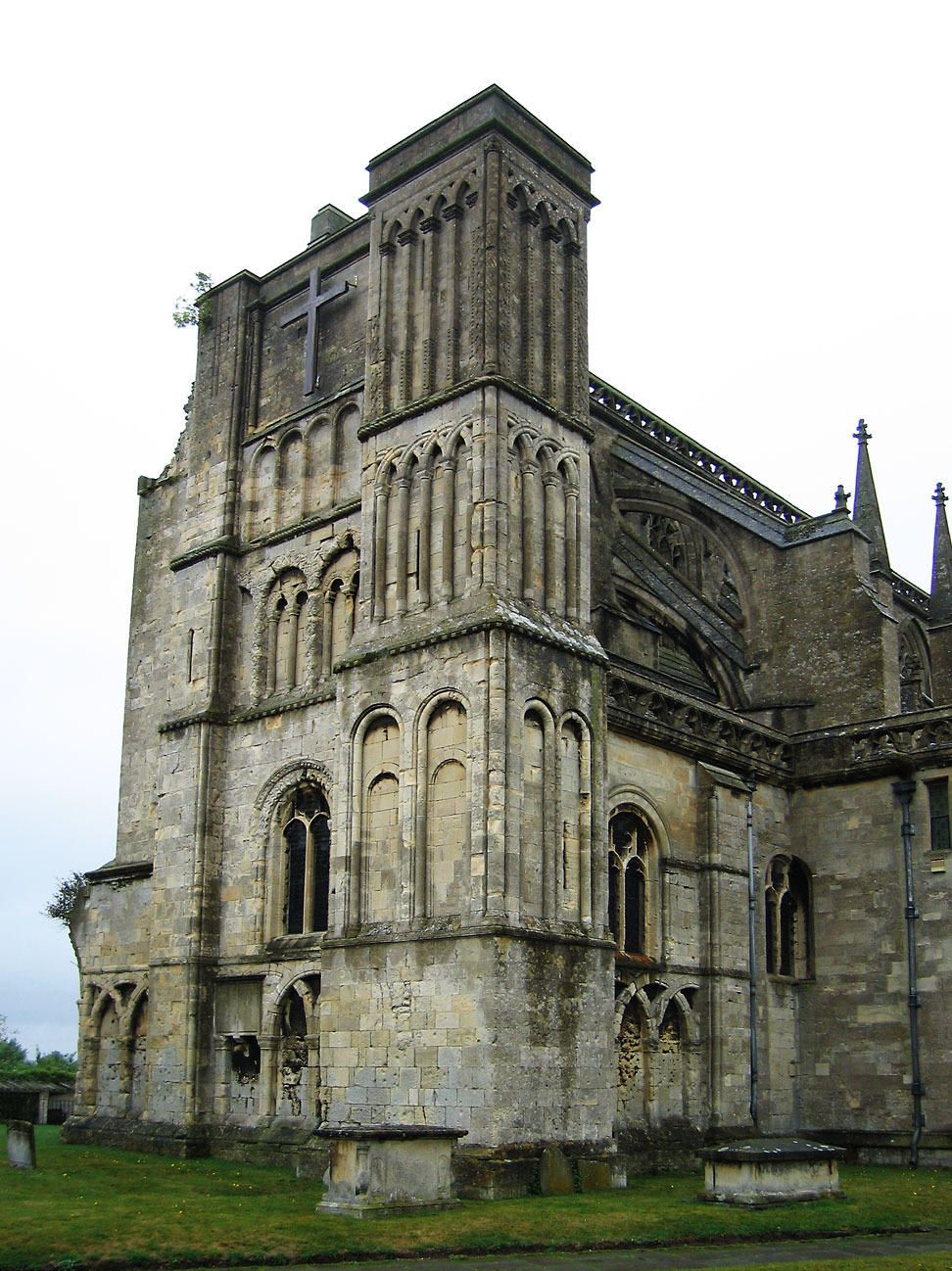
In modern times, Malmesbury is best known for its abbey, the bulk of which forms a rare survival of the dissolution of the monasteries. The economy benefits mostly from agriculture, as well as tourism to the Cotswolds; Dyson is the town's main employer. At the 2021 census, the population of the parish was almost 6,000.
Malmesbury sits on a flat Cotswolds hilltop at the convergence of two rivers. The town has a maximum elevation of 146 metres (479 ft) and a minimum of 56 metres (184 ft); the average elevation is 92 metres (302 ft) above sea level. From the west, the infant (Bristol) Avon flows from Sherston, and from the north west, a tributary either known as the Tetbury Avon, River Avon (Tetbury branch), or—locally—The Ingleburn. They flow within 200 metres (660 ft) of each other but are separated by a narrow and high isthmus which forces the Bristol Avon south and the Tetbury Avon east. This creates a rocky outcrop as a south-facing, gently sloping hilltop, until the two rivers meet on the southern edge of the town. With steep sides, in places cliff-like, the town was described by Sir William Waller as the best naturally defended inland location he had seen.
In the 19th and 20th centuries the town expanded to the northwest, occupying land between the two rivers which was formerly in Westport and Brokenborough parishes. In the later 20th and early 21st, development was to the north, as far as the area known as Filands which is bounded by the B4014 road.
The hilltop contains several freshwater springs, which helped early settlements. It was the site of an Iron Age fort, and in the Anglo-Saxon period it had a monastery famed as a centre of learning. The town is listed in the Burghal Hidage as one of Alfred the Great's defended burhs assessed at 1200 hides, its Iron Age defences helping to provide protection against Viking attack. The town was described in the Domesday Book of 1086 as a borough. Also within the Domesday Book it is reported to be within the Hundred (county division) of Cicementone. Alfred's grandson, Æthelstan, the first king of England, was buried in Malmesbury Abbey in 939.
The Abbey was founded in 675 by Maildubh, Mailduf or Maelduib, an Irishman. The town came to be named after Maildubh; the name Malmesbury is a combination of Maildubh and burh, meaning Maildubh's fortification. After his death around 700, St Aldhelm became the first abbot and built the first church organ in England, which was described as a "mighty instrument with innumerable tones, blown with bellows, and enclosed in a gilded case." Having founded other churches in the area, including at Bradford on Avon, he died in 709 and was canonised. The Abbey's architecture is listed in the highest category and it is a Scheduled Ancient Monument.
Across the River Avon's Sherston branch via the footpath by 18 Gloucester Street (leading south-west) is a depression called Daniels Well, and a farm beyond it is named after this. This derives from a monk called Daniel named after an earlier Daniel of Winchester. This former bishop, on losing his sight, lived at the abbey briefly until death in 745 and was educated there. The later monk is said to have submerged himself in the cold water every day for decades to quell fiery passions.
Hub AI
Malmesbury AI simulator
(@Malmesbury_simulator)
Malmesbury
Malmesbury (/ˈmɑː(l)mzbəri/) is a town and civil parish in north Wiltshire, England, which lies approximately 14 miles (23 km) west of Swindon, 25 miles (40 km) northeast of Bristol, 9 miles (14 km) north of Chippenham and 5 miles south of Tetbury. The older part of the town is on a hilltop which is almost surrounded by the upper waters of the Bristol Avon and one of its tributaries.
Once the site of an Iron Age fort, in the early medieval period Malmesbury became the site of Malmesbury Abbey, a monastery famed for its learning. It was later home to one of Alfred the Great's fortified burhs for defence against the Vikings. Æthelstan, the first king of all England, was buried in the abbey when he died in 939. As a market town, it became prominent in the Middle Ages as a centre for learning, focused on and around the abbey.
In modern times, Malmesbury is best known for its abbey, the bulk of which forms a rare survival of the dissolution of the monasteries. The economy benefits mostly from agriculture, as well as tourism to the Cotswolds; Dyson is the town's main employer. At the 2021 census, the population of the parish was almost 6,000.
Malmesbury sits on a flat Cotswolds hilltop at the convergence of two rivers. The town has a maximum elevation of 146 metres (479 ft) and a minimum of 56 metres (184 ft); the average elevation is 92 metres (302 ft) above sea level. From the west, the infant (Bristol) Avon flows from Sherston, and from the north west, a tributary either known as the Tetbury Avon, River Avon (Tetbury branch), or—locally—The Ingleburn. They flow within 200 metres (660 ft) of each other but are separated by a narrow and high isthmus which forces the Bristol Avon south and the Tetbury Avon east. This creates a rocky outcrop as a south-facing, gently sloping hilltop, until the two rivers meet on the southern edge of the town. With steep sides, in places cliff-like, the town was described by Sir William Waller as the best naturally defended inland location he had seen.
In the 19th and 20th centuries the town expanded to the northwest, occupying land between the two rivers which was formerly in Westport and Brokenborough parishes. In the later 20th and early 21st, development was to the north, as far as the area known as Filands which is bounded by the B4014 road.
The hilltop contains several freshwater springs, which helped early settlements. It was the site of an Iron Age fort, and in the Anglo-Saxon period it had a monastery famed as a centre of learning. The town is listed in the Burghal Hidage as one of Alfred the Great's defended burhs assessed at 1200 hides, its Iron Age defences helping to provide protection against Viking attack. The town was described in the Domesday Book of 1086 as a borough. Also within the Domesday Book it is reported to be within the Hundred (county division) of Cicementone. Alfred's grandson, Æthelstan, the first king of England, was buried in Malmesbury Abbey in 939.
The Abbey was founded in 675 by Maildubh, Mailduf or Maelduib, an Irishman. The town came to be named after Maildubh; the name Malmesbury is a combination of Maildubh and burh, meaning Maildubh's fortification. After his death around 700, St Aldhelm became the first abbot and built the first church organ in England, which was described as a "mighty instrument with innumerable tones, blown with bellows, and enclosed in a gilded case." Having founded other churches in the area, including at Bradford on Avon, he died in 709 and was canonised. The Abbey's architecture is listed in the highest category and it is a Scheduled Ancient Monument.
Across the River Avon's Sherston branch via the footpath by 18 Gloucester Street (leading south-west) is a depression called Daniels Well, and a farm beyond it is named after this. This derives from a monk called Daniel named after an earlier Daniel of Winchester. This former bishop, on losing his sight, lived at the abbey briefly until death in 745 and was educated there. The later monk is said to have submerged himself in the cold water every day for decades to quell fiery passions.