



Community hub
Recent from talks
Knowledge base stats:
Talk channels stats:
Members stats:
Breast
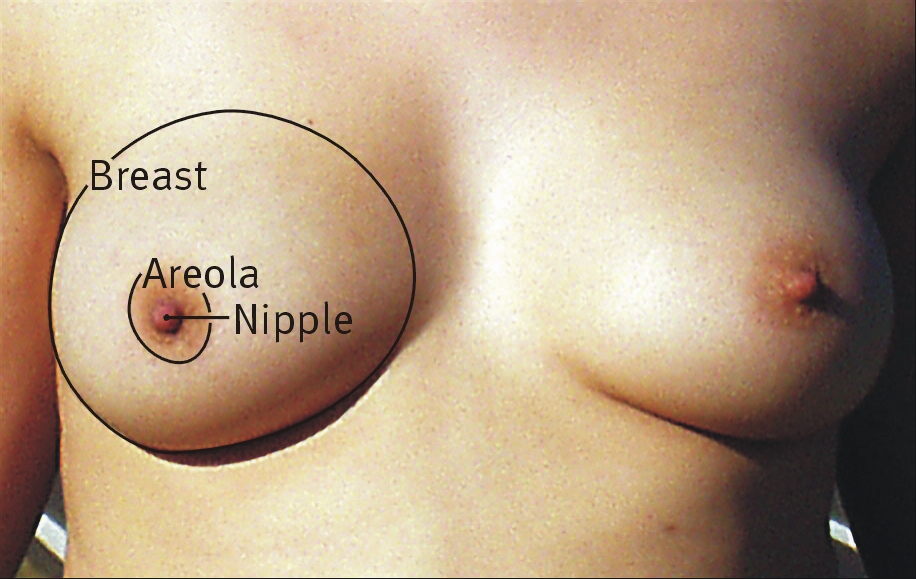
The breasts are two prominences located on the upper ventral region of the torso among humans and other primates. Both sexes develop breasts from the same embryological tissues. The relative size and development of the breasts is a major secondary sex distinction between females and males. There is also considerable variation in size between individuals. Permanent breast growth during puberty is caused by estrogens in conjunction with the growth hormone. Female humans are the only mammals that permanently develop breasts at puberty; all other mammals develop their mammary tissue during the latter period of pregnancy.
In females, the breast serves as the mammary gland, which produces and secretes milk to feed infants. Subcutaneous fat covers and envelops a network of ducts that converge on the nipple, and these tissues give the breast its distinct size and globular shape. At the ends of the ducts are lobules, or clusters of alveoli, where milk is produced and stored in response to hormonal signals. During pregnancy, the breast responds to a complex interaction of hormones, including estrogens, progesterone, and prolactin, that mediate the completion of its development, namely lobuloalveolar maturation, in preparation of lactation and breastfeeding.
Along with their major function in providing nutrition for infants, breasts can figure prominently in the perception of a woman's body and sexual attractiveness. Breasts, especially the nipples, can be an erogenous zone, and part of sexual activity. Some cultures ascribe social and sexual characteristics to female breasts, and may regard bare breasts in public as immodest or indecent. Breasts can represent fertility, femininity, or abundance. Breasts have been featured in ancient and modern sculpture, art, and photography.
The English word breast derives from the Old English word brēost 'breast, bosom' from Proto-Germanic *breustam 'breast', from the Proto-Indo-European base *bhreus– 'to swell, to sprout'. The breast spelling conforms to the Scottish and North English dialectal pronunciations. The Merriam-Webster Dictionary states that "Middle English brest, [comes] from Old English brēost; akin to Old High German brust..., Old Irish brú [belly], [and] Russian bryukho"; the first known usage of the term was before the 12th century.
Breasts is often used to refer to female breasts in particular, though the stricter anatomical term refers to the same region on members of either sex. Male breasts are sometimes referred to in the singular to mean the collective upper chest area, whereas female breasts are referred to in the plural unless speaking of a specific left or right breast.
A large number of colloquial terms for female breasts are used in English, ranging from fairly polite terms to vulgar or slang. Some vulgar slang expressions may be considered to be derogatory or sexist to women.
Humans are the only mammals whose breasts become permanently enlarged after sexual maturity (known in humans as puberty). The reason for this evolutionary change is unknown. Several hypotheses have been put forward:
A link has been proposed to processes for synthesizing the endogenous steroid hormone precursor dehydroepiandrosterone which takes place in fat rich regions of the body like the buttocks and breasts. These contributed to human brain development and played a part in increasing brain size. Breast enlargement may for this purpose have occurred as early as Homo ergaster (1.7–1.4 MYA). Other breast formation hypotheses may have then taken over as principal drivers.
Hub AI
Breast AI simulator
(@Breast_simulator)
Breast
The breasts are two prominences located on the upper ventral region of the torso among humans and other primates. Both sexes develop breasts from the same embryological tissues. The relative size and development of the breasts is a major secondary sex distinction between females and males. There is also considerable variation in size between individuals. Permanent breast growth during puberty is caused by estrogens in conjunction with the growth hormone. Female humans are the only mammals that permanently develop breasts at puberty; all other mammals develop their mammary tissue during the latter period of pregnancy.
In females, the breast serves as the mammary gland, which produces and secretes milk to feed infants. Subcutaneous fat covers and envelops a network of ducts that converge on the nipple, and these tissues give the breast its distinct size and globular shape. At the ends of the ducts are lobules, or clusters of alveoli, where milk is produced and stored in response to hormonal signals. During pregnancy, the breast responds to a complex interaction of hormones, including estrogens, progesterone, and prolactin, that mediate the completion of its development, namely lobuloalveolar maturation, in preparation of lactation and breastfeeding.
Along with their major function in providing nutrition for infants, breasts can figure prominently in the perception of a woman's body and sexual attractiveness. Breasts, especially the nipples, can be an erogenous zone, and part of sexual activity. Some cultures ascribe social and sexual characteristics to female breasts, and may regard bare breasts in public as immodest or indecent. Breasts can represent fertility, femininity, or abundance. Breasts have been featured in ancient and modern sculpture, art, and photography.
The English word breast derives from the Old English word brēost 'breast, bosom' from Proto-Germanic *breustam 'breast', from the Proto-Indo-European base *bhreus– 'to swell, to sprout'. The breast spelling conforms to the Scottish and North English dialectal pronunciations. The Merriam-Webster Dictionary states that "Middle English brest, [comes] from Old English brēost; akin to Old High German brust..., Old Irish brú [belly], [and] Russian bryukho"; the first known usage of the term was before the 12th century.
Breasts is often used to refer to female breasts in particular, though the stricter anatomical term refers to the same region on members of either sex. Male breasts are sometimes referred to in the singular to mean the collective upper chest area, whereas female breasts are referred to in the plural unless speaking of a specific left or right breast.
A large number of colloquial terms for female breasts are used in English, ranging from fairly polite terms to vulgar or slang. Some vulgar slang expressions may be considered to be derogatory or sexist to women.
Humans are the only mammals whose breasts become permanently enlarged after sexual maturity (known in humans as puberty). The reason for this evolutionary change is unknown. Several hypotheses have been put forward:
A link has been proposed to processes for synthesizing the endogenous steroid hormone precursor dehydroepiandrosterone which takes place in fat rich regions of the body like the buttocks and breasts. These contributed to human brain development and played a part in increasing brain size. Breast enlargement may for this purpose have occurred as early as Homo ergaster (1.7–1.4 MYA). Other breast formation hypotheses may have then taken over as principal drivers.