



Community hub
Recent from talks
Knowledge base stats:
Talk channels stats:
Members stats:
Mangrove forest
Mangrove forests, also called mangrove swamps, mangrove thickets or mangals, are productive wetlands located in tropical and subtropical intertidal zones. Approximately 80 mangrove species exist, all adapted to areas where slow-moving water allows for the deposition of fine sediment and low-oxygen soil conditions. These trees cannot endure freezing temperatures, which restricts their distribution to warmer climates.
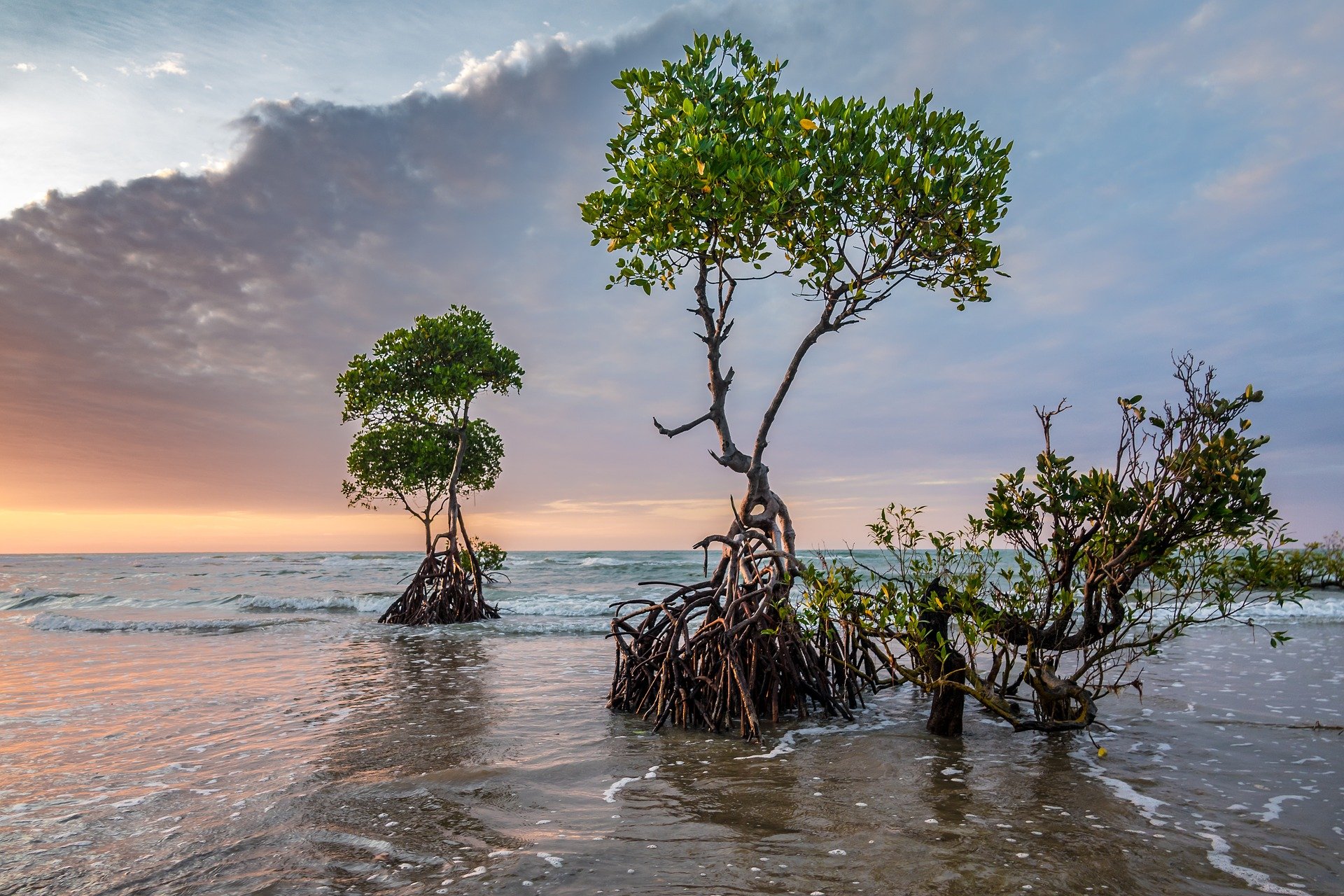
Their distinct, stilt-like roots allow the trees to slow the movement of tidal waters, causing the settlement of suspended sediments and acting as a protective barrier to reduce coastal erosion. These roots also provide an important habitat for many species.
Mangrove forests live at the interface between the land, the ocean, and the atmosphere, and are centres for the flow of energy and matter between these systems. They have attracted much research interest because of the various ecological functions of the mangrove ecosystems, including runoff and flood prevention, storage and recycling of nutrients and wastes, cultivation and energy conversion. The forests are major blue carbon systems, storing considerable amounts of carbon in marine sediments, thus becoming important regulators of climate change. Marine microorganisms are key parts of these mangrove ecosystems. However, much remains to be discovered about how mangrove microbiomes contribute to high ecosystem productivity and efficient cycling of elements.
Mangrove forests, are productive wetlands located in tropical and subtropical intertidal zones. Approximately 80 mangrove species exist, all adapted to areas where slow-moving water allows for the deposition of fine sediment and low-oxygen soil conditions. These trees cannot endure freezing temperatures, which restricts their distribution to warmer climates.
Their distinct, stilt-like roots allow the trees to slow the movement of tidal waters, causing the settlement of suspended sediments and acting as a protective barrier to reduce coastal erosion from storm surge and waves. These roots also provide a habitat for many species and act as nurseries for juvenile fish, including species that are recreationally and commercially important.
The main contribution of mangroves to the larger ecosystem comes from litter fall from the trees, which is then decomposed by primary consumers. Bacteria and protozoans colonise the plant litter and break it down chemically into organic compounds, minerals, carbon dioxide, and nitrogenous wastes. The intertidal existence to which these trees are adapted represents the major limitation to the number of species able to thrive in their habitat. High tide brings in salt water, and when the tide recedes, solar evaporation of the seawater in the soil leads to further increases in salinity. The return of tide can flush out these soils, bringing them back to salinity levels comparable to that of seawater. At low tide, organisms are exposed to increases in temperature and reduced moisture before being then cooled and flooded by the tide. Thus, for a plant to survive in this environment, it must tolerate broad ranges of salinity, temperature, and moisture, as well as several other key environmental factors—thus only a select few species make up the mangrove tree community.
A mangrove swamp typically features only a small number of tree species. It is not uncommon for a mangrove forest in the Caribbean to feature only three or four tree species. For comparison, a tropical rainforest biome may contain thousands of tree species, but this is not to say mangrove forests lack diversity. Though the trees are few in species, the ecosystem that these trees create provides a habitat for a great variety of other species, including as many as 174 species of marine megafauna.
Mangrove plants require a number of physiological adaptations to overcome the problems of low environmental oxygen levels, high salinity, and frequent tidal flooding. Each species has its own solutions to these problems; this may be the primary reason why, on some shorelines, mangrove tree species show distinct zonation. Small environmental variations within a mangal may lead to greatly differing methods for coping with the environment. Therefore, the mix of species is partly determined by the tolerances of individual species to physical conditions, such as tidal flooding and salinity, but may also be influenced by other factors, such as crabs preying on plant seedlings.
Hub AI
Mangrove forest AI simulator
(@Mangrove forest_simulator)
Mangrove forest
Mangrove forests, also called mangrove swamps, mangrove thickets or mangals, are productive wetlands located in tropical and subtropical intertidal zones. Approximately 80 mangrove species exist, all adapted to areas where slow-moving water allows for the deposition of fine sediment and low-oxygen soil conditions. These trees cannot endure freezing temperatures, which restricts their distribution to warmer climates.
Their distinct, stilt-like roots allow the trees to slow the movement of tidal waters, causing the settlement of suspended sediments and acting as a protective barrier to reduce coastal erosion. These roots also provide an important habitat for many species.
Mangrove forests live at the interface between the land, the ocean, and the atmosphere, and are centres for the flow of energy and matter between these systems. They have attracted much research interest because of the various ecological functions of the mangrove ecosystems, including runoff and flood prevention, storage and recycling of nutrients and wastes, cultivation and energy conversion. The forests are major blue carbon systems, storing considerable amounts of carbon in marine sediments, thus becoming important regulators of climate change. Marine microorganisms are key parts of these mangrove ecosystems. However, much remains to be discovered about how mangrove microbiomes contribute to high ecosystem productivity and efficient cycling of elements.
Mangrove forests, are productive wetlands located in tropical and subtropical intertidal zones. Approximately 80 mangrove species exist, all adapted to areas where slow-moving water allows for the deposition of fine sediment and low-oxygen soil conditions. These trees cannot endure freezing temperatures, which restricts their distribution to warmer climates.
Their distinct, stilt-like roots allow the trees to slow the movement of tidal waters, causing the settlement of suspended sediments and acting as a protective barrier to reduce coastal erosion from storm surge and waves. These roots also provide a habitat for many species and act as nurseries for juvenile fish, including species that are recreationally and commercially important.
The main contribution of mangroves to the larger ecosystem comes from litter fall from the trees, which is then decomposed by primary consumers. Bacteria and protozoans colonise the plant litter and break it down chemically into organic compounds, minerals, carbon dioxide, and nitrogenous wastes. The intertidal existence to which these trees are adapted represents the major limitation to the number of species able to thrive in their habitat. High tide brings in salt water, and when the tide recedes, solar evaporation of the seawater in the soil leads to further increases in salinity. The return of tide can flush out these soils, bringing them back to salinity levels comparable to that of seawater. At low tide, organisms are exposed to increases in temperature and reduced moisture before being then cooled and flooded by the tide. Thus, for a plant to survive in this environment, it must tolerate broad ranges of salinity, temperature, and moisture, as well as several other key environmental factors—thus only a select few species make up the mangrove tree community.
A mangrove swamp typically features only a small number of tree species. It is not uncommon for a mangrove forest in the Caribbean to feature only three or four tree species. For comparison, a tropical rainforest biome may contain thousands of tree species, but this is not to say mangrove forests lack diversity. Though the trees are few in species, the ecosystem that these trees create provides a habitat for a great variety of other species, including as many as 174 species of marine megafauna.
Mangrove plants require a number of physiological adaptations to overcome the problems of low environmental oxygen levels, high salinity, and frequent tidal flooding. Each species has its own solutions to these problems; this may be the primary reason why, on some shorelines, mangrove tree species show distinct zonation. Small environmental variations within a mangal may lead to greatly differing methods for coping with the environment. Therefore, the mix of species is partly determined by the tolerances of individual species to physical conditions, such as tidal flooding and salinity, but may also be influenced by other factors, such as crabs preying on plant seedlings.