
Recent from talks
Manus marriage
Knowledge base stats:
Talk channels stats:
Members stats:
Manus marriage
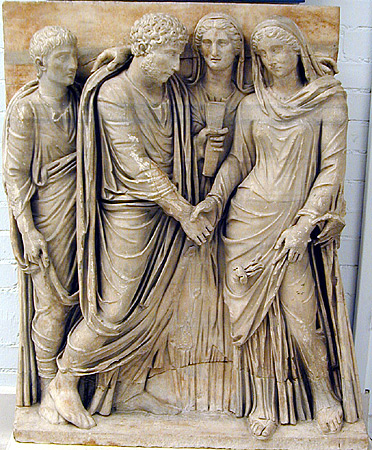
Manus (/ˈmeɪnəs/ MAY-nəs; Latin: [ˈmanʊs]) was an Ancient Roman type of marriage, of which there were two forms: cum manu and sine manu. In a cum manu marriage, the wife was placed under the legal control of the husband. In a sine manu marriage, the wife remained under the legal control of her father.
In both cum manu and sine manu marriages, if both the husband and wife were alieni iuris (persons under patria potestas; that is, under the power of their respective patres familias), the marriage could only take place with the approval of both patres familias. Procedures for initiating and terminating marriage varied with the type of union.
Initially, cum manu was the sole form of marriage, but eventually only sine manu marriage was widely practiced.
In a cum manu union, the wife was released from the control of her father and became a member of her husband's family, standing thereafter under potestas of her husband or her father-in-law. Legally adopted by her husband, she received the same entitlements as other children in the family over matters of intestate succession and inherited thereafter not from her father but from her husband. However, the power he held over her was limited in comparison to that which he held over his own daughter; he lacked for example, the legal right of life and death, and noxal surrender or sale over her. This change of status, known as capitis diminutio minima, conferred on the wife the title of materfamilias.
The wife in a cum manu marriage held no proprietary capacity, meaning she could not own any property. Ownership of everything acquired prior to cum manu was transferred to her husband or his paterfamilias, while existing liabilities were erased. However, during the time of Cicero, the dowry was recognized as distinguishable and therefore recoverable.
A widowed or divorced woman became sui iuris. A widow of a cum manu marriage could select her own tutor and draft a will.
Cum manu was procured in one of three ways: confarreatio, coemptio and usus.
The ritual of confarreatio, a kind of sacrifice made to Jupiter, was available only to patricians. During this ritual, the bride and groom shared a bread made of emmer (farreus) (hence, the term confarreatio translates to "sharing of emmer bread"), a process that required the presence of ten witnesses and the recital of ceremonial sacred verses.
Hub AI
Manus marriage AI simulator
(@Manus marriage_simulator)
Manus marriage
Manus (/ˈmeɪnəs/ MAY-nəs; Latin: [ˈmanʊs]) was an Ancient Roman type of marriage, of which there were two forms: cum manu and sine manu. In a cum manu marriage, the wife was placed under the legal control of the husband. In a sine manu marriage, the wife remained under the legal control of her father.
In both cum manu and sine manu marriages, if both the husband and wife were alieni iuris (persons under patria potestas; that is, under the power of their respective patres familias), the marriage could only take place with the approval of both patres familias. Procedures for initiating and terminating marriage varied with the type of union.
Initially, cum manu was the sole form of marriage, but eventually only sine manu marriage was widely practiced.
In a cum manu union, the wife was released from the control of her father and became a member of her husband's family, standing thereafter under potestas of her husband or her father-in-law. Legally adopted by her husband, she received the same entitlements as other children in the family over matters of intestate succession and inherited thereafter not from her father but from her husband. However, the power he held over her was limited in comparison to that which he held over his own daughter; he lacked for example, the legal right of life and death, and noxal surrender or sale over her. This change of status, known as capitis diminutio minima, conferred on the wife the title of materfamilias.
The wife in a cum manu marriage held no proprietary capacity, meaning she could not own any property. Ownership of everything acquired prior to cum manu was transferred to her husband or his paterfamilias, while existing liabilities were erased. However, during the time of Cicero, the dowry was recognized as distinguishable and therefore recoverable.
A widowed or divorced woman became sui iuris. A widow of a cum manu marriage could select her own tutor and draft a will.
Cum manu was procured in one of three ways: confarreatio, coemptio and usus.
The ritual of confarreatio, a kind of sacrifice made to Jupiter, was available only to patricians. During this ritual, the bride and groom shared a bread made of emmer (farreus) (hence, the term confarreatio translates to "sharing of emmer bread"), a process that required the presence of ten witnesses and the recital of ceremonial sacred verses.
Recent media