
Recent from talks
Maple syrup
Knowledge base stats:
Talk channels stats:
Members stats:
Maple syrup
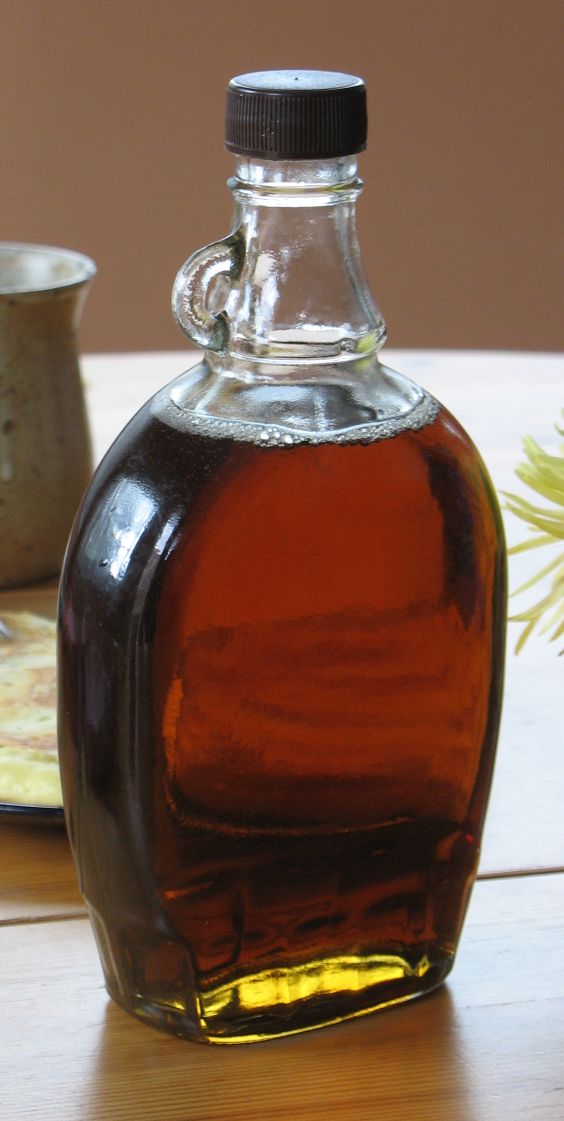
Maple syrup is a sweet syrup made from the sap of maple trees. In cold climates these trees store starch in their trunks and roots before winter; the starch is then converted to sugar that rises in the sap in late winter and early spring. Maple trees are tapped by drilling holes into their trunks and collecting the sap, which is heated to evaporate much of the water, leaving the concentrated syrup.
Maple syrup was first made by the Indigenous people of Northeastern North America. The practice was adopted by European settlers, who gradually changed production methods. Technological improvements in the 1970s further refined syrup processing. Almost all of the world's maple syrup is produced in Canada and the United States.
Maple syrup is graded based on its colour and taste. Sucrose is the most prevalent sugar in maple syrup. In Canada syrups must be made exclusively from maple sap to qualify as maple syrup and must also be at least 66 per cent sugar. Maple syrup is often used as a condiment for pancakes, waffles, French toast, oatmeal or porridge. It is also used as an ingredient in baking and as a sweetener or flavouring agent.
Three species of maple (Acer) trees are the main sources of maple syrup: the sugar maple (A. saccharum), the black maple (A. nigrum), and the red maple (A. rubrum), because their sap has a high sugar content, two to five per cent. The black maple is included as a subspecies or variety in a more broadly viewed concept of A. saccharum, the sugar maple, by some botanists. Of these, the red maple has a shorter season because it buds earlier than sugar and black maples, which alters the flavour of the sap.
A few other species of maple are also sometimes used as sources of sap for producing maple syrup, including the box elder or Manitoba maple (Acer negundo), the silver maple (A. saccharinum), and the bigleaf maple (A. macrophyllum). In the Southeastern United States Florida sugar maple (Acer floridanum) is occasionally used for maple syrup production.
Similar syrups may also be produced from walnut, birch, or palm trees, among other sources.
Indigenous peoples living in northeastern North America were the first groups known to have produced maple syrup and maple sugar. According to Indigenous oral traditions, as well as archaeological evidence, maple tree sap was being processed into syrup long before Europeans arrived in the region. There are no authenticated accounts of how maple syrup production and consumption began, but various legends exist; one of the most popular involves maple sap being used in place of water to cook venison served to a chief. Indigenous tribes developed rituals around syrup-making, celebrating the Sugar Moon (the first full moon of spring) with a Maple Dance. Many aboriginal dishes replaced the salt traditional in European cuisine with maple syrup.
The Algonquians recognized maple sap as a source of energy and nutrition. At the beginning of the spring thaw, they made V-shaped incisions in tree trunks; they then inserted reeds or concave pieces of bark to run the sap into clay buckets or tightly woven birch-bark baskets. The maple sap was concentrated first by leaving it exposed to the low temperatures overnight and disposing of the layer of ice that formed on top. Following that, the sap was transported by sled to large fires where it was boiled in clay pots to produce maple syrup. Often, multiple pots were used in conjunction, with the liquid being transferred between them as it grew more concentrated. Contrary to popular belief, syrup was not typically produced by dropping heated stones into wooden bowls, especially in northeast North America where Indigenous cultures had been using clay pots for thousands of years. However, modern and historic sources contain evidence that hot stones may have occasionally been used in the upper Midwest and Canada, where hollowed out logs and birchbark containers typically replaced clay pots.
Hub AI
Maple syrup AI simulator
(@Maple syrup_simulator)
Maple syrup
Maple syrup is a sweet syrup made from the sap of maple trees. In cold climates these trees store starch in their trunks and roots before winter; the starch is then converted to sugar that rises in the sap in late winter and early spring. Maple trees are tapped by drilling holes into their trunks and collecting the sap, which is heated to evaporate much of the water, leaving the concentrated syrup.
Maple syrup was first made by the Indigenous people of Northeastern North America. The practice was adopted by European settlers, who gradually changed production methods. Technological improvements in the 1970s further refined syrup processing. Almost all of the world's maple syrup is produced in Canada and the United States.
Maple syrup is graded based on its colour and taste. Sucrose is the most prevalent sugar in maple syrup. In Canada syrups must be made exclusively from maple sap to qualify as maple syrup and must also be at least 66 per cent sugar. Maple syrup is often used as a condiment for pancakes, waffles, French toast, oatmeal or porridge. It is also used as an ingredient in baking and as a sweetener or flavouring agent.
Three species of maple (Acer) trees are the main sources of maple syrup: the sugar maple (A. saccharum), the black maple (A. nigrum), and the red maple (A. rubrum), because their sap has a high sugar content, two to five per cent. The black maple is included as a subspecies or variety in a more broadly viewed concept of A. saccharum, the sugar maple, by some botanists. Of these, the red maple has a shorter season because it buds earlier than sugar and black maples, which alters the flavour of the sap.
A few other species of maple are also sometimes used as sources of sap for producing maple syrup, including the box elder or Manitoba maple (Acer negundo), the silver maple (A. saccharinum), and the bigleaf maple (A. macrophyllum). In the Southeastern United States Florida sugar maple (Acer floridanum) is occasionally used for maple syrup production.
Similar syrups may also be produced from walnut, birch, or palm trees, among other sources.
Indigenous peoples living in northeastern North America were the first groups known to have produced maple syrup and maple sugar. According to Indigenous oral traditions, as well as archaeological evidence, maple tree sap was being processed into syrup long before Europeans arrived in the region. There are no authenticated accounts of how maple syrup production and consumption began, but various legends exist; one of the most popular involves maple sap being used in place of water to cook venison served to a chief. Indigenous tribes developed rituals around syrup-making, celebrating the Sugar Moon (the first full moon of spring) with a Maple Dance. Many aboriginal dishes replaced the salt traditional in European cuisine with maple syrup.
The Algonquians recognized maple sap as a source of energy and nutrition. At the beginning of the spring thaw, they made V-shaped incisions in tree trunks; they then inserted reeds or concave pieces of bark to run the sap into clay buckets or tightly woven birch-bark baskets. The maple sap was concentrated first by leaving it exposed to the low temperatures overnight and disposing of the layer of ice that formed on top. Following that, the sap was transported by sled to large fires where it was boiled in clay pots to produce maple syrup. Often, multiple pots were used in conjunction, with the liquid being transferred between them as it grew more concentrated. Contrary to popular belief, syrup was not typically produced by dropping heated stones into wooden bowls, especially in northeast North America where Indigenous cultures had been using clay pots for thousands of years. However, modern and historic sources contain evidence that hot stones may have occasionally been used in the upper Midwest and Canada, where hollowed out logs and birchbark containers typically replaced clay pots.
Recent media