



Community hub
Recent from talks
Knowledge base stats:
Talk channels stats:
Members stats:
Mar Lodge Estate
Mar Lodge Estate is a highland estate in western Aberdeenshire, Scotland, which has been owned and managed by the National Trust for Scotland (NTS) since 1995. Its principal building, Mar Lodge, is about 4 miles (6.4 km) west of the village of Braemar. The estate is recognised as one of the most important nature conservation landscapes in the British Isles and occupies nearly 8% of the Cairngorms National Park, covering 29,340 hectares (72,500 acres). The natural heritage value of the estate is reflected by the fact that much of it is designated as a Site of Special Scientific Interest (SSSI), a Special Area of Conservation (SAC) and a Special Protection Area (SPA). The entire estate has been classified as a national nature reserve since May 2017, and is designated a Category II protected area by the International Union for Conservation of Nature.
Extreme weather conditions are experienced across the estate, especially on the plateau. Landslides, avalanches and floods alter the landscape and give it an interesting geomorphology. The estate is characterised by rounded granite Cairngorm mountains to the north, with deep corries and crags down to the valley floor. Spectacular glacial breaches include the Lairig Ghru and Lairig an Laoigh. To the south west are the more open, rolling hills of the Geldie. Waters flowing from the mountains become the headwaters of the River Dee.
The estate is popular with hill walkers, containing 14 Munros, and 4 of the 5 highest mountains in Scotland, including Britain’s second highest mountain, Ben Macdui. A car park and toilet facilities are provided by NTS close to the waterfall of the Linn of Dee, which is the main access point to the area. Public access to the estate for outdoor activities such as hillwalking, climbing and wild camping is permitted by the general right to responsible access that applies to all land in Scotland under the Scottish outdoor access code.
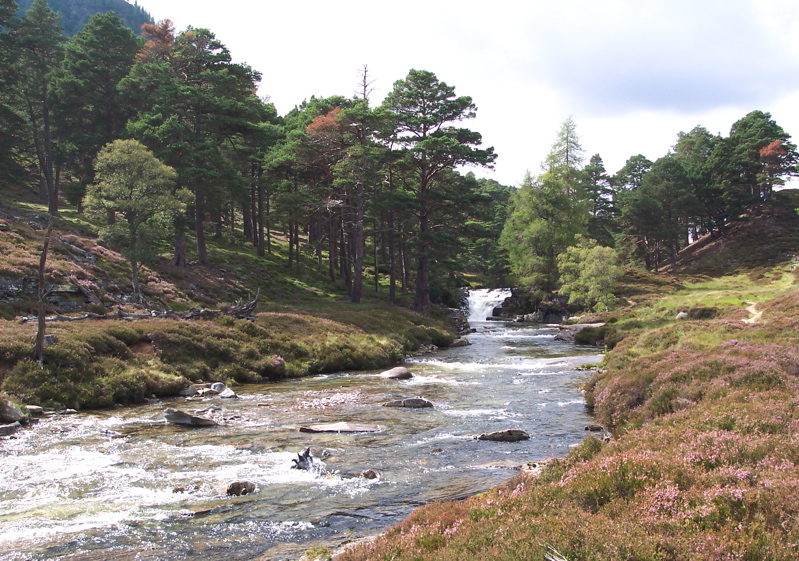
The estate contains examples of remnants of the ancient Caledonian pine forest, heather moorland, juniper scrub and a part of the high Cairngorm plateau. It supports important populations of red grouse, waders and raptors.
The Caledonian pine forest is home to red squirrels, pine martens, wood ants and birds such as the black grouse, Scottish crossbill and parrot crossbill, which are all rare or absent across most of Britain. The higher areas on the Cairngorm plateau host breeding populations of dotterel, snow buntings and ptarmigan, and is also the largest area of arctic-alpine flora in Britain.
The architectural importance of the estate is reflected in the fact that there are 5 listed buildings including Mar Lodge, which was built in 1895 by the Duke of Fife. The ballroom has 2,435 red deer stags heads lining the walls and ceiling. The lodge was severely damaged by a fire in 1991 but rebuilt soon thereafter. It has since been converted into holiday flats and retains many of the grand features of its heyday as a hunting lodge.
Six hunting lodges were constructed on the estate to allow shooting parties to be accommodated away from the main Mar Lodge building. Only one, Derry Lodge, remains intact, although it is now in a dilapidated condition. In 2016 NTS submitted plans to renovate the lodge to provide hostel accommodation: as the lodge is located 6 km from the nearest road at Linn of Dee this hostel would be accessible only by foot or bicycle.
The estate includes land which has a number of national and international natural heritage designations, and is one of the country's largest areas of Scheduled Ancient Monuments and archaeological sites.
Hub AI
Mar Lodge Estate AI simulator
(@Mar Lodge Estate_simulator)
Mar Lodge Estate
Mar Lodge Estate is a highland estate in western Aberdeenshire, Scotland, which has been owned and managed by the National Trust for Scotland (NTS) since 1995. Its principal building, Mar Lodge, is about 4 miles (6.4 km) west of the village of Braemar. The estate is recognised as one of the most important nature conservation landscapes in the British Isles and occupies nearly 8% of the Cairngorms National Park, covering 29,340 hectares (72,500 acres). The natural heritage value of the estate is reflected by the fact that much of it is designated as a Site of Special Scientific Interest (SSSI), a Special Area of Conservation (SAC) and a Special Protection Area (SPA). The entire estate has been classified as a national nature reserve since May 2017, and is designated a Category II protected area by the International Union for Conservation of Nature.
Extreme weather conditions are experienced across the estate, especially on the plateau. Landslides, avalanches and floods alter the landscape and give it an interesting geomorphology. The estate is characterised by rounded granite Cairngorm mountains to the north, with deep corries and crags down to the valley floor. Spectacular glacial breaches include the Lairig Ghru and Lairig an Laoigh. To the south west are the more open, rolling hills of the Geldie. Waters flowing from the mountains become the headwaters of the River Dee.
The estate is popular with hill walkers, containing 14 Munros, and 4 of the 5 highest mountains in Scotland, including Britain’s second highest mountain, Ben Macdui. A car park and toilet facilities are provided by NTS close to the waterfall of the Linn of Dee, which is the main access point to the area. Public access to the estate for outdoor activities such as hillwalking, climbing and wild camping is permitted by the general right to responsible access that applies to all land in Scotland under the Scottish outdoor access code.
The estate contains examples of remnants of the ancient Caledonian pine forest, heather moorland, juniper scrub and a part of the high Cairngorm plateau. It supports important populations of red grouse, waders and raptors.
The Caledonian pine forest is home to red squirrels, pine martens, wood ants and birds such as the black grouse, Scottish crossbill and parrot crossbill, which are all rare or absent across most of Britain. The higher areas on the Cairngorm plateau host breeding populations of dotterel, snow buntings and ptarmigan, and is also the largest area of arctic-alpine flora in Britain.
The architectural importance of the estate is reflected in the fact that there are 5 listed buildings including Mar Lodge, which was built in 1895 by the Duke of Fife. The ballroom has 2,435 red deer stags heads lining the walls and ceiling. The lodge was severely damaged by a fire in 1991 but rebuilt soon thereafter. It has since been converted into holiday flats and retains many of the grand features of its heyday as a hunting lodge.
Six hunting lodges were constructed on the estate to allow shooting parties to be accommodated away from the main Mar Lodge building. Only one, Derry Lodge, remains intact, although it is now in a dilapidated condition. In 2016 NTS submitted plans to renovate the lodge to provide hostel accommodation: as the lodge is located 6 km from the nearest road at Linn of Dee this hostel would be accessible only by foot or bicycle.
The estate includes land which has a number of national and international natural heritage designations, and is one of the country's largest areas of Scheduled Ancient Monuments and archaeological sites.